


Introduction
Since the autonomous mainnet launch, Filecoin has gone through three phases: building storage capacity (2020–2022), improving usability (2022–2024), and generating paid demand since 2025 — a shift formally reflected in the 2026 Filecoin Network Strategy. That strategy sets three priorities: increasing the number of paid onchain transactions; strengthening network profitability and crypto-economics; and achieving scaled adoption among paid onchain flagship customers.
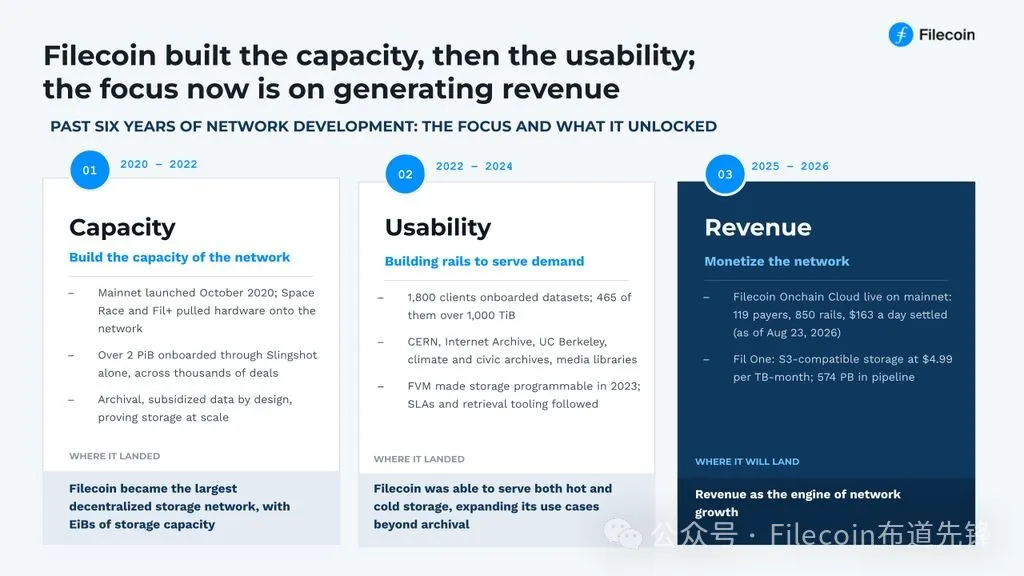
This year's building blocks are Filecoin Onchain Cloud (FOC), which adds onchain payments and programmable storage on top of the Synapse SDK, and Fil One, a Filecoin path for S3 workloads. As we move into Q4 2026 and 2027, both ends of the market are converging: demand is becoming measurable and growing, while FIL supply is approaching the largest planned change since launch.
In this update, we’ll dive into three parts:
1. Supply-side: In Q4 2026, two tightening changes to FIL crypto economics
2. Demand: the product is live, and paid usage is growing
3. What does this fusion mean for token holders, and how can they participate?
1. Supply: In Q4 2026, two tightening adjustments to FIL crypto economics
FIL circulating supply consists of multiple stages: new FIL enters through block rewards and vesting, while collateral locking and token burning remove FIL from liquid circulation.
What to watch for in Q4'26 is that two key components in this equation are changing: PL and FF complete vesting in October 2026, and it’s expected to be under nv29’s Solstice (FIP-0118).
PL and FF vesting completes in October 2026
Since the network launched, vesting has been a predictable source of new FIL—and the largest one. The current supply entering circulation is close to 10% per year; within that, PL and FF vest add about 66.7 million FIL per year, while block rewards are about 21.7 million. On October 15, this funding source stops, reducing total issuance by about 75%. What remains is block rewards—about 22 million dukes per year, accounting for a little over 2% of circulating supply.
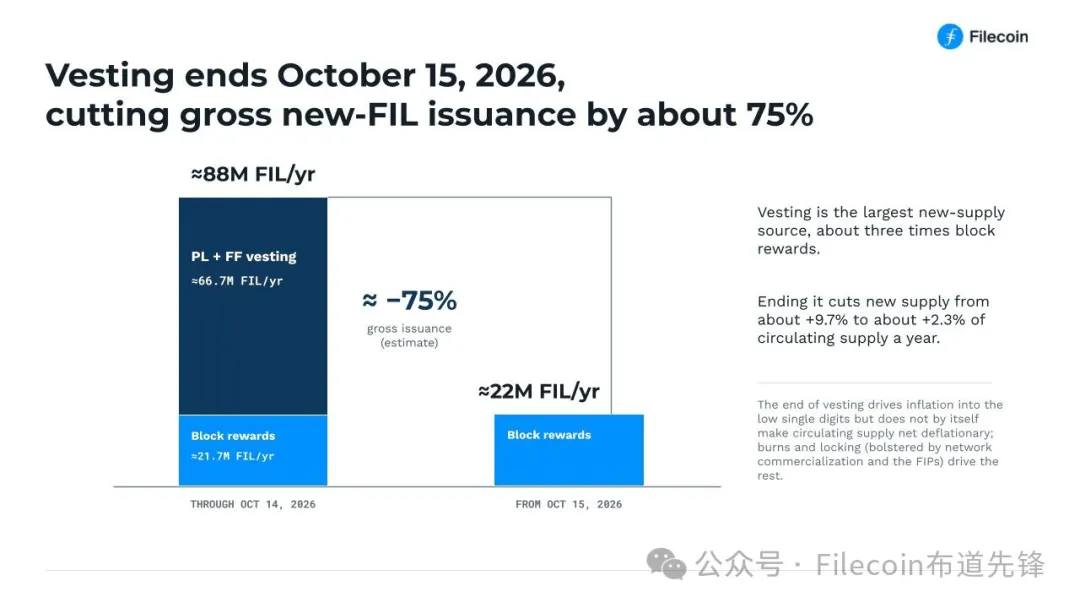
What changes at the end of vesting is the amount of material entering circulation, not what happens next to circulating supply; burning and any accompanying locks determine what remains. Simulations using the FIL token economics simulator show that, depending on network conditions, by the end of 2027 the average daily net supply growth could drop by about 86% from the August 2026 level to 119%. At the upper end of that range, daily supply Delta turns negative, meaning FIL (International Freedom) becomes net deflationary: more FIL leaves circulation supply than enters it.
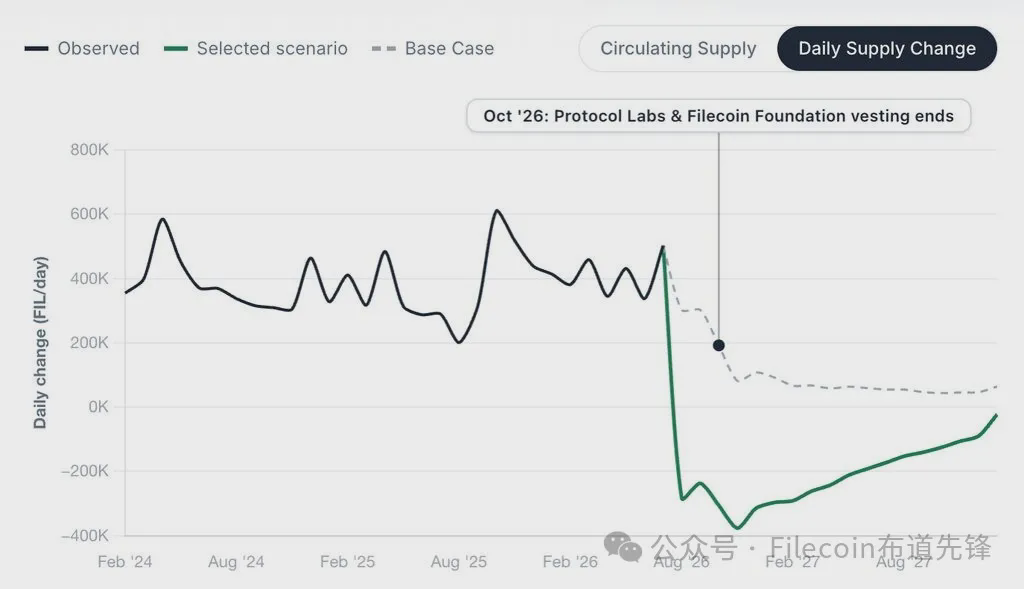
Source: FilecoinTLDR, FIL token economics simulator
These are modeled scenarios rather than predictions; outcomes depend on factors such as network demand, block rewards, collateral, and burning.
Solstice (FIP-0118) pushes Filecoin toward crypto economics that better align with demand
FIP-0118 proposes a major redesign of Filecoin’s rewards system. Its goal is to go beyond the existing Fil+ model and create a protocol-level mechanism to fund services responsible for bringing paying customers and workloads into Filecoin.
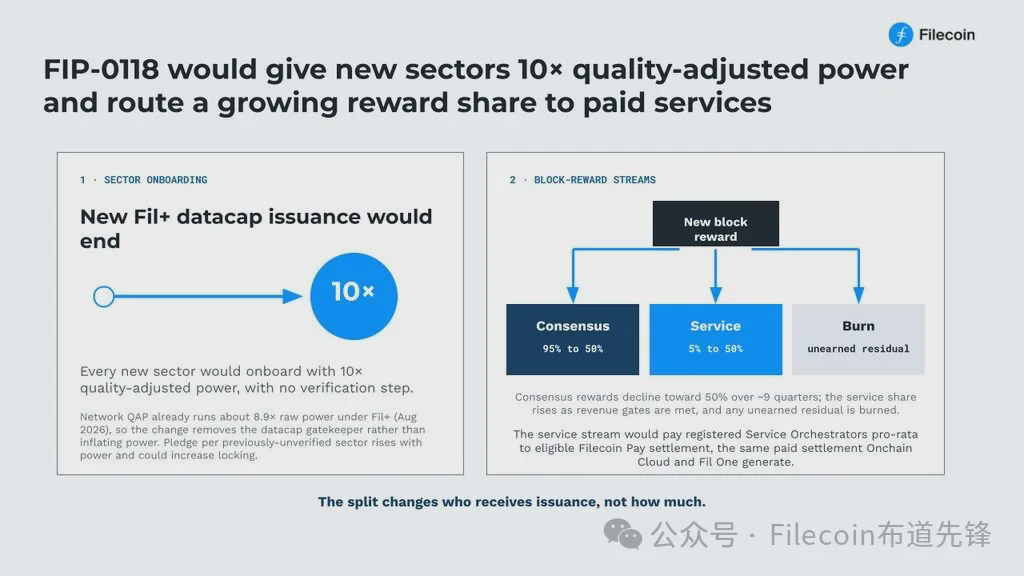
Today, Fil+ uses DataCap to provide additional quality-adjustment power for verified deals. Under the Solstice plan, this validation layer will be removed: each new sector will come online with 10x quality-adjustment power, with no verification step. Another portion of the block rewards will be used to fund services that generate paid network usage. This broadly aligns with the official Solstice framework: replacing manual verification with more direct customer activity signals.
For FIL’s economic loop, the key change is that this service funding will be tied to measurable demand:
• Part of Filecoin block rewards will fund services that drive paid network usage.
• This ratio can only grow as the amount of on-chain Filecoin Pay reaches a predetermined target.
• If these targets are not met, the corresponding rewards will be burned rather than allocated.
The result is that the rewards system becomes more responsive to demand: stronger paid usage supports more service funding, while weaker usage allocates fewer FIL.
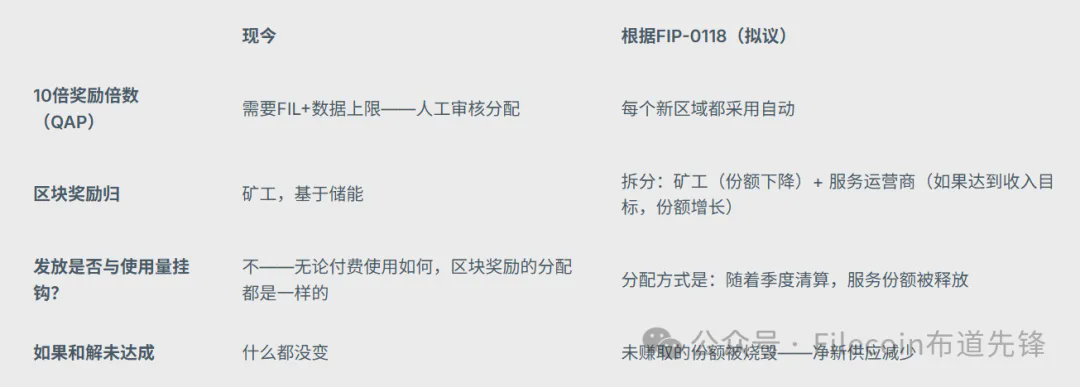
For token holders, this creates a tighter feedback loop between network activity and FIL’s crypto economics. Service incentives are no longer independently expanding with demand; increasingly, they need to be proven by requiring payment for use—otherwise free allocations will be removed from the supply.
FIP-0118 was accepted in September and is awaiting scheduling for a network upgrade; implementation details can still be further refined up until release. The table reflects the specifications as of September 1, 2026.
2. Demand: the product is live, and paid usage is growing
A key goal set in the 2026 network strategy is paid demand: storage paid for by people outside the ecosystem, and settled on-chain.
This April, we identified three trends favorable to Filecoin: the speed of data growth outpacing the rate at which centralized storage can absorb it; AI pushing value and trust needs down into the data layer; and locked-in costs becoming impossible to ignore. Six months later, these trends remain unchanged. New clouds like CoreWeave and Nebius show that when workloads require it, buyers choose beyond hyperscale enterprises—specialized compute needs a storage layer that can prove its value, not just store data. Although the EU’s data act bans cloud switching fees starting January 2027, the rules only go as far as exiting: leaving becomes cheaper, but every byte you extract is still billed on your account.
Here is the current state of the product:
Filecoin on-chain cloud: paid usage that is measurable and steadily growing
FOC launched on the mainnet in Q1 2026. Based on a multi-year vision for a composable marketplace, it supports storage and on-chain payments, connecting applications with storage, verification, retrieval, and payments.
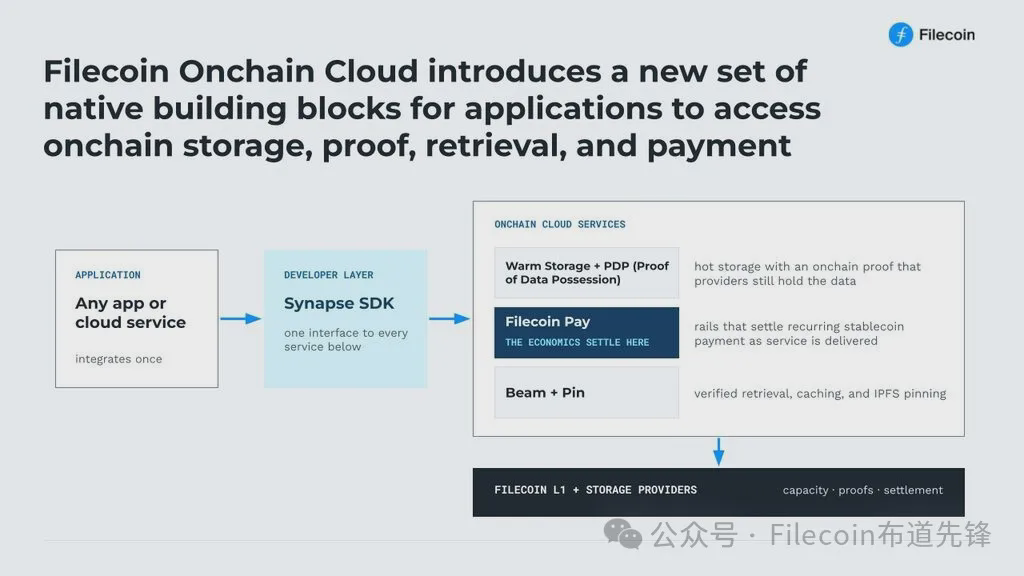
Early adoption can be categorized into three types
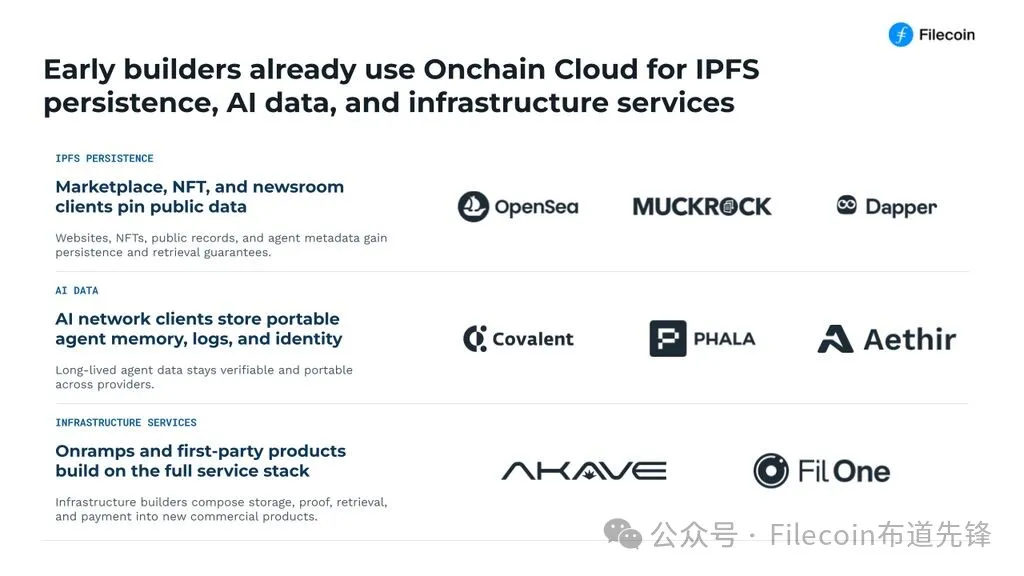
Usage of Filecoin on-chain cloud on the mainnet is measurable and accelerating
Because FOC payments are made on-chain through Filecoin Pay, usage can be measured directly without reporting. Filecoin Pay’s annualized run rate increased from $663 in January to $59,327 by the end of August. Over the same period, active payers rose from 73 to 119; as of August, there were 865 active rail payers.
Fil One: S3 storage, $4.99 per TB, no egress
Fil One launched in June. It is an S3-compatible object storage supported by Filecoin, priced at $4.99 per TB per month, with no egress fees. Applications, backup tools, or pipelines that have already communicated with S3 can communicate with Fil One by changing the endpoint and a set of credentials. Each object is revalidated on the network approximately once every 24 hours.
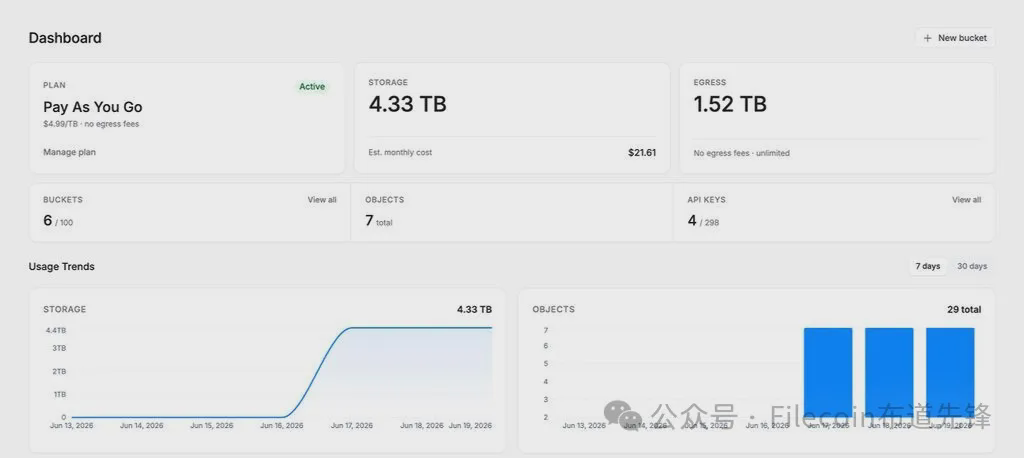
Pricing: $4.99 per month; no egress or API request fees; minimum monthly payment of $4.99
Integrity: content identifiers assigned at upload, rechecked approximately once every 24 hours
Durability: 11nines
Compatibility: existing S3 SDKs and CLI can connect by changing the terminal endpoint; managed migration is available
Regionally, the United States and the EU; more content coming soon
Terms: pay-as-you-go, or reserve capacity for 1 year, 3 years, and 5 years
Trial: 1TB free for 30 days, no credit card required
Roadmap: Bucket Intelligence and AI agent toolkits are both in early access
Scale is what matters. Enterprise object storage is measured in exabytes and millions of dollars. Fil One is exactly built for this space. Every enterprise account it wins becomes paid on-chain storage, which can be measured on the Filecoin network.
Filecoin Onramp update
Entry nodes are where enterprise demand first becomes visible. They sell managed storage services to large customers, handle contracts and compliance matters, and use Filecoin as the underlying technology. Therefore, their funding rounds, product releases, and customer acquisition are the most direct indicators of whether the network is truly being used for real workloads.
Akave Cloud
Akave Cloud is an enterprise and AI data storage platform that is compatible with S3 and compute-agnostic. It uses Filecoin as the storage layer and employs an independent chain based on Avalanche.
• Fundraising: Akave raised $6.65 million in March, officially entered the storage market, and launched Akave Cloud.
• Product: O3 shifted from the 1.2 version’s PDP integration and trustless graphical interface to the 1.7 version’s multi-part uploads, IAM, and object locking; the protocol layer adds per-file encryption keys and faster erase-rebuild.
• Customers and integrations: Intuizi reports that after migrating to Akave, storage costs dropped by more than 50%, analysis speed increased by 60%, and The Defiant is one of Akave’s enterprise customers. Integrations with Snowflake, Akash, and Hugging Face enable data stored in Akave to be covered by GPU computing and mainstream AI tools.
3. Convergence and beyond
Bringing the two together: on the demand side, there are now two tracks in operation. One has paid usage, evidenced on-chain, with monthly acceleration; the other is Fil One, a first-party product targeting the S3 and enterprise object storage markets, measured in exabytes.
On the supply side, things change in October: vesting ends, and block rewards become the only source of new FIL. From there, whether circulating supply grows or shrinks depends on burning and collateral locking, and both will change with usage. FIP-0118 will further tighten this constraint: only when on-chain payment volume reaches the target will part of the block rewards be released; otherwise it will be burned.
Once supply tightens in sync with accelerating demand, convergence can truly happen.
Sources: official media / network news
Disclaimer: The content published on this account is for learning and exchange purposes only. The materials in this article are sourced from publicly available materials on the internet. If any copyright issues are involved, please leave a message to contact us, and we will correct or remove it promptly. This article is intended to share more market information and does not constitute any investment advice.