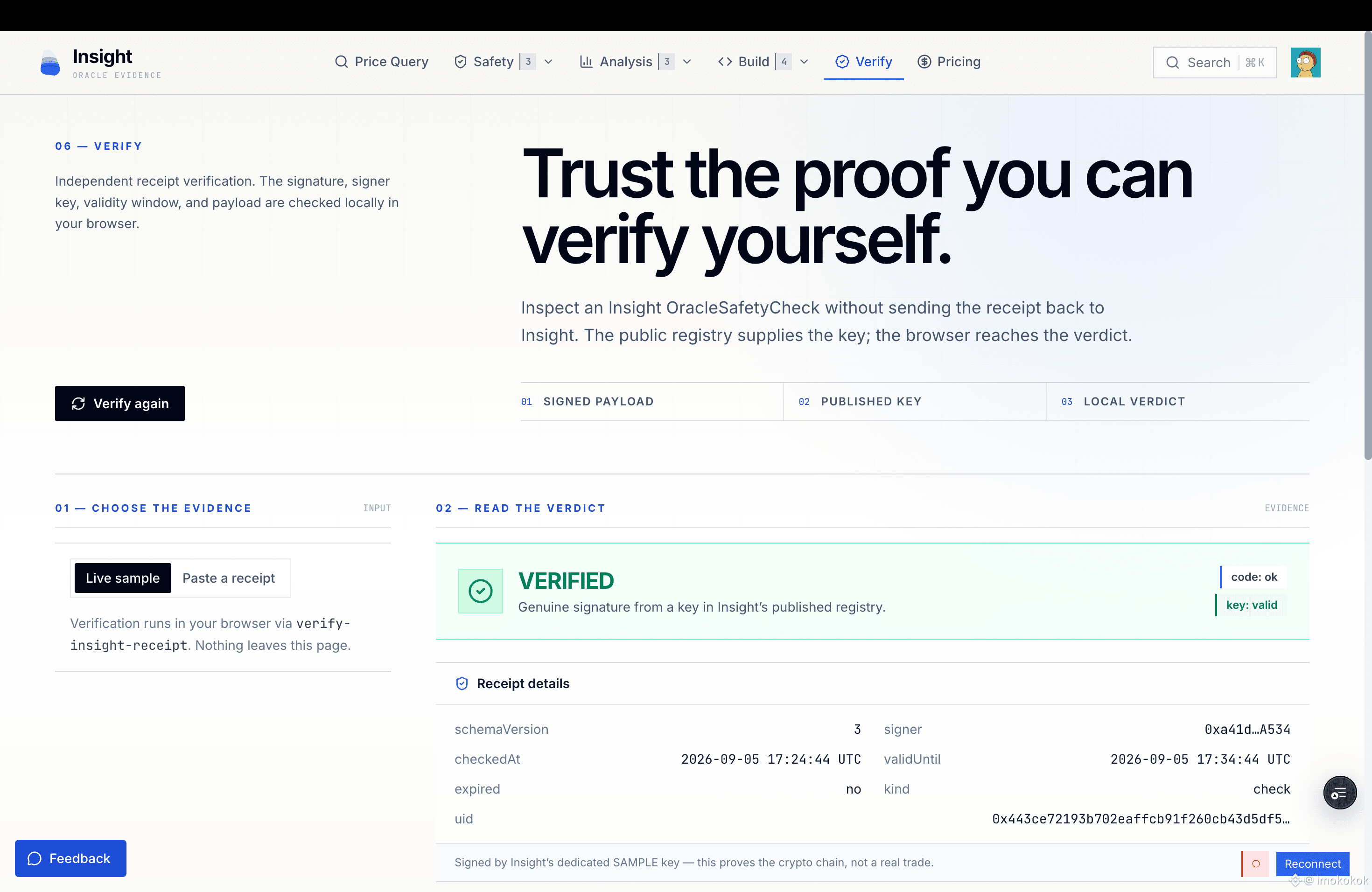
In the previous post, I briefly introduced verify-insight-receipt.
This time, I want to focus on the problem it actually solves:
When a system returns a “safe” result, how can you verify that result independently?
An Insight Oracle Safety Receipt contains a signature, request hashes, validity data, and the original verification outcome. But receiving a JSON object is not the same as being able to trust it.
You still need to determine whether:
• The receipt was modified after it was issued
• The signature belongs to the claimed signer
• The UID matches the reconstructed EIP-712 payload
• A recheck is bound to the original request
• The receipt has expired
• The signing key is still considered trustworthy
That is what verify-insight-receipt is designed to do.
Install:
npm install verify-insight-receipt
Usage:
import { verifyReceipt } from 'verify-insight-receipt';
const result = await verifyReceipt(receipt);
if (result.code !== 'ok') {
throw new Error(`Receipt rejected: ${result.code}`);
}
The entire verification process happens locally:
• No Insight API key
• No receipt upload
• No dependency on Insight being online
• The result is reconstructed from the public EIP-712 schema and cryptographic signature
This turns a receipt from something displayed by a platform into evidence that developers, AI agents, auditors, and execution systems can verify for themselves.
A valid signature does not guarantee that a trade is correct, and it is not investment approval.
It proves something narrower and more useful:
The stated content was signed by the corresponding key and has not been altered since.
Verify, don’t blindly trust.
https://www.npmjs.com/package/verify-insight-receipt
#AIAgents
This time, I want to focus on the problem it actually solves:
When a system returns a “safe” result, how can you verify that result independently?
An Insight Oracle Safety Receipt contains a signature, request hashes, validity data, and the original verification outcome. But receiving a JSON object is not the same as being able to trust it.
You still need to determine whether:
• The receipt was modified after it was issued
• The signature belongs to the claimed signer
• The UID matches the reconstructed EIP-712 payload
• A recheck is bound to the original request
• The receipt has expired
• The signing key is still considered trustworthy
That is what verify-insight-receipt is designed to do.
Install:
npm install verify-insight-receipt
Usage:
import { verifyReceipt } from 'verify-insight-receipt';
const result = await verifyReceipt(receipt);
if (result.code !== 'ok') {
throw new Error(`Receipt rejected: ${result.code}`);
}
The entire verification process happens locally:
• No Insight API key
• No receipt upload
• No dependency on Insight being online
• The result is reconstructed from the public EIP-712 schema and cryptographic signature
This turns a receipt from something displayed by a platform into evidence that developers, AI agents, auditors, and execution systems can verify for themselves.
A valid signature does not guarantee that a trade is correct, and it is not investment approval.
It proves something narrower and more useful:
The stated content was signed by the corresponding key and has not been altered since.
Verify, don’t blindly trust.
https://www.npmjs.com/package/verify-insight-receipt
#AIAgents