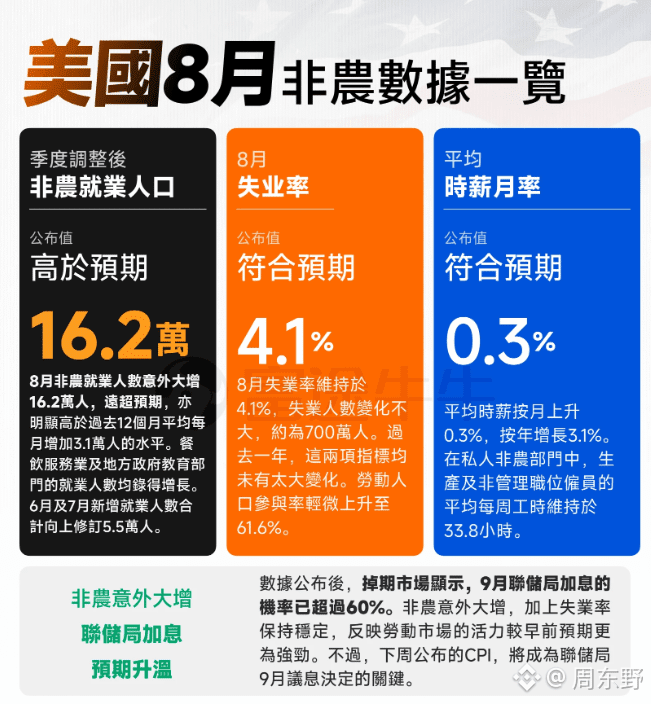
This time, the additional 162,000 nonfarm payrolls data directly shattered the market’s one-sided expectation of a “recession and rate cuts.”
The market had expected 56,000, but the actual figure was nearly three times higher. Combined with the upward revisions of 55,000 in the previous June and July figures, the already fragile labor market nerve was pulled tight again. The dollar index instantly surged to 99.93, $XAU gold sold off sharply and broke below 4400, and the market-implied probability of a Fed rate hike in September was pushed above 60%.
Seeing the unemployment rate holding steady at 4.1%, along with stronger-than-expected job gains in leisure, hospitality, and manufacturing, many people rushed in to follow the crowd and go long the dollar or short risk-on assets.
The key lies in the inversion between wages and inflation. Average hourly earnings growth slowed to 3.1% year over year, marking the lowest reading since the pandemic.
Under the old playbook, slower wage growth would mean the labor market is no longer the engine of inflation, giving the Fed plenty of reason to sit tight. But in reality, the Middle East situation has pushed imported energy prices higher, and nominal wage growth has already been squeezed into negative territory in real CPI terms.
This has evolved into a very ugly liquidity massacre: neither on-chain nor secondary-market liquidity has seen fresh capital enter because of “strong employment”; instead, it now has to absorb a double drain from both “rising living costs squeezing disposable income” and “higher borrowing capital costs as rate-hike expectations rise.”
Fed Chair Walsh’s line that “the overall financial environment is hard to classify as restrictive” is, in essence, a green light for further liquidity tightening, implying that the authorities will not sacrifice the inflation target just to protect asset prices.
So this is by no means a node for a one-way macro long or a complete cleanup.
The surge in employment data at most removes the tail risk of a short-term, collapse-style recession, but it has massively taken away the easing expectations that bulls most desperately wanted.
Next week’s CPI and PPI are the real guillotine. As long as inflation stickiness comes in even slightly above expectations, the market will be forced to price in a higher-for-longer interest-rate environment, and that will be when leveraged capital’s stampede becomes the real main event. For now, those still maintaining high leverage in the derivatives market are very likely to be whipsawed from both sides in the second half of next week’s macro volatility.$BTC
#美国8月新增就业16.2万近预期三倍
The market had expected 56,000, but the actual figure was nearly three times higher. Combined with the upward revisions of 55,000 in the previous June and July figures, the already fragile labor market nerve was pulled tight again. The dollar index instantly surged to 99.93, $XAU gold sold off sharply and broke below 4400, and the market-implied probability of a Fed rate hike in September was pushed above 60%.
Seeing the unemployment rate holding steady at 4.1%, along with stronger-than-expected job gains in leisure, hospitality, and manufacturing, many people rushed in to follow the crowd and go long the dollar or short risk-on assets.
The key lies in the inversion between wages and inflation. Average hourly earnings growth slowed to 3.1% year over year, marking the lowest reading since the pandemic.
Under the old playbook, slower wage growth would mean the labor market is no longer the engine of inflation, giving the Fed plenty of reason to sit tight. But in reality, the Middle East situation has pushed imported energy prices higher, and nominal wage growth has already been squeezed into negative territory in real CPI terms.
This has evolved into a very ugly liquidity massacre: neither on-chain nor secondary-market liquidity has seen fresh capital enter because of “strong employment”; instead, it now has to absorb a double drain from both “rising living costs squeezing disposable income” and “higher borrowing capital costs as rate-hike expectations rise.”
Fed Chair Walsh’s line that “the overall financial environment is hard to classify as restrictive” is, in essence, a green light for further liquidity tightening, implying that the authorities will not sacrifice the inflation target just to protect asset prices.
So this is by no means a node for a one-way macro long or a complete cleanup.
The surge in employment data at most removes the tail risk of a short-term, collapse-style recession, but it has massively taken away the easing expectations that bulls most desperately wanted.
Next week’s CPI and PPI are the real guillotine. As long as inflation stickiness comes in even slightly above expectations, the market will be forced to price in a higher-for-longer interest-rate environment, and that will be when leveraged capital’s stampede becomes the real main event. For now, those still maintaining high leverage in the derivatives market are very likely to be whipsawed from both sides in the second half of next week’s macro volatility.$BTC
#美国8月新增就业16.2万近预期三倍