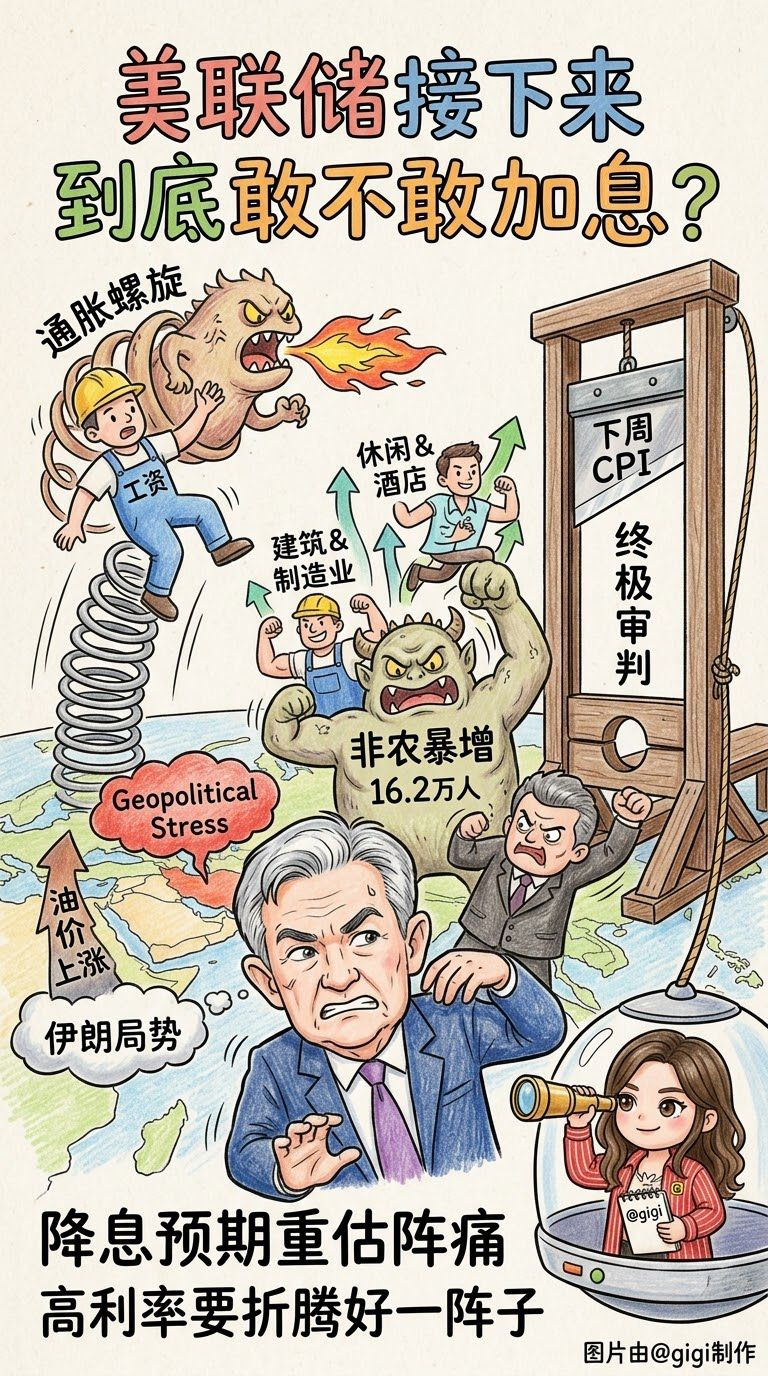

Will the Federal Reserve dare to raise interest rates next?
The just-released U.S. non-farm payrolls for August surged by 162,000, completely crushing the market's original expectation of around 50,000, while the unemployment rate held steady at 4.1%. Against the backdrop of rising tensions in Iran and heightened geopolitical uncertainty, the labor market managing such a rebound is indeed eye-opening
There are two details worth examining
First is structural divergence
In addition to the traditional drivers of growth like leisure and hospitality and government, even construction and manufacturing, which are under pressure from high interest rates, rebounded strongly. This shows that the corporate sector has not completely gone passive because of geopolitical conflict, and hiring demand remains resilient
Second is the second-stage transmission of inflation
Everyone is watching employment, but what is actually more alarming is that workers' wages may rise along with it. At a time when geopolitical conflict is driving up oil prices and supply-chain costs, the better employment gets, the higher the risk of a wage-inflation spiral
The Federal Reserve is now in an extremely awkward position. Such a hot labor market is effectively handing a knife to the hawkish officials, greatly strengthening the case for a rate hike. But the real killer blow is next week's CPI release. If CPI also comes in above expectations, a rate hike this month is almost a foregone conclusion
Forecasting the next move
The Federal Reserve will most likely take a tough, strongly hawkish stance, and the market will also go through a painful repricing as expectations for rate cuts are completely shattered. Unless next week's CPI falls miraculously and sharply, high interest rates may continue to cause turbulence for quite some time
DYOR
#美国8月非农数据今日公布
The just-released U.S. non-farm payrolls for August surged by 162,000, completely crushing the market's original expectation of around 50,000, while the unemployment rate held steady at 4.1%. Against the backdrop of rising tensions in Iran and heightened geopolitical uncertainty, the labor market managing such a rebound is indeed eye-opening
There are two details worth examining
First is structural divergence
In addition to the traditional drivers of growth like leisure and hospitality and government, even construction and manufacturing, which are under pressure from high interest rates, rebounded strongly. This shows that the corporate sector has not completely gone passive because of geopolitical conflict, and hiring demand remains resilient
Second is the second-stage transmission of inflation
Everyone is watching employment, but what is actually more alarming is that workers' wages may rise along with it. At a time when geopolitical conflict is driving up oil prices and supply-chain costs, the better employment gets, the higher the risk of a wage-inflation spiral
The Federal Reserve is now in an extremely awkward position. Such a hot labor market is effectively handing a knife to the hawkish officials, greatly strengthening the case for a rate hike. But the real killer blow is next week's CPI release. If CPI also comes in above expectations, a rate hike this month is almost a foregone conclusion
Forecasting the next move
The Federal Reserve will most likely take a tough, strongly hawkish stance, and the market will also go through a painful repricing as expectations for rate cuts are completely shattered. Unless next week's CPI falls miraculously and sharply, high interest rates may continue to cause turbulence for quite some time
DYOR
#美国8月非农数据今日公布