
Why are Meme coins becoming harder and harder to play right now, to the point that even following KOLs means you end up holding the bag?
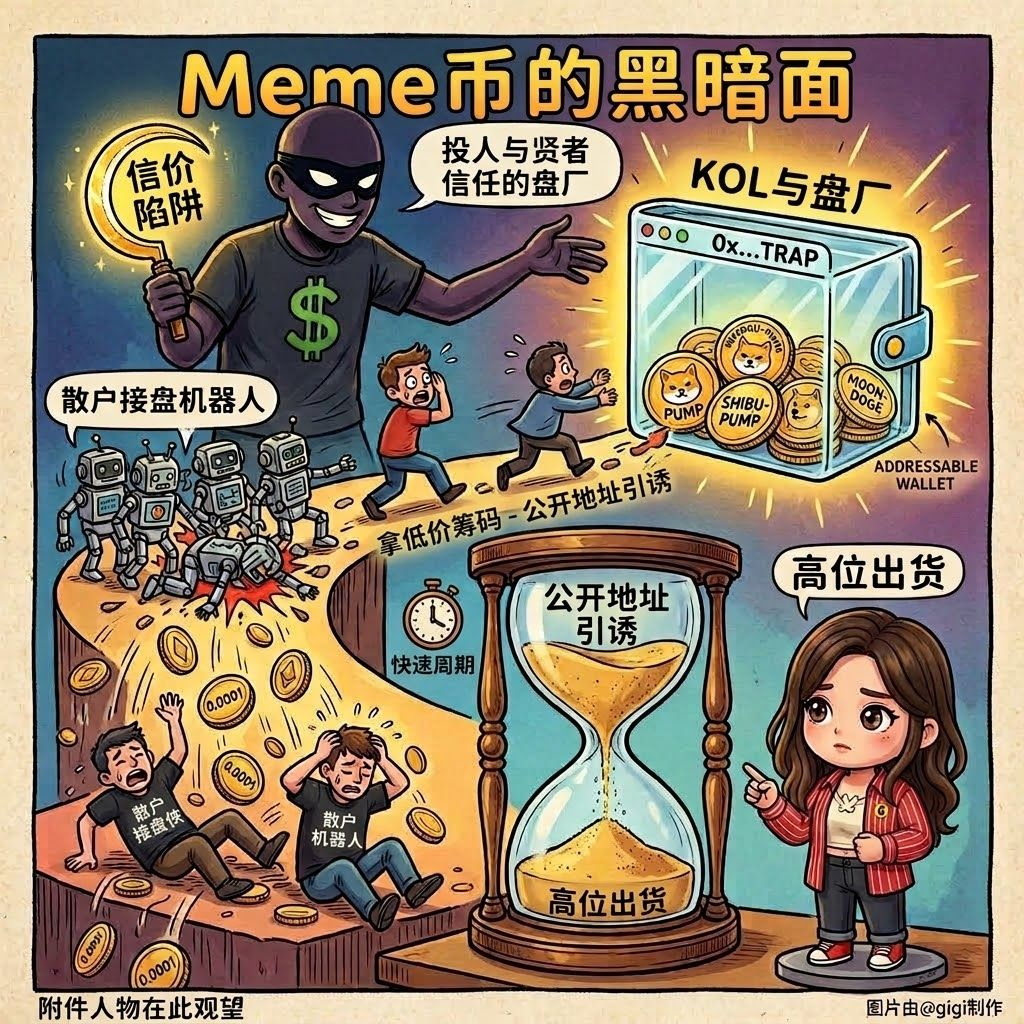
Because KOLs’ knives have already evolved. They started by getting paid to shill, then moved on to using cheap tokens to build a high-returns persona, then deliberately exposing wallet addresses to lure in copy-trading bots, and even setting up their own teams to launch coins and stage everything themselves. You think you’re following smart money, but in reality your buy orders are just the liquidity for their exit.
On-chain transparency has become the most hidden trust trap
People are used to watching on-chain addresses, and coin creators and KOLs exploit exactly that. They intentionally expose addresses to create attractive paper gains and attract automated copy-trading systems. This kind of transparency has not brought fairness; instead, it has become the most precise unloading tool.
Narrative cycles are being compressed endlessly
When KOLs are both the traffic pool and the token holders, token lifecycles shrink dramatically. From launch to draining liquidity can take only a few hours, and retail investors simply cannot react as fast as automated bots.
IP premium is legitimizing low-quality tokens
Create one hundredfold legend, and you can keep ten subsequent half-crash tokens alive. What people are buying is not the token, but blind worship of the KOL; attention is being monetized at high speed.
How will this evolve next?
• Copy-trading will fail faster and faster; algorithm bots replacing human copy-trading will make competition in tiny pools even more intense.
• Pure air Meme plays will reach their limit, and funds will periodically flow into assets with real yield or extreme deflationary mechanisms.
• Token flow matters ten thousand times more than promotional copy. If you can’t understand the movement of funds, you will always be the last one holding the bag.
DYOR
Because KOLs’ knives have already evolved. They started by getting paid to shill, then moved on to using cheap tokens to build a high-returns persona, then deliberately exposing wallet addresses to lure in copy-trading bots, and even setting up their own teams to launch coins and stage everything themselves. You think you’re following smart money, but in reality your buy orders are just the liquidity for their exit.
On-chain transparency has become the most hidden trust trap
People are used to watching on-chain addresses, and coin creators and KOLs exploit exactly that. They intentionally expose addresses to create attractive paper gains and attract automated copy-trading systems. This kind of transparency has not brought fairness; instead, it has become the most precise unloading tool.
Narrative cycles are being compressed endlessly
When KOLs are both the traffic pool and the token holders, token lifecycles shrink dramatically. From launch to draining liquidity can take only a few hours, and retail investors simply cannot react as fast as automated bots.
IP premium is legitimizing low-quality tokens
Create one hundredfold legend, and you can keep ten subsequent half-crash tokens alive. What people are buying is not the token, but blind worship of the KOL; attention is being monetized at high speed.
How will this evolve next?
• Copy-trading will fail faster and faster; algorithm bots replacing human copy-trading will make competition in tiny pools even more intense.
• Pure air Meme plays will reach their limit, and funds will periodically flow into assets with real yield or extreme deflationary mechanisms.
• Token flow matters ten thousand times more than promotional copy. If you can’t understand the movement of funds, you will always be the last one holding the bag.
DYOR