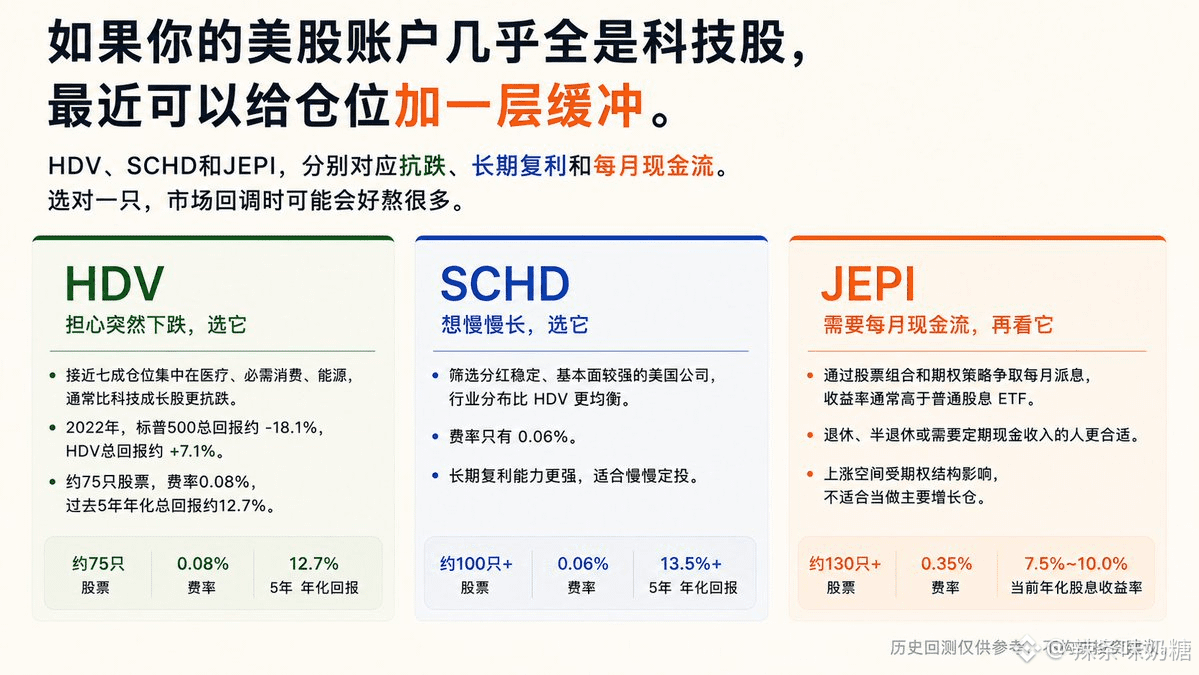
If your U.S. stock account is almost entirely made up of technology stocks, you can add an extra layer of buffer to your position recently.
HDV, SCHD, JEPI correspond to: downside protection, long-term compounding, and monthly cash flow, respectively.
Pick the right one, and you may find it much easier to ride out market pullbacks.
HDV: If you’re worried about a sudden drop, choose it
In 2022, the S&P 500’s total return was about -18.1%, while HDV’s total return was about +7.1%.
Nearly 70% of its holdings are concentrated in healthcare, consumer staples, and energy. When the economy slows, inflation rises, or geopolitical risks increase, it usually holds up better than tech growth stocks.
As of the end of August 2026: about 75 stocks, expense ratio 0.08%, and an annualized total return over the past 5 years of about 12.7%.
If I had to choose only one to take on the defensive role within a portfolio, I personally would choose HDV.
SCHD: If you want to grow slowly, choose it
It screens for U.S. companies with stable dividend histories and stronger fundamentals. Its sector allocation is more balanced than HDV’s, and its expense ratio is only 0.06%.
It may not always be steadier than HDV during downturns, but its long-term compounding potential is stronger.
If you don’t rely on dividends for living expenses and you also don’t want the wild volatility of a pure tech allocation, SCHD is better suited for gradually dollar-cost averaging.
JEPI: If you need monthly cash flow, look at this one
By using a stock portfolio combined with options-related strategies to target monthly distributions, its yield is typically higher than that of a regular dividend ETF.
Retirees, semi-retirees, or anyone who needs regular cash income will care more about how much they can receive each month.
Upside potential can be affected by the options structure, so it isn’t suitable to be your main growth allocation.
If you don’t currently need cash flow, there’s no need to buy it just because the yield is high.
Individual investors don’t need to buy all three.
First figure out what you’re missing—downside protection, compounding, or cash flow—then choose the corresponding one.
Defensive ETFs can still fall, and their industry/style tilts may shift as well.
Their value is that they help you hold your portfolio more easily and reduce the number of emotional decisions you make during periods of extreme volatility.
Historical backtests are for reference only and do not constitute investment advice.
HDV, SCHD, JEPI correspond to: downside protection, long-term compounding, and monthly cash flow, respectively.
Pick the right one, and you may find it much easier to ride out market pullbacks.
HDV: If you’re worried about a sudden drop, choose it
In 2022, the S&P 500’s total return was about -18.1%, while HDV’s total return was about +7.1%.
Nearly 70% of its holdings are concentrated in healthcare, consumer staples, and energy. When the economy slows, inflation rises, or geopolitical risks increase, it usually holds up better than tech growth stocks.
As of the end of August 2026: about 75 stocks, expense ratio 0.08%, and an annualized total return over the past 5 years of about 12.7%.
If I had to choose only one to take on the defensive role within a portfolio, I personally would choose HDV.
SCHD: If you want to grow slowly, choose it
It screens for U.S. companies with stable dividend histories and stronger fundamentals. Its sector allocation is more balanced than HDV’s, and its expense ratio is only 0.06%.
It may not always be steadier than HDV during downturns, but its long-term compounding potential is stronger.
If you don’t rely on dividends for living expenses and you also don’t want the wild volatility of a pure tech allocation, SCHD is better suited for gradually dollar-cost averaging.
JEPI: If you need monthly cash flow, look at this one
By using a stock portfolio combined with options-related strategies to target monthly distributions, its yield is typically higher than that of a regular dividend ETF.
Retirees, semi-retirees, or anyone who needs regular cash income will care more about how much they can receive each month.
Upside potential can be affected by the options structure, so it isn’t suitable to be your main growth allocation.
If you don’t currently need cash flow, there’s no need to buy it just because the yield is high.
Individual investors don’t need to buy all three.
First figure out what you’re missing—downside protection, compounding, or cash flow—then choose the corresponding one.
Defensive ETFs can still fall, and their industry/style tilts may shift as well.
Their value is that they help you hold your portfolio more easily and reduce the number of emotional decisions you make during periods of extreme volatility.
Historical backtests are for reference only and do not constitute investment advice.