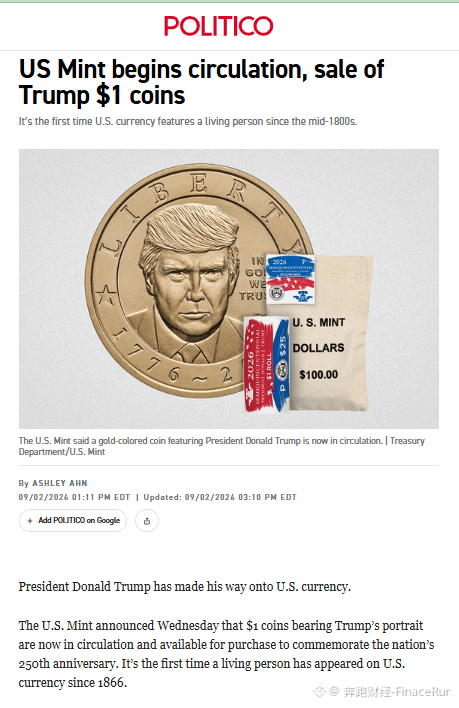
A one-dollar coin featuring Donald Trump’s portrait officially enters circulation
On Wednesday, the U.S. Mint announced that, to mark the 250th anniversary of the founding of the United States, the one-dollar coin bearing a portrait of Donald Trump has begun circulating sales, breaking with the tradition since 1866 that no living person’s portrait appears on U.S. currency.
The newly issued one-dollar coin’s obverse bears the inscriptions "LIBERTY" and "IN GOD WE TRUST." The reverse uses a presidential seal design, with "250" on the shield to commemorate the 250th anniversary of the founding.
In fact, these newly minted coins were showcased earlier this week during the G20 summit in North Carolina, when U.S. Treasury officials presented and distributed the new coins to their foreign counterparts.
Looking back at the history of coinage rules, in 1864, a Treasury official’s portrait was printed on a five-cent paper bill, sparking strong public backlash. As a result, Congress passed a 1866 law banning the depiction of living persons’ portraits on "money, bonds, or securities."
Entering 2020, Trump signed a bipartisan bill authorizing the Treasury to issue, in 2026, a one-dollar coin with commemorative significance for the 250th anniversary of the nation’s founding—and this issuance is implemented based on the provisions of that legislation.
By then, from the renaming of buildings related to the John F. Kennedy Center, to federal building banners, passports, and national park passes, as well as the million-dollar “gold card” visa introduced last year, Trump’s name and portrait will have already permeated all kinds of official U.S. carriers.
Of note, Trump has also proposed issuing a $250 banknote featuring his portrait, which would make him the first living person to appear on U.S. paper currency in several centuries.
However, this approach has also sparked considerable partisan controversy. Coming ahead of the U.S. midterm elections, Democratic lawmakers have seized on the moment to publicly criticize the administration’s perceived imbalance in priorities.
Democratic Senator Elizabeth Warren said bluntly that Americans today struggle to afford basic expenses like food, housing, and healthcare, while Trump continues to print his personal portrait on various public-facing mediums.
In sum, from Congress’s 1866 ban on using portraits of living people on currency to the breaking of this tradition today, it shows that the tension between personal worship and democratic traditions in American political culture is entering a brand-new phase of power realignment.
#美国建国250周年纪念币
On Wednesday, the U.S. Mint announced that, to mark the 250th anniversary of the founding of the United States, the one-dollar coin bearing a portrait of Donald Trump has begun circulating sales, breaking with the tradition since 1866 that no living person’s portrait appears on U.S. currency.
The newly issued one-dollar coin’s obverse bears the inscriptions "LIBERTY" and "IN GOD WE TRUST." The reverse uses a presidential seal design, with "250" on the shield to commemorate the 250th anniversary of the founding.
In fact, these newly minted coins were showcased earlier this week during the G20 summit in North Carolina, when U.S. Treasury officials presented and distributed the new coins to their foreign counterparts.
Looking back at the history of coinage rules, in 1864, a Treasury official’s portrait was printed on a five-cent paper bill, sparking strong public backlash. As a result, Congress passed a 1866 law banning the depiction of living persons’ portraits on "money, bonds, or securities."
Entering 2020, Trump signed a bipartisan bill authorizing the Treasury to issue, in 2026, a one-dollar coin with commemorative significance for the 250th anniversary of the nation’s founding—and this issuance is implemented based on the provisions of that legislation.
By then, from the renaming of buildings related to the John F. Kennedy Center, to federal building banners, passports, and national park passes, as well as the million-dollar “gold card” visa introduced last year, Trump’s name and portrait will have already permeated all kinds of official U.S. carriers.
Of note, Trump has also proposed issuing a $250 banknote featuring his portrait, which would make him the first living person to appear on U.S. paper currency in several centuries.
However, this approach has also sparked considerable partisan controversy. Coming ahead of the U.S. midterm elections, Democratic lawmakers have seized on the moment to publicly criticize the administration’s perceived imbalance in priorities.
Democratic Senator Elizabeth Warren said bluntly that Americans today struggle to afford basic expenses like food, housing, and healthcare, while Trump continues to print his personal portrait on various public-facing mediums.
In sum, from Congress’s 1866 ban on using portraits of living people on currency to the breaking of this tradition today, it shows that the tension between personal worship and democratic traditions in American political culture is entering a brand-new phase of power realignment.
#美国建国250周年纪念币