
Retail dreams, platform harvesting—how long can this Robinhood Chain U.S. stock short-squeeze drama go on?
Recently, Robinhood Chain triggered FOMO due to stock-meme coin speculation. But after the community questioned and scrutinized it, FAMI and JINQIAN fast-in-and-out trades caused a massive drop in market value. I also got trapped and watched my position go to zero.
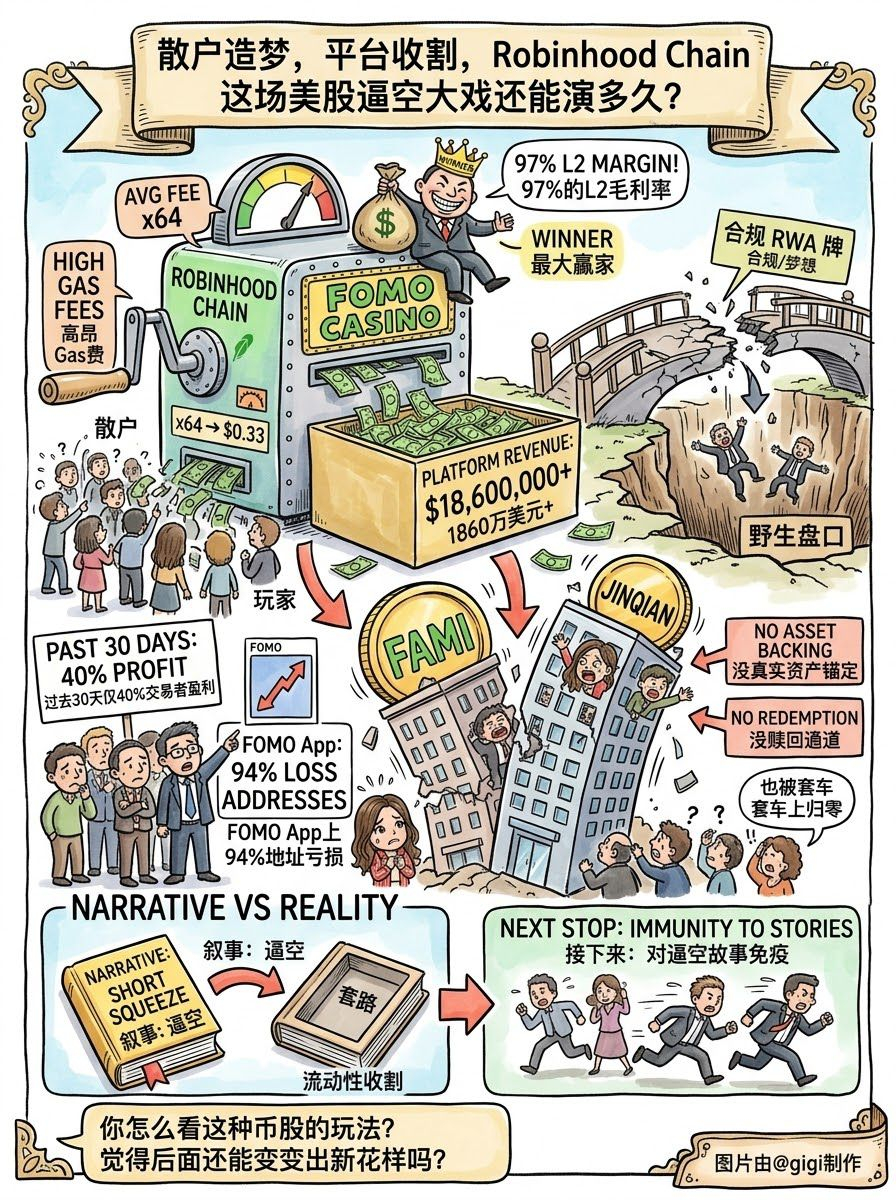
Data shows that over the past 30 days, only 40% of traders were profitable. On the FOMO App, 94% of addresses are losing money. Average trading fees have skyrocketed 64x to $0.33, while the platform’s cumulative fee revenue reached $18.6 million.
This whole farce is narrative arbitrage and liquidity harvesting. The so-called short-squeeze logic doesn’t hold up at all. FAMI has neither real asset backing nor any redemption pathway—it's simply the old penny-stock pump-and-dump play from traditional U.S. markets, repackaged to pull liquidity on-chain.
Once you read this order book clearly, there are two dimensions:
The platform is the biggest winner.
With a 97% L2 gross margin, players keep losing and trying again in deep trouble, while the platform just sits in the background collecting $18.6 million in fees—an on-chain casino money-siphon machine.
The narrative directly self-destructs.
They wanted to play the compliant RWA card to attract traditional capital, but what really caught fire was the wild, unregulated order flow. High gas fees keep real retail users out, completely betraying the original intent.
Where things may go next:
After retail traders swallow this bitter lesson, they’ll quickly become immune to stories like U.S. stock short squeezes. Once the “making money” effect fully disappears, the hot money will leave even faster than people expect.
What do you think about this kind of coin-stock play? Do you think they can come up with new tricks going forward?
Recently, Robinhood Chain triggered FOMO due to stock-meme coin speculation. But after the community questioned and scrutinized it, FAMI and JINQIAN fast-in-and-out trades caused a massive drop in market value. I also got trapped and watched my position go to zero.
Data shows that over the past 30 days, only 40% of traders were profitable. On the FOMO App, 94% of addresses are losing money. Average trading fees have skyrocketed 64x to $0.33, while the platform’s cumulative fee revenue reached $18.6 million.
This whole farce is narrative arbitrage and liquidity harvesting. The so-called short-squeeze logic doesn’t hold up at all. FAMI has neither real asset backing nor any redemption pathway—it's simply the old penny-stock pump-and-dump play from traditional U.S. markets, repackaged to pull liquidity on-chain.
Once you read this order book clearly, there are two dimensions:
The platform is the biggest winner.
With a 97% L2 gross margin, players keep losing and trying again in deep trouble, while the platform just sits in the background collecting $18.6 million in fees—an on-chain casino money-siphon machine.
The narrative directly self-destructs.
They wanted to play the compliant RWA card to attract traditional capital, but what really caught fire was the wild, unregulated order flow. High gas fees keep real retail users out, completely betraying the original intent.
Where things may go next:
After retail traders swallow this bitter lesson, they’ll quickly become immune to stories like U.S. stock short squeezes. Once the “making money” effect fully disappears, the hot money will leave even faster than people expect.
What do you think about this kind of coin-stock play? Do you think they can come up with new tricks going forward?