
#美国8月adp就业创1月来最小增幅
FOMC’s last set of data before the event: Nonfarm Payrolls this Friday
If Nonfarm Payrolls weaken noticeably this Friday, will the Fed still dare to raise rates in September?
Right now, the U.S. economy is somewhat contradictory.
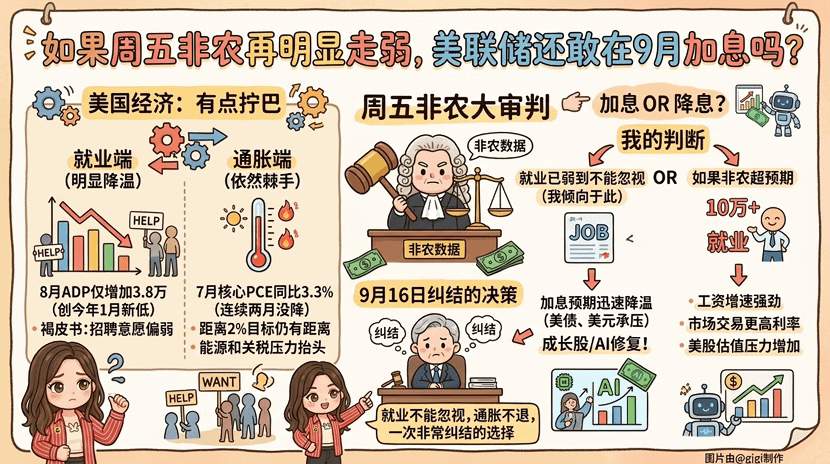
On the employment side, conditions have clearly cooled. In August, ADP added only 38,000 jobs—the lowest since January this year—well below expectations. The latest Beige Book also indicates that overall employment has increased only slightly, and hiring intentions remain weak.
But the problem is inflation. In July, core PCE year-on-year was still 3.3%, with no decline for two straight months. That’s still a long way from the 2% target. At the same time, cost pressures driven by energy and tariffs are beginning to rise again.
So I think the real importance of this Friday’s Nonfarm Payrolls isn’t just how many jobs are added, but whether employment cooling has become fast enough to outweigh the inflation risk.
The market’s pricing for a September rate hike has already risen to more than 60%, and at one point it was close to 70%.
My view is:
If Nonfarm Payrolls come in below 50,000 and the unemployment rate rises to 4.2% or higher, expectations for a rate hike are likely to cool quickly. U.S. Treasury yields and the dollar would come under pressure, and growth stocks—especially the AI segment—may be primed for a rebound.
But if Nonfarm Payrolls move back above 100,000 and wage growth is still strong, that would be troublesome. The market would likely continue to price in higher rates, and pressure on U.S. stock valuations would increase significantly.
I lean toward the former scenario: employment is already weak enough to be impossible to ignore, but inflation isn’t weak enough to let the Fed easily turn dovish. September 16 is more likely to be a highly uncomfortable policy choice rather than a simple “rate hike vs. rate cut” trade.
DYOR
FOMC’s last set of data before the event: Nonfarm Payrolls this Friday
If Nonfarm Payrolls weaken noticeably this Friday, will the Fed still dare to raise rates in September?
Right now, the U.S. economy is somewhat contradictory.
On the employment side, conditions have clearly cooled. In August, ADP added only 38,000 jobs—the lowest since January this year—well below expectations. The latest Beige Book also indicates that overall employment has increased only slightly, and hiring intentions remain weak.
But the problem is inflation. In July, core PCE year-on-year was still 3.3%, with no decline for two straight months. That’s still a long way from the 2% target. At the same time, cost pressures driven by energy and tariffs are beginning to rise again.
So I think the real importance of this Friday’s Nonfarm Payrolls isn’t just how many jobs are added, but whether employment cooling has become fast enough to outweigh the inflation risk.
The market’s pricing for a September rate hike has already risen to more than 60%, and at one point it was close to 70%.
My view is:
If Nonfarm Payrolls come in below 50,000 and the unemployment rate rises to 4.2% or higher, expectations for a rate hike are likely to cool quickly. U.S. Treasury yields and the dollar would come under pressure, and growth stocks—especially the AI segment—may be primed for a rebound.
But if Nonfarm Payrolls move back above 100,000 and wage growth is still strong, that would be troublesome. The market would likely continue to price in higher rates, and pressure on U.S. stock valuations would increase significantly.
I lean toward the former scenario: employment is already weak enough to be impossible to ignore, but inflation isn’t weak enough to let the Fed easily turn dovish. September 16 is more likely to be a highly uncomfortable policy choice rather than a simple “rate hike vs. rate cut” trade.
DYOR