


Fil is aggressively sprinting today despite everyone being weak. What happened?
Recently, the official Filecoin FIP repository has been updated. FIP-0118 (Solstice) has been formally marked as Accepted, indicating that the community review process for the network economic model reform—after multiple rounds of discussion—has been completed and the proposal has entered the implementation phase. This proposal will completely retire the long-running Filecoin Plus (Fil+ / DataCap) data quota system, and it will also reshape the logic for block reward distribution. It will have far-reaching impacts on storage providers, ecosystem service parties, and public-institution customers.
Say goodbye to DataCap: new sectors uniformly receive 10x QAP
Under the current mechanism, for storage miners to obtain 10x effective compute power QAP, they must apply for DataCap quotas with Fil+. After offline reviewers assess the authenticity of the data, the quotas are granted. When this mechanism was created, the goal was to guide genuinely useful data onto the chain; however, over long-term operation it has also revealed a series of problems, such as low efficiency of manual review, governance centralization, and disputes over quota allocation.
According to the Solstice plan, after the network upgrade and NV29 activation, all newly onboarded sectors will not require manual review and will automatically receive the full 10x QAP compute power uplift. Existing legacy sectors keep their original compute power, and they are also supported to proactively upgrade and switch to the new 10x QAP mode. The underlying consensus algorithm itself will not change; only the reward calculation and allocation rules will change.
The third-incentive flow reward model: only real business earns service rewards
Solstice designs three block reward flows—w1, w2, and w0—rewriting FIL production distribution logic:
Solstice’s core changes: three things
First, abandon DataCap—every new sector automatically receives 10x QAP.
Starting from the activation epoch, every newly onboarded sector—regardless of what content it stores—automatically receives a 10x quality multiplier (QAP). Existing sectors can also be upgraded to 10x QAP. The threshold for data verification is completely removed.
Second, block rewards are split into three flows:
w1 (consensus flow): continue rewarding block miners, gradually reducing linearly from 95% down to 50%, with a transition period of about 9 quarters
w2 (service flow): pays registered service orchestrators (Service Orchestrators) in proportion to the amount of on-chain services; initially 5%, and can increase by 5 percentage points each quarter—but only on the condition that Filecoin Pay’s quarterly payment volume reaches a preset USD target
w0 (burn flow): the remaining portion is burned, providing a deflationary constraint—when the service economy has not yet proven its scale, this part of the rewards will not flow to any party
Third, introduce two regulated smart contracts:
Flow-weight executor (SWA): manages the parameters that control reward allocation weights
Service reward executor (SRA): maintains the service orchestrator registry, tracks service volume, and calculates each party’s share
At the same time, set up a separate Solstice-Governance governance repository to house the orchestrator onboarding review, quarterly reports, dispute appeals, and long-term operational procedures. The full set of rules will continue to be improved and supplemented going forward. Projects such as the Bermuda government’s public records on-chain initiative will also become an important real-business stress test case after this new mechanism goes live.
Accepted does not mean the mainnet is active—there are still multiple gates before rollout
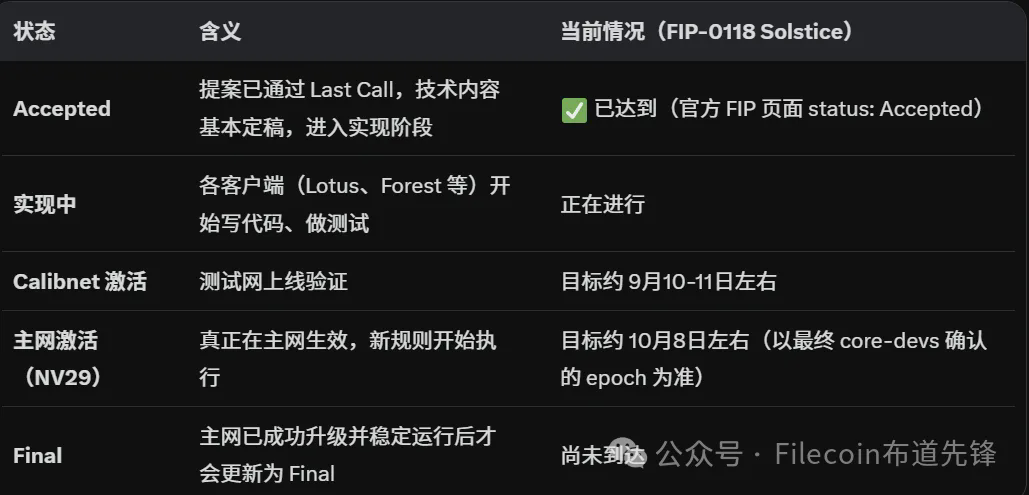
Here we need to clarify one key concept: a FIP status of Accepted means the community has adopted the technical specification—allowing development to begin—but it does not mean the mainnet has already been officially launched and is running live.
According to Filecoin FIP-0001 governance standards, a proposal’s complete lifecycle is Draft→Last Call→Accepted→Final. Only after the mainnet hard-fork upgrade is completed will the status be updated to Final, and the rules will truly take effect on-chain.
Although the current FIP-0118 has been Accepted, there is still a lot of work to be delivered: merging client code development, completing full security audits for the SWA/SRA contracts, filling in all operational details via Solstice-Governance, and fully validating Calibnet on the calibration testnet. The community’s rumored timeline—permission on September 1, Calibnet activation on September 10–11, and an upgrade to the NV29 mainnet on October 8—is based on optimistic community estimates, not an officially finalized block height. The launch time will dynamically change depending on audit results and bug-fix progress.
What does “the ecosystem” mean?
For storage service providers: new sectors no longer depend on DataCap, so the threshold to achieve high QAP drops significantly. However, the revenue structure changes—part of future revenue will come from consensus mining, and part will come from service rewards for connecting real, paid services. For B2B and public institution clients: the new mechanism encourages genuine paid storage businesses. Public archive archiving projects such as the Bermuda government, AI dataset storage, and preserving scientific research data will all become key service scenarios for the NeoCloud on-chain cloud ecosystem. For the entire network: tie additional token issuance and real on-chain economic activity together, avoid token issuance without business backing, use w0 burning to create a deflationary buffer, and attempt to address governance pain points of the past Fil+ model.
Source of materials: official media / online news
Statement: The content published in this account is for learning and exchange purposes only. Materials referenced in the article come from publicly available information online. If any copyright issues are involved, please leave a message to contact us, and we will correct or remove it promptly. This article is intended to convey more market information and does not constitute any investment advice.
#fil #FIL/USDT