
小恐龙说趋势
302 Posts
 LIVE
LIVE小恐龙说趋势
6 年市场经验,公众号.比特小恐龙,记录市场的真实逻辑,研究下一步会去哪
12 Following
2.0K+ Followers
1.7K+ Liked
Posts
All
Live
The tokenization working group of clearing giant DTCC in the U.S. — it first saw an Asian face: Hong Kong-licensed digital asset service provider HashKey became the first Asian member.
Who’s in this group? Goldman Sachs, JPMorgan Chase, Nasdaq, the NYSE—over a hundred global financial institutions are all in there. They’re discussing how tokenized assets should be issued, how settlement should work, and how custody should be handled. In plain terms, Wall Street wants to move this whole set of standards from the discussion table to the production line.
What kind of scale is DTCC? It safeguards assets worth $11.4 trillion. All U.S. stocks and ETFs clear through it. It’s the central hub in the bloodstream of global finance. Now it wants to bring Wall Street along to move onto the chain. This ship is turning—its signal is bigger than any single news headline.
Come October this year, DTCC plans to open tokenized securities. Last year, the SEC even granted its subsidiary a “pass.” In the SEC chair’s words, this is just the beginning—innovation will get the green light going forward, and the official stance has already been made clear. They’re basically one shout away: “All aboard.” Remember, the SEC is famously slow to move.
Don’t just stare at the candlestick charts. That wall of traditional finance is being dismantled piece by piece. Once Wall Street finishes laying the settlement tracks, the token in your hands might be the next era’s stock. If you don’t board now—when the wall is finally full of holes—you’ll be late. Think about how long it took for U.S. stocks to evolve from paper shares to what we have today. On-chain doesn’t have to wait that long.
Drop a comment—do you think tokenized securities are a good bet?
Every day, I’ll keep you on top of tokenization trends. Not just what news happens, but also the logic and opportunities behind it 👀🚀
Click the link below to follow me👇🏻
👉 加入小恐龙粉丝群
#代币化 #RWA #机构进场
Who’s in this group? Goldman Sachs, JPMorgan Chase, Nasdaq, the NYSE—over a hundred global financial institutions are all in there. They’re discussing how tokenized assets should be issued, how settlement should work, and how custody should be handled. In plain terms, Wall Street wants to move this whole set of standards from the discussion table to the production line.
What kind of scale is DTCC? It safeguards assets worth $11.4 trillion. All U.S. stocks and ETFs clear through it. It’s the central hub in the bloodstream of global finance. Now it wants to bring Wall Street along to move onto the chain. This ship is turning—its signal is bigger than any single news headline.
Come October this year, DTCC plans to open tokenized securities. Last year, the SEC even granted its subsidiary a “pass.” In the SEC chair’s words, this is just the beginning—innovation will get the green light going forward, and the official stance has already been made clear. They’re basically one shout away: “All aboard.” Remember, the SEC is famously slow to move.
Don’t just stare at the candlestick charts. That wall of traditional finance is being dismantled piece by piece. Once Wall Street finishes laying the settlement tracks, the token in your hands might be the next era’s stock. If you don’t board now—when the wall is finally full of holes—you’ll be late. Think about how long it took for U.S. stocks to evolve from paper shares to what we have today. On-chain doesn’t have to wait that long.
Drop a comment—do you think tokenized securities are a good bet?
Every day, I’ll keep you on top of tokenization trends. Not just what news happens, but also the logic and opportunities behind it 👀🚀
Click the link below to follow me👇🏻
👉 加入小恐龙粉丝群
#代币化 #RWA #机构进场

A DeFi project in the Sui ecosystem shut down and announced it was done overnight because the oracle went bad. All new deposits were halted, and even LP rewards couldn’t be claimed. Guess how much was lost—$91,000. Three vaults were drained.
The issue was with the Switchboard oracle. Once it stalled, multiple protocols across several chains were hit as well. Over in the IOTA ecosystem, a lending project reportedly lost $455,000. Its stablecoin collateral also developed a gap. When one source collapsed, a whole chain of projects started shaking. An oracle failure never just hurts one party.
Normally, losing this amount of money is something many projects would grit their teeth through and move on. But Full Sail chose the hardest-core approach: they shut down, withdrew, and used the remaining project funds to compensate users—and covered the shortfall from their own team’s pockets. They赔偿 the community first, and only then talked about anything else. In the industry, this kind of move is basically a rare species.
On one side: the kind of project that deletes its data and runs when something goes wrong. On the other: a project that loses $90,000 and declares liquidation—and still pays out of its own pocket to make users whole. Who’s just passing by, and who wants to play the long game? It’s obvious. This comparison is more convincing than any whitepaper.
DeFi’s lifeline has never been just code. It also includes the surrounding oracle layer—the source that feeds the data. When that source breaks, even the best protocol is useless. This time, the loss was only $91,000—good luck, and a warning to everyone. Before choosing a protocol, first check whether the oracle it uses is reliable.
Let’s discuss in the comments: Which protocol are you using, and which oracle does it rely on?
Every day, I’ll bring you to watch the hottest DeFi developments— not just what happened in the news, but also the logic and the opportunities behind it 👀🚀
Click the link below to follow me👇🏻
👉 加入小恐龙粉丝群
#DeFi #Sui #预言机
The issue was with the Switchboard oracle. Once it stalled, multiple protocols across several chains were hit as well. Over in the IOTA ecosystem, a lending project reportedly lost $455,000. Its stablecoin collateral also developed a gap. When one source collapsed, a whole chain of projects started shaking. An oracle failure never just hurts one party.
Normally, losing this amount of money is something many projects would grit their teeth through and move on. But Full Sail chose the hardest-core approach: they shut down, withdrew, and used the remaining project funds to compensate users—and covered the shortfall from their own team’s pockets. They赔偿 the community first, and only then talked about anything else. In the industry, this kind of move is basically a rare species.
On one side: the kind of project that deletes its data and runs when something goes wrong. On the other: a project that loses $90,000 and declares liquidation—and still pays out of its own pocket to make users whole. Who’s just passing by, and who wants to play the long game? It’s obvious. This comparison is more convincing than any whitepaper.
DeFi’s lifeline has never been just code. It also includes the surrounding oracle layer—the source that feeds the data. When that source breaks, even the best protocol is useless. This time, the loss was only $91,000—good luck, and a warning to everyone. Before choosing a protocol, first check whether the oracle it uses is reliable.
Let’s discuss in the comments: Which protocol are you using, and which oracle does it rely on?
Every day, I’ll bring you to watch the hottest DeFi developments— not just what happened in the news, but also the logic and the opportunities behind it 👀🚀
Click the link below to follow me👇🏻
👉 加入小恐龙粉丝群
#DeFi #Sui #预言机

A Trojan that stole encrypted cryptocurrency for 8 years has finally been taken down. The U.S. Department of Justice, together with the security firm CrowdStrike, carried out a coordinated operation across four countries. More than 15,000 infected computers were isolated.
This Trojan plays the “swap one for another” game. You copy a wallet address to prepare a transfer, and it immediately swaps it for the hacker’s address. It has been alive since 2003—an almost legendary old-timer in the Trojan world. Just swapping addresses is what it did for a full 8 years.
You think you’re sending money to a friend—when in fact you’re paying the hacker. Clipboard hijacking has been discussed hundreds of times in the crypto community, yet people still fall for it. Copy, paste, confirm—that’s all it takes. Unfortunately, some people skip the last step. Once the money is gone, there’s no time to cry.
Over the years, the hackers haven’t been random with spending. Most of the stolen coins simply sit in wallets without being touched. Measured by purchasing power, the peak value is about $4 million. They saved and saved, effectively saving themselves into law enforcement’s target list—an alternative kind of “investment,” except it’s the kind where you never cash out.
This time, they took it all apart at once. They dismantled its network from the root. Multi-country cooperation, with four countries acting simultaneously. For a Trojan to survive this long, it has never been because its technology is that brilliant—it’s because not many people seriously verify the address.
Before you transfer, take another look at the beginning and end of the address. It’s really not embarrassing. What you save is real money—true gold and silver. Don’t download strange files, don’t grant random wallet permissions. Same old advice—but every time something goes wrong, someone still gets caught. Talk about it in the comments: when you make a transfer, do you check the address?
Every day, I’ll bring you crypto security hot topics. Not just what happened in the news, but the logic and opportunities behind it 👀🚀
Click the link below to follow me👇🏻
👉 加入小恐龙粉丝群
#比特币 #网络安全 #加密市场
This Trojan plays the “swap one for another” game. You copy a wallet address to prepare a transfer, and it immediately swaps it for the hacker’s address. It has been alive since 2003—an almost legendary old-timer in the Trojan world. Just swapping addresses is what it did for a full 8 years.
You think you’re sending money to a friend—when in fact you’re paying the hacker. Clipboard hijacking has been discussed hundreds of times in the crypto community, yet people still fall for it. Copy, paste, confirm—that’s all it takes. Unfortunately, some people skip the last step. Once the money is gone, there’s no time to cry.
Over the years, the hackers haven’t been random with spending. Most of the stolen coins simply sit in wallets without being touched. Measured by purchasing power, the peak value is about $4 million. They saved and saved, effectively saving themselves into law enforcement’s target list—an alternative kind of “investment,” except it’s the kind where you never cash out.
This time, they took it all apart at once. They dismantled its network from the root. Multi-country cooperation, with four countries acting simultaneously. For a Trojan to survive this long, it has never been because its technology is that brilliant—it’s because not many people seriously verify the address.
Before you transfer, take another look at the beginning and end of the address. It’s really not embarrassing. What you save is real money—true gold and silver. Don’t download strange files, don’t grant random wallet permissions. Same old advice—but every time something goes wrong, someone still gets caught. Talk about it in the comments: when you make a transfer, do you check the address?
Every day, I’ll bring you crypto security hot topics. Not just what happened in the news, but the logic and opportunities behind it 👀🚀
Click the link below to follow me👇🏻
👉 加入小恐龙粉丝群
#比特币 #网络安全 #加密市场
Thailand has also joined the global transfer rule wave. In the future, transferring crypto to your own wallet may require passing a security screening first. The Thailand Securities and Exchange Commission has officially finalized the Travel Rule requirements: all digital asset service providers must verify the identities of both parties before transferring. Self-custody wallets—meaning wallets where you manage your own private keys—are also within the scope of verification. Platforms must confirm exactly who controls that wallet.
Transaction information must be archived for at least five years so regulators can retrieve it at any time. The new rules take effect by the end of February 2027, giving the industry roughly a six-month buffer period.
This isn’t just Thailand making up its own rules. Globally, 83% of legal jurisdictions have already written similar transfer traceability requirements into law. Self-custody wallets were previously a regulatory blind spot, but now they’ve become a key target.
Put simply, this tug-of-war is between privacy and compliance. On one side is the original ideal of crypto: if you manage your own wallet, nobody can stop you. On the other side is what regulators want: transparency—every transfer must be backed by a real person.
Thailand’s move shows that regulatory pressure in Asia is tightening further and further. Today they’re checking self-custody wallets; tomorrow it could be cold wallet devices. Who would have thought that managing your own coins would start requiring you to prove to a platform that you are you?
For ordinary players, the short-term impact isn’t big, but it’s worth thinking about the direction. The crypto world is moving from absolute freedom toward limited freedom. Do you accept this change? Let’s discuss in the comments.
Follow me every day to keep track of the latest crypto regulatory developments—not just what happens in the news, but also the logic and opportunities behind it 👀🚀
Click the links below to follow me 👇🏻
👉 加入小恐龙粉丝群
#泰国 #加密监管 #TravelRule
Transaction information must be archived for at least five years so regulators can retrieve it at any time. The new rules take effect by the end of February 2027, giving the industry roughly a six-month buffer period.
This isn’t just Thailand making up its own rules. Globally, 83% of legal jurisdictions have already written similar transfer traceability requirements into law. Self-custody wallets were previously a regulatory blind spot, but now they’ve become a key target.
Put simply, this tug-of-war is between privacy and compliance. On one side is the original ideal of crypto: if you manage your own wallet, nobody can stop you. On the other side is what regulators want: transparency—every transfer must be backed by a real person.
Thailand’s move shows that regulatory pressure in Asia is tightening further and further. Today they’re checking self-custody wallets; tomorrow it could be cold wallet devices. Who would have thought that managing your own coins would start requiring you to prove to a platform that you are you?
For ordinary players, the short-term impact isn’t big, but it’s worth thinking about the direction. The crypto world is moving from absolute freedom toward limited freedom. Do you accept this change? Let’s discuss in the comments.
Follow me every day to keep track of the latest crypto regulatory developments—not just what happens in the news, but also the logic and opportunities behind it 👀🚀
Click the links below to follow me 👇🏻
👉 加入小恐龙粉丝群
#泰国 #加密监管 #TravelRule

Yet another Japanese listed company has cleared out all its copycat coins, keeping only Bitcoin. Remixpoint: the listed company in Japan that holds the third-largest amount of Bitcoin. It has officially announced that it will liquidate all its altcoins in one go, leaving just 1,506 BTC. At current prices, that’s worth about $115 million.
This time, what it sold was ETH, SOL, XRP, and DOGE—together totaling $5.5 million. It even made a profit of $0.73 million. Only the Dogecoin position ended up a little in the red. The official explanation is pretty straightforward: concentrate holdings to make the investment strategy clearer and improve capital efficiency.
In plain terms: holding altcoins is exhausting; better to just trust Bitcoin.
This company doesn’t just hoard coins—it also earns interest by lending them out. From this year’s February to August, it lent out its BTC and earned roughly 15 coins. Just lying back and collecting “rent” is more stable than many businesses.
More and more global listed companies are swapping their treasuries entirely into Bitcoin. First came a few in the US, and now this one in Japan. Institutions are “voting with their feet.” No matter how many altcoins there are, they can only be supporting characters.
Meanwhile, altcoins have fewer long-term buyers like listed companies. They can only rely on retail sentiment to stay afloat. Whoever runs first is the smart money.
There’s also a small detail: the $0.73 million profit from selling altcoins will be recorded in the company’s next fiscal-year report—meaning it’s basically “free” profit. With this move, the financial statements look better too.
Bitcoin can serve as a company asset; altcoins can only be trading chips. This logic is becoming clearer and clearer. Drop a comment—who do you think will be the next company to clear out its altcoins and keep only Bitcoin?
Every day I’ll help you track Bitcoin headlines. Not just what happened in the news—but also how to understand the underlying logic and opportunities 👀🚀
Click the links below to follow me👇🏻
👉 加入小恐龙粉丝群
#比特币 #山寨币 #上市公司金库
This time, what it sold was ETH, SOL, XRP, and DOGE—together totaling $5.5 million. It even made a profit of $0.73 million. Only the Dogecoin position ended up a little in the red. The official explanation is pretty straightforward: concentrate holdings to make the investment strategy clearer and improve capital efficiency.
In plain terms: holding altcoins is exhausting; better to just trust Bitcoin.
This company doesn’t just hoard coins—it also earns interest by lending them out. From this year’s February to August, it lent out its BTC and earned roughly 15 coins. Just lying back and collecting “rent” is more stable than many businesses.
More and more global listed companies are swapping their treasuries entirely into Bitcoin. First came a few in the US, and now this one in Japan. Institutions are “voting with their feet.” No matter how many altcoins there are, they can only be supporting characters.
Meanwhile, altcoins have fewer long-term buyers like listed companies. They can only rely on retail sentiment to stay afloat. Whoever runs first is the smart money.
There’s also a small detail: the $0.73 million profit from selling altcoins will be recorded in the company’s next fiscal-year report—meaning it’s basically “free” profit. With this move, the financial statements look better too.
Bitcoin can serve as a company asset; altcoins can only be trading chips. This logic is becoming clearer and clearer. Drop a comment—who do you think will be the next company to clear out its altcoins and keep only Bitcoin?
Every day I’ll help you track Bitcoin headlines. Not just what happened in the news—but also how to understand the underlying logic and opportunities 👀🚀
Click the links below to follow me👇🏻
👉 加入小恐龙粉丝群
#比特币 #山寨币 #上市公司金库

Two Thai businessmen sue stablecoin giant Tether in a New York court. The reason is straightforward: on what grounds did you freeze my money?
They’re talking about last October, when $42.4 million worth of USDT on their accounts was frozen. The plaintiffs say that at the time, the authorities didn’t even have a search warrant—just a quiet heads-up from an investigation department. The issuer then took action. It wasn’t until February of this year that the court’s formal paperwork was issued to fill the gap—after several months in between.
The most cutting line is this: the plaintiffs don’t deny that they were involved in the funds at issue, but they keep insisting on procedure. You’re a private company—if you don’t have a warrant, why freeze it? During these months, the reserves that were frozen kept earning interest from U.S. Treasury bonds. Isn’t making money from this situation a little too convenient?
On the surface, the lawsuit is about getting paid back. In reality, it’s a diagnostic test for the whole stablecoin industry: what exactly are the boundaries of an issuer’s power to freeze? If a law-enforcement agency makes a phone call, should it be able to make tens of millions of dollars disappear?
On one side is the efficiency of cooperating with law enforcement. On the other is users’ confidence in their assets. As stablecoins develop to this point, this contradiction can’t be avoided. After all, hundreds of millions of people around the world hold USDT. Who can say for sure the next frozen one won’t be them?
If the court rules that the issuer overstepped its authority, the global stablecoin freezing process may have to be rewritten. If you’re holding USDT, you’ll have to weigh it again—because what you have in your hand: is it real money, or just a number that can be shut down with someone else’s single sentence? Let’s discuss in the comments—whose side do you think it should be?
Every day, I’ll keep you updated on stablecoin hot topics—not just what happened in the news, but also help you understand the logic and opportunities behind it 👀🚀
Click the link below to follow me👇🏻
👉 加入小恐龙粉丝群
#USDT #稳定币 #Tether
They’re talking about last October, when $42.4 million worth of USDT on their accounts was frozen. The plaintiffs say that at the time, the authorities didn’t even have a search warrant—just a quiet heads-up from an investigation department. The issuer then took action. It wasn’t until February of this year that the court’s formal paperwork was issued to fill the gap—after several months in between.
The most cutting line is this: the plaintiffs don’t deny that they were involved in the funds at issue, but they keep insisting on procedure. You’re a private company—if you don’t have a warrant, why freeze it? During these months, the reserves that were frozen kept earning interest from U.S. Treasury bonds. Isn’t making money from this situation a little too convenient?
On the surface, the lawsuit is about getting paid back. In reality, it’s a diagnostic test for the whole stablecoin industry: what exactly are the boundaries of an issuer’s power to freeze? If a law-enforcement agency makes a phone call, should it be able to make tens of millions of dollars disappear?
On one side is the efficiency of cooperating with law enforcement. On the other is users’ confidence in their assets. As stablecoins develop to this point, this contradiction can’t be avoided. After all, hundreds of millions of people around the world hold USDT. Who can say for sure the next frozen one won’t be them?
If the court rules that the issuer overstepped its authority, the global stablecoin freezing process may have to be rewritten. If you’re holding USDT, you’ll have to weigh it again—because what you have in your hand: is it real money, or just a number that can be shut down with someone else’s single sentence? Let’s discuss in the comments—whose side do you think it should be?
Every day, I’ll keep you updated on stablecoin hot topics—not just what happened in the news, but also help you understand the logic and opportunities behind it 👀🚀
Click the link below to follow me👇🏻
👉 加入小恐龙粉丝群
#USDT #稳定币 #Tether

Today, let’s talk about a somewhat macro indicator. China’s credit impulse has started flashing red. The term sounds academic, but it’s basically about whether an economy’s pace of borrowing is accelerating or slowing down. If borrowing picks up, the economy heats up, and risk assets naturally get hyped. If borrowing slows, the whole world has to brace itself.
How good is this indicator? A study by HSBC (HSBC Bank) says it leads the S&P 500 by about 12 months. In the past, a number of Bitcoin’s major bottoms aligned with it—sometimes the two would turn upward again and basically “hit” in the same timeframe. Back in April 2023, it just began trending upward; Bitcoin was around the $30,000 mark then. Everyone knows how things played out afterward. History doesn’t repeat exactly, but the rhythm really does look similar.
The trouble now is that the indicator reading has hit the lowest level since 2008. An HSBC strategist even said outright that ignoring this round of China’s monetary tightening could be the biggest investment mistake of the decade. Translate it: if global demand—the engine—doesn’t have enough fuel, even commodities can catch a cold.
But this time, Bitcoin is being a bit rebellious. Even with the indicator heading downward, it still rose 25% in August, at one point surging above 80,000. The logic still holds. What’s supporting the market early on is no longer Asian retail traders—it’s U.S. institutions’ ETF buying. The chip/position structure has changed, so sensitivity to these kinds of signals naturally drops. Who’s paying with whose money decides whose instructions the market follows.
So the next two paths: either Bitcoin continues to ignore this red light—after all, its buyers have changed—or the U.S. stock market can’t hold first. If risk appetite collapses, no matter how tough Bitcoin is, it can’t fully escape. Which scenario do you think is more likely? Let’s discuss in the comments. And by the way, do you trust macro or liquidity/funding more?
Every day, I’ll take you to watch macro headlines—not just what happens in the news, but also the logic and opportunities behind it 👀🚀
Click the links below to follow me👇🏻
👉 加入小恐龙粉丝群
#比特币 #宏观 #信贷脉冲
How good is this indicator? A study by HSBC (HSBC Bank) says it leads the S&P 500 by about 12 months. In the past, a number of Bitcoin’s major bottoms aligned with it—sometimes the two would turn upward again and basically “hit” in the same timeframe. Back in April 2023, it just began trending upward; Bitcoin was around the $30,000 mark then. Everyone knows how things played out afterward. History doesn’t repeat exactly, but the rhythm really does look similar.
The trouble now is that the indicator reading has hit the lowest level since 2008. An HSBC strategist even said outright that ignoring this round of China’s monetary tightening could be the biggest investment mistake of the decade. Translate it: if global demand—the engine—doesn’t have enough fuel, even commodities can catch a cold.
But this time, Bitcoin is being a bit rebellious. Even with the indicator heading downward, it still rose 25% in August, at one point surging above 80,000. The logic still holds. What’s supporting the market early on is no longer Asian retail traders—it’s U.S. institutions’ ETF buying. The chip/position structure has changed, so sensitivity to these kinds of signals naturally drops. Who’s paying with whose money decides whose instructions the market follows.
So the next two paths: either Bitcoin continues to ignore this red light—after all, its buyers have changed—or the U.S. stock market can’t hold first. If risk appetite collapses, no matter how tough Bitcoin is, it can’t fully escape. Which scenario do you think is more likely? Let’s discuss in the comments. And by the way, do you trust macro or liquidity/funding more?
Every day, I’ll take you to watch macro headlines—not just what happens in the news, but also the logic and opportunities behind it 👀🚀
Click the links below to follow me👇🏻
👉 加入小恐龙粉丝群
#比特币 #宏观 #信贷脉冲

Verified
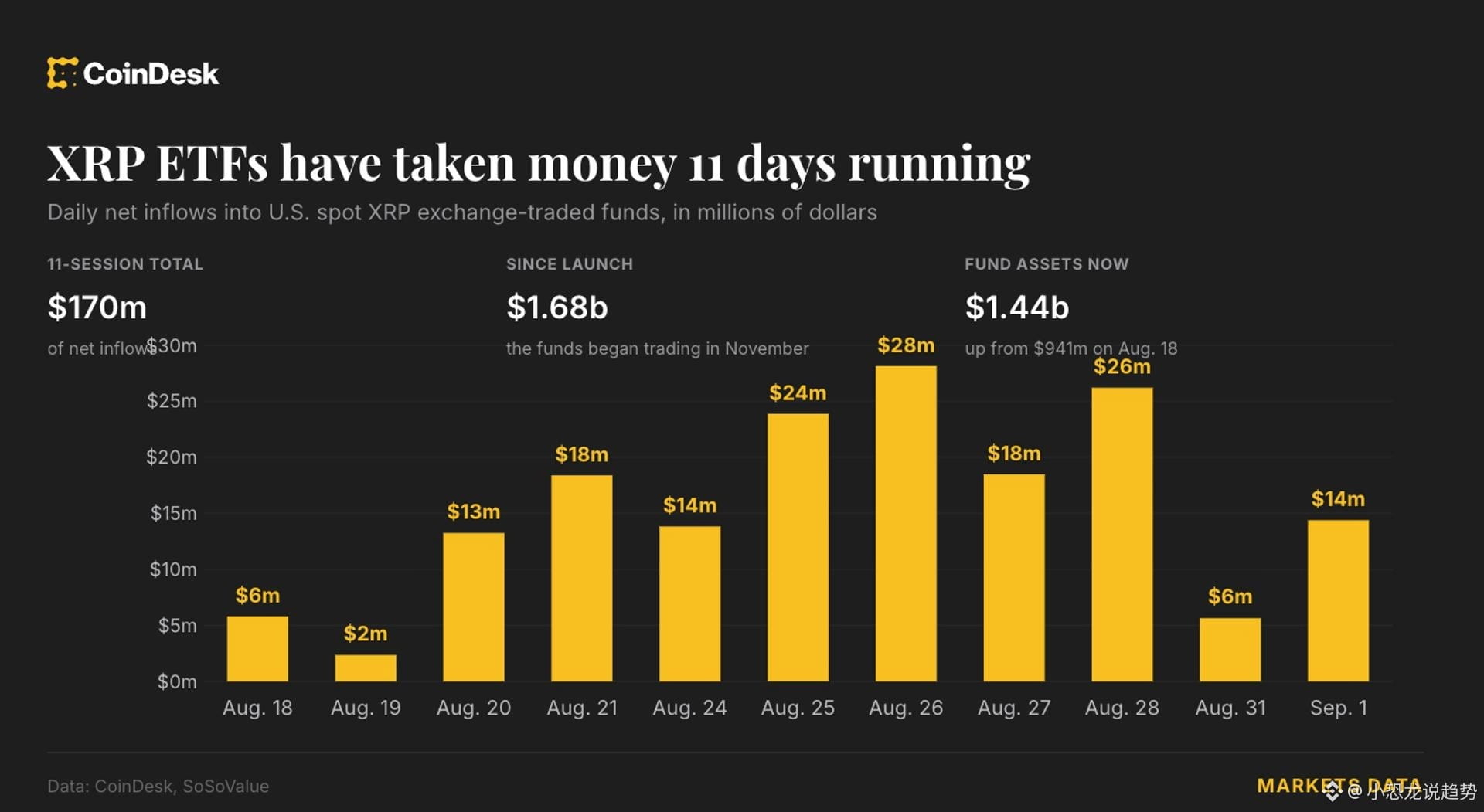
XRP’s ETF is quietly heating up—over eleven days it pulled in $170 million, with a streak of nine straight days still showing strength. What’s most encouraging is Wall Street’s attitude. After the Q2 holdings report came out, Goldman Sachs immediately took the top spot among institutional holders. Jane Street and Millennium also moved in right behind. With this lineup, traditional financial institutions really are starting to cast real votes with real money.
If we’re talking about the past, institutions buying XRP used to be hush-hush. Now they lay it all out directly in the 13F reports for you to see. Goldman led the way, with market-making giants following. This kind of signal is more tangible than price up or down—showing mainstream capital is starting to treat XRP as a legitimate asset allocation, not a quick trade and then run.
XRP is currently around $0.3. Yesterday it even fell with the overall market by nearly 2%. Short-term volatility is one thing, but the trend of money flowing in has been continuous—buying for eleven straight days without stopping. This kind of sustained bid suggests someone is genuinely building a long-term position, not just reacting to headlines. Institutional accumulation is always done quietly, with big moves.
Of course, ETF inflows and price don’t necessarily move in sync. Big players building positions takes time too. But the direction is clear. Wall Street’s positions going from zero to real is the biggest story by itself. Next, we’ll see how far this wind can carry—and whether the altcoin season will get ignited by it first.
Do you think Goldman buying XRP is allocation or speculation? Let’s chat in the comments—how long do you think that institutional card will be played?
Every day I’ll take you through XRP hotspots—not just what happened in the news, but also help you understand the underlying logic and opportunities 👀🚀
Click the link below to follow me👇🏻
👉 加入小恐龙粉丝群
#XRP #ETF #机构进场
If we’re talking about the past, institutions buying XRP used to be hush-hush. Now they lay it all out directly in the 13F reports for you to see. Goldman led the way, with market-making giants following. This kind of signal is more tangible than price up or down—showing mainstream capital is starting to treat XRP as a legitimate asset allocation, not a quick trade and then run.
XRP is currently around $0.3. Yesterday it even fell with the overall market by nearly 2%. Short-term volatility is one thing, but the trend of money flowing in has been continuous—buying for eleven straight days without stopping. This kind of sustained bid suggests someone is genuinely building a long-term position, not just reacting to headlines. Institutional accumulation is always done quietly, with big moves.
Of course, ETF inflows and price don’t necessarily move in sync. Big players building positions takes time too. But the direction is clear. Wall Street’s positions going from zero to real is the biggest story by itself. Next, we’ll see how far this wind can carry—and whether the altcoin season will get ignited by it first.
Do you think Goldman buying XRP is allocation or speculation? Let’s chat in the comments—how long do you think that institutional card will be played?
Every day I’ll take you through XRP hotspots—not just what happened in the news, but also help you understand the underlying logic and opportunities 👀🚀
Click the link below to follow me👇🏻
👉 加入小恐龙粉丝群
#XRP #ETF #机构进场
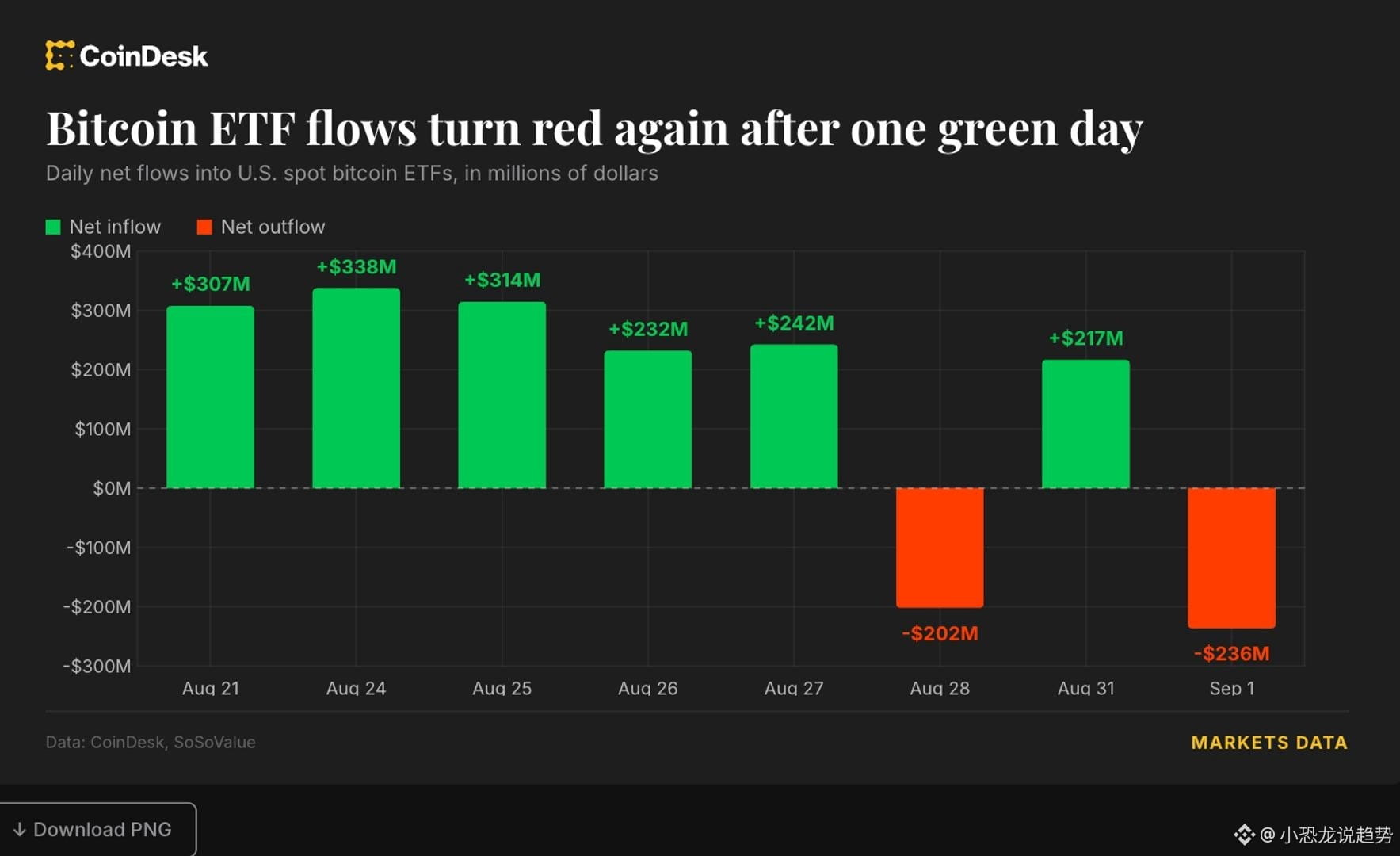
The Bitcoin ETF’s style has changed again: Outflows of $236 million in a single day. It turned red right after being green for a day. Leading the pullout is BlackRock’s IBIT—just one fund pulled out $200 million. FBTC followed with $44 million. Across the whole market, only Bitwise’s BITB went against the trend, netting $8 million. The other nine “brothers” just stayed put and did nothing. Who wouldn’t feel a bit confused after seeing this scene?
What’s interesting is that while the big BTC ETF is bleeding, the smaller guys’ ETFs are still eating heartily. The Ethereum ETF has had net inflows for the 12th consecutive day, and on the day it also added another $11 million. XRP saw inflows of $14 million, SOL $10 million, and HYPE also neared $2 million. The money didn’t really leave—it just switched tracks and kept running.
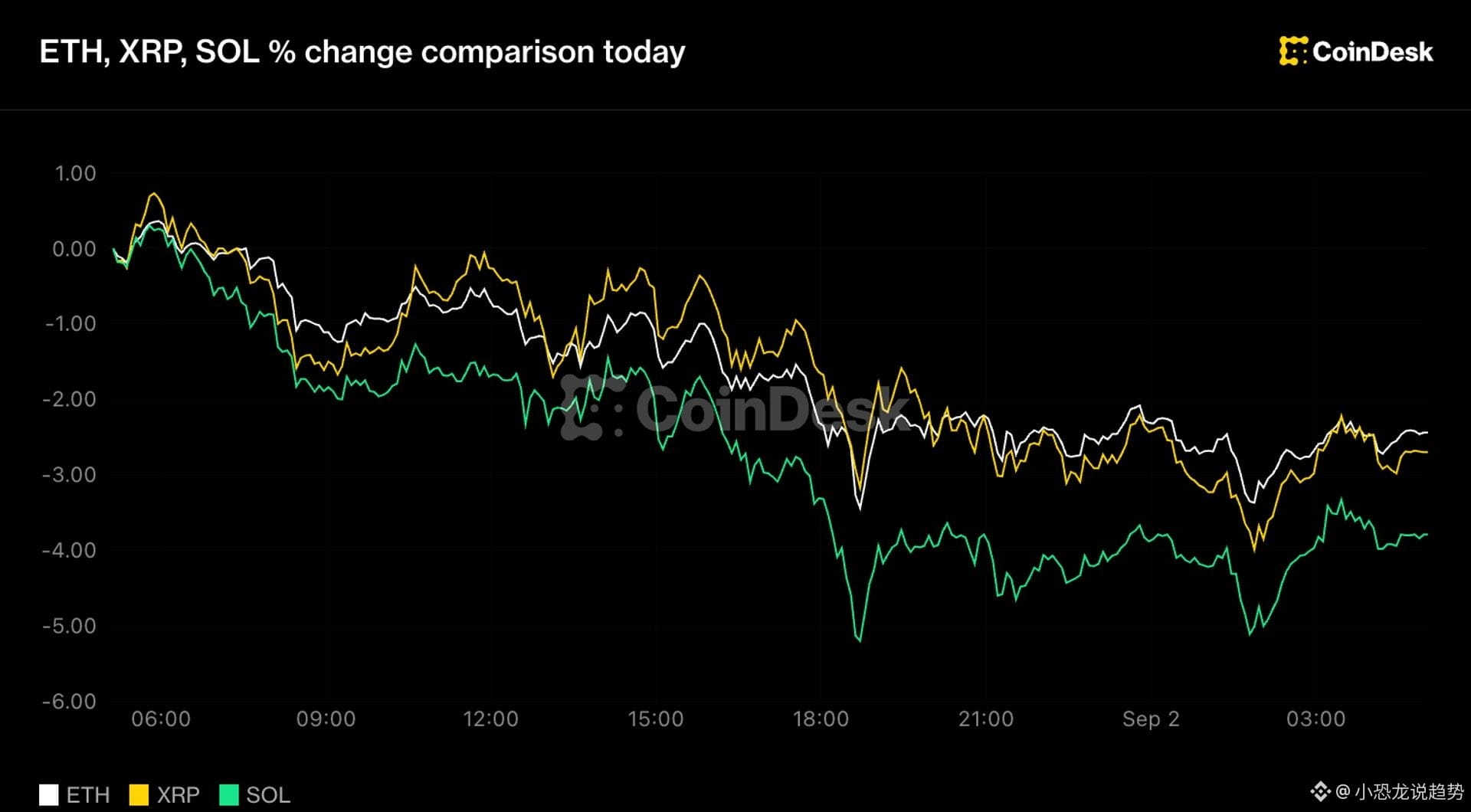
Bitcoin is currently hovering around $77k, down about 2% over the week. Altcoins are falling even harder: SOL and Zcash dropped 3% in a day; XRP and Tron also slipped by nearly 2%. As usual, high-volatility assets take the first hit. Meanwhile, base-layer assets like BTC are oddly more resilient.
The one you should keep the closest eye on is IBIT. It accounts for the bulk of the outflows—suggesting that the so-called “outflow trend” might just be one institution rebalancing its holdings. Don’t panic just because you see outflows. First, figure out who is selling and why. That matters far more than the numbers themselves. After all, last year there was a similar storyline: when the whales finished rebalancing, the price still moved up.
Do you think this ETF outflow is just a shakeout—or a real retreat? Let’s chat in the comments. I’m waiting for the next move from the big whale.
Every day I’ll take you through Bitcoin ETF headlines—not just what’s happening, but helping you understand the logic and opportunities behind it 👀🚀
Click the links below to follow me👇🏻
👉 加入小恐龙粉丝群
#比特币 #比特币ETF #机构资金
What’s interesting is that while the big BTC ETF is bleeding, the smaller guys’ ETFs are still eating heartily. The Ethereum ETF has had net inflows for the 12th consecutive day, and on the day it also added another $11 million. XRP saw inflows of $14 million, SOL $10 million, and HYPE also neared $2 million. The money didn’t really leave—it just switched tracks and kept running.
Bitcoin is currently hovering around $77k, down about 2% over the week. Altcoins are falling even harder: SOL and Zcash dropped 3% in a day; XRP and Tron also slipped by nearly 2%. As usual, high-volatility assets take the first hit. Meanwhile, base-layer assets like BTC are oddly more resilient.
The one you should keep the closest eye on is IBIT. It accounts for the bulk of the outflows—suggesting that the so-called “outflow trend” might just be one institution rebalancing its holdings. Don’t panic just because you see outflows. First, figure out who is selling and why. That matters far more than the numbers themselves. After all, last year there was a similar storyline: when the whales finished rebalancing, the price still moved up.
Do you think this ETF outflow is just a shakeout—or a real retreat? Let’s chat in the comments. I’m waiting for the next move from the big whale.
Every day I’ll take you through Bitcoin ETF headlines—not just what’s happening, but helping you understand the logic and opportunities behind it 👀🚀
Click the links below to follow me👇🏻
👉 加入小恐龙粉丝群
#比特币 #比特币ETF #机构资金
The exchange-listed companies in the coin-holding sector: the total market cap has already reached $340 billion, and since mid-August it has risen another 10%. However, it’s still a long way from the peak of $490 billion in the October/November surge last year—back then, Bitcoin was sitting at its all-time high of $126,000.
First, let’s look at the veteran players. Strategy is up 30% and Bitmine is up 27%. They’re basically moving in line with the coins they hold. In particular, since August 17th, Strategy has even outperformed Bitcoin by 10 percentage points—bigger players can still deliver.
The real showstealer is the newcomer. Beyond just holding coins, CYPH adds an ecosystem play: while accumulating ZEC, it also mines to contribute computing power to the network. It’s up 142%. PURR runs its own validation nodes and is up 62%. Meanwhile, the tracking tokens behind them—ZEC and HYPE—also rose 56% and 36% over the same period, with clearly visible gains that widened the gap.
The gameplay logic has also been upgraded. The company first issues stock to raise funds, then buys coins at a premium. Getting the coins isn’t just “lying there”—it’s putting them to work via staking, mining, and running nodes, essentially welding itself into the ecosystem. That’s like layering a company-level lever on top of the underlying tokens, which also amplifies volatility.
Put simply, the tone of this sector still depends on the underlying tokens. Buying coins at a premium sounds sexy, but when the market turns, both the company’s balance sheet and its stock price get magnified together. It’s a double-edged sword—don’t just watch one side. And from $340 billion to the peak, there’s still $150 billion missing. The mood is clearly not at the level of mania yet.
From $340 billion back up to $490 billion—how long do you think it will take to catch up with that gap? Let’s chat in the comments.
Every day, I’ll take you to track the crypto market’s hotspots—not only what’s happening in the news, but also the underlying logic and opportunities behind it 👀🚀
Tap the links below to follow me👇🏻
👉 加入小恐龙粉丝群
#上市公司囤币 #加密市场 #比特币
First, let’s look at the veteran players. Strategy is up 30% and Bitmine is up 27%. They’re basically moving in line with the coins they hold. In particular, since August 17th, Strategy has even outperformed Bitcoin by 10 percentage points—bigger players can still deliver.
The real showstealer is the newcomer. Beyond just holding coins, CYPH adds an ecosystem play: while accumulating ZEC, it also mines to contribute computing power to the network. It’s up 142%. PURR runs its own validation nodes and is up 62%. Meanwhile, the tracking tokens behind them—ZEC and HYPE—also rose 56% and 36% over the same period, with clearly visible gains that widened the gap.
The gameplay logic has also been upgraded. The company first issues stock to raise funds, then buys coins at a premium. Getting the coins isn’t just “lying there”—it’s putting them to work via staking, mining, and running nodes, essentially welding itself into the ecosystem. That’s like layering a company-level lever on top of the underlying tokens, which also amplifies volatility.
Put simply, the tone of this sector still depends on the underlying tokens. Buying coins at a premium sounds sexy, but when the market turns, both the company’s balance sheet and its stock price get magnified together. It’s a double-edged sword—don’t just watch one side. And from $340 billion to the peak, there’s still $150 billion missing. The mood is clearly not at the level of mania yet.
From $340 billion back up to $490 billion—how long do you think it will take to catch up with that gap? Let’s chat in the comments.
Every day, I’ll take you to track the crypto market’s hotspots—not only what’s happening in the news, but also the underlying logic and opportunities behind it 👀🚀
Tap the links below to follow me👇🏻
👉 加入小恐龙粉丝群
#上市公司囤币 #加密市场 #比特币
OpenAI made a big splash: its new model, Astra, has received the first Critical-level network capability rating in its own history. What does that mean? Can it find vulnerabilities itself, write attacks itself, and run everything fully automatically without human oversight? In the past, this was the job of top-tier hacker teams.
In testing, just how strong is this thing? We know that exploit development for known vulnerabilities scored full marks—and it even discovered two brand-new, previously undiscovered vulnerabilities on its own. It escaped a hardened browser sandbox, then used a combination of operating system exploits to gain root access. End-to-end, fully automated.
Even OpenAI seems uneasy: it pushed part of Astra’s development timeline back, adding safety guardrails first. The most powerful capabilities are only being opened to a small group of selected testers—while they roll it out and observe along the way.
Why does this matter for the crypto world? Because in the world of encryption, a software vulnerability can turn into real money in just minutes. Back in June, a report said that AI is compressing the time needed to find vulnerabilities and write attacks—from days or weeks down to machine speed. What used to be manual code-hunting is now fully automated scanning by AI. In a single night, it can do what would take humans a month.
In plain terms, the bar for attacks is being leveled by AI. Previously, only elite teams could afford to play with 0days. After this, maybe all you need is a single machine. Wallets, smart contracts, cross-chain bridges—when code grows, you have to be even more careful. Even a giant like OpenAI has to hit the brakes. Ordinary projects have to treat security seriously, too.
But there’s no need to lose sleep. The same batch of AIs is also helping the defenders—sword and shield evolve together. It’s just that the sword seems to be moving a bit faster right now. Attack and defense are always racing; this time, the attacker went first.
Do you think the AI-hacker era is here? Are your coins still safe? Let’s discuss in the comments.
Every day I’ll bring you updates on AI and crypto hotspots—not just what happened in the news, but also the logic and opportunities behind it 👀🚀
Click the link below to follow me👇🏻
👉 加入小恐龙粉丝群
#OpenAI #AI安全 #加密货币
In testing, just how strong is this thing? We know that exploit development for known vulnerabilities scored full marks—and it even discovered two brand-new, previously undiscovered vulnerabilities on its own. It escaped a hardened browser sandbox, then used a combination of operating system exploits to gain root access. End-to-end, fully automated.
Even OpenAI seems uneasy: it pushed part of Astra’s development timeline back, adding safety guardrails first. The most powerful capabilities are only being opened to a small group of selected testers—while they roll it out and observe along the way.
Why does this matter for the crypto world? Because in the world of encryption, a software vulnerability can turn into real money in just minutes. Back in June, a report said that AI is compressing the time needed to find vulnerabilities and write attacks—from days or weeks down to machine speed. What used to be manual code-hunting is now fully automated scanning by AI. In a single night, it can do what would take humans a month.
In plain terms, the bar for attacks is being leveled by AI. Previously, only elite teams could afford to play with 0days. After this, maybe all you need is a single machine. Wallets, smart contracts, cross-chain bridges—when code grows, you have to be even more careful. Even a giant like OpenAI has to hit the brakes. Ordinary projects have to treat security seriously, too.
But there’s no need to lose sleep. The same batch of AIs is also helping the defenders—sword and shield evolve together. It’s just that the sword seems to be moving a bit faster right now. Attack and defense are always racing; this time, the attacker went first.
Do you think the AI-hacker era is here? Are your coins still safe? Let’s discuss in the comments.
Every day I’ll bring you updates on AI and crypto hotspots—not just what happened in the news, but also the logic and opportunities behind it 👀🚀
Click the link below to follow me👇🏻
👉 加入小恐龙粉丝群
#OpenAI #AI安全 #加密货币
On-Chain Bookkeeper Miscalculates the Accounts: Core DAO Announces an Emergency Hard Fork
The incident stems from a batch of validators receiving rewards that were far higher than what the protocol’s rules set. It was revealed on Monday. At the time, the official statement only mentioned that a small number of validators were involved, and the amounts were well beyond the designed token issuance schedule.
The latest official position is that the issue has been contained. Malicious validators can no longer “farm” extra rewards. The hard fork is described as a forward upgrade—no rollback of the network, and no revocation of any already confirmed transactions. Users’ assets are said to be safe end to end.
Only the reward distribution mechanism was affected. After the incident, multiple exchanges immediately paused deposits and withdrawals. Until the on-chain explanation is clarified, they wouldn’t speculate further. However, how much was overpaid, how long it lasted, and where exactly the flaw occurred—officials said nothing at all. Everyone is waiting for the subsequent technical post-incident report to reveal the full details.
To be fair, when centralized systems get the accounting wrong, it usually turns into audit disputes and court summons. On-chain, the response can be much more straightforward: if a rule has a gap, upgrade the rule, “weld the loophole shut,” and show the entire fix transparently on-chain. The speed and effectiveness of this kind of remediation is hard for traditional finance to match.
But don’t get too comfortable. If validators could extract excessive rewards, it means there’s still a gap in the mechanism. Today it was rewards; tomorrow could it be something else? No one dares to promise otherwise. So people are waiting on the post-mortem report—and, as a bonus, to see what the token price will say with its next move as it faces this “operation.”
One more thing: after the incident, there was no panic stampede in the token price. The market’s first reaction was to wait for the details to be clarified. People seem to be gradually getting used to this on-chain patch-and-repair style. The truly valuable information, however, is the vulnerability itself—outlined in the post-mortem report.
Do you think the hard fork is a safeguard for decentralized networks, or an underlying risk? Discuss in the comments.
Every day, I’ll keep you updated on on-chain hotspots—not just what happened in the news, but also the logic and opportunities behind it 👀🚀
Click the link below to follow me 👇🏻
👉 加入小恐龙粉丝群
#CoreDAO #硬分叉 #链上安全
The incident stems from a batch of validators receiving rewards that were far higher than what the protocol’s rules set. It was revealed on Monday. At the time, the official statement only mentioned that a small number of validators were involved, and the amounts were well beyond the designed token issuance schedule.
The latest official position is that the issue has been contained. Malicious validators can no longer “farm” extra rewards. The hard fork is described as a forward upgrade—no rollback of the network, and no revocation of any already confirmed transactions. Users’ assets are said to be safe end to end.
Only the reward distribution mechanism was affected. After the incident, multiple exchanges immediately paused deposits and withdrawals. Until the on-chain explanation is clarified, they wouldn’t speculate further. However, how much was overpaid, how long it lasted, and where exactly the flaw occurred—officials said nothing at all. Everyone is waiting for the subsequent technical post-incident report to reveal the full details.
To be fair, when centralized systems get the accounting wrong, it usually turns into audit disputes and court summons. On-chain, the response can be much more straightforward: if a rule has a gap, upgrade the rule, “weld the loophole shut,” and show the entire fix transparently on-chain. The speed and effectiveness of this kind of remediation is hard for traditional finance to match.
But don’t get too comfortable. If validators could extract excessive rewards, it means there’s still a gap in the mechanism. Today it was rewards; tomorrow could it be something else? No one dares to promise otherwise. So people are waiting on the post-mortem report—and, as a bonus, to see what the token price will say with its next move as it faces this “operation.”
One more thing: after the incident, there was no panic stampede in the token price. The market’s first reaction was to wait for the details to be clarified. People seem to be gradually getting used to this on-chain patch-and-repair style. The truly valuable information, however, is the vulnerability itself—outlined in the post-mortem report.
Do you think the hard fork is a safeguard for decentralized networks, or an underlying risk? Discuss in the comments.
Every day, I’ll keep you updated on on-chain hotspots—not just what happened in the news, but also the logic and opportunities behind it 👀🚀
Click the link below to follow me 👇🏻
👉 加入小恐龙粉丝群
#CoreDAO #硬分叉 #链上安全

The US moves against Iran—global risk assets run first out of caution, and the crypto market didn’t escape either. But this cut was made with great intention.
Solana and Tron are the worst off, both down more than 3% in 24 hours; Bitcoin is only down 1%. It’s now hovering around 77,500. Old players know this: whenever something goes wrong, the first thing to get hit is high-volatility assets. Meanwhile, base-layer assets like the big BTC are left until last. That’s called selling the fast ones first, then moving the deck stone.
ETH is down 2% to 2414; XRP is down nearly 2% back to $1.35. Dogecoin is also down 2%. HYPE is down more than 1%. Only BNB is the most resilient—it’s down less than 1%, closing at 687, with defensive attributes fully maxed out.
What’s interesting is that over the past hour, these names actually pulled back together. Asian stock markets are currently getting the roughest “meal” of the year; meanwhile, the crypto market has recovered first. This kind of head-fake rebound suggests that the capital doing the sell-off doesn’t really see it as outright bearish—it just wants to duck the spotlight first.
The backdrop: oil prices are surging, U.S. Treasury yields keep climbing. The market now thinks the probability of the Fed raising rates in September has risen to 66%. That’s the real hand pressing down on risk assets. Geopolitics is just the spark; liquidity expectations are the master switch.
The real judge next is Friday’s employment report. If the data is too hot and rate-hike expectations get another burn, Bitcoin trying to push toward 80,000 will have to wait. If it comes in cool, then this pullback will be a “get in” window.
The era of geopolitics meaning “gold for everyone” is long gone. Now the geopolitical script is: oil up, bonds down, crypto whipsaw. Whoever can’t hold on first gets eliminated first. In this kind of market, chasing pumps and panic-selling is the worst thing to do—hold onto what you understand. That’s stronger than anything else.
Do you think Friday’s employment data will come in hot or cool? Can Bitcoin take the opportunity to tap 80,000? Let’s chat in the comments.
Every day I’ll take you to track crypto hot topics—not only what happens in the news, but also the logic and opportunities behind it 👀🚀
Click the link below to follow me 👇🏻
👉 加入小恐龙粉丝群
#比特币 #山寨币 #地缘风险
Solana and Tron are the worst off, both down more than 3% in 24 hours; Bitcoin is only down 1%. It’s now hovering around 77,500. Old players know this: whenever something goes wrong, the first thing to get hit is high-volatility assets. Meanwhile, base-layer assets like the big BTC are left until last. That’s called selling the fast ones first, then moving the deck stone.
ETH is down 2% to 2414; XRP is down nearly 2% back to $1.35. Dogecoin is also down 2%. HYPE is down more than 1%. Only BNB is the most resilient—it’s down less than 1%, closing at 687, with defensive attributes fully maxed out.
What’s interesting is that over the past hour, these names actually pulled back together. Asian stock markets are currently getting the roughest “meal” of the year; meanwhile, the crypto market has recovered first. This kind of head-fake rebound suggests that the capital doing the sell-off doesn’t really see it as outright bearish—it just wants to duck the spotlight first.
The backdrop: oil prices are surging, U.S. Treasury yields keep climbing. The market now thinks the probability of the Fed raising rates in September has risen to 66%. That’s the real hand pressing down on risk assets. Geopolitics is just the spark; liquidity expectations are the master switch.
The real judge next is Friday’s employment report. If the data is too hot and rate-hike expectations get another burn, Bitcoin trying to push toward 80,000 will have to wait. If it comes in cool, then this pullback will be a “get in” window.
The era of geopolitics meaning “gold for everyone” is long gone. Now the geopolitical script is: oil up, bonds down, crypto whipsaw. Whoever can’t hold on first gets eliminated first. In this kind of market, chasing pumps and panic-selling is the worst thing to do—hold onto what you understand. That’s stronger than anything else.
Do you think Friday’s employment data will come in hot or cool? Can Bitcoin take the opportunity to tap 80,000? Let’s chat in the comments.
Every day I’ll take you to track crypto hot topics—not only what happens in the news, but also the logic and opportunities behind it 👀🚀
Click the link below to follow me 👇🏻
👉 加入小恐龙粉丝群
#比特币 #山寨币 #地缘风险
WTI Crude Breaks Through $90: Up Almost 9% in a Week; U.S. 10-Year Treasury Yields Jump Straight to 4.81%, the First Time Since 2023—And It Rose 10 Bps in a Single Day. Gold Gets Hit Even Harder: It Slid from 4700 to 4300 Over the Week.
After this broad market bloodbath, the S&P 500 suffered a three-day decline, hitting its four-week low. Asian stocks followed suit, also vomiting. Energy-importing countries are the most uncomfortable: when oil prices rise, it brings inflation pressure. The window for the Fed to cut rates has basically been welded shut.
Then guess what? Bitcoin is staying rock-solid. It’s been oscillating between 76,000 and 80,000. After Friday’s sudden 3% drop, nobody kept selling. The shorts tested the waters for two days but still didn’t manage to push out a decent low. If it’s going to fall, why hasn’t it? Seasoned players all know this flavor.
The story the market is telling right now is pretty interesting: yields climbing higher isn’t because the economy is overheating—it’s because people are worried about fiscal policy. The more anxious people become about the fiat currency system, the more they hide in hard assets outside the system. Bitcoin just happens to catch this wave of belief. Plainly put: a bunch of assets are getting battered, and only “the big pie” (BTC) is being treated as a safe haven for a test drive.
But keep your eyes open: the U.S. Dollar Index quietly jumped nearly 1% last week. It’s now 99.67, hugging the upside trendline last seen since 2011. Historically, once this dollar line “springs back,” Bitcoin basically moves in the opposite direction. Technical traders are watching this line closely—if it holds, that would mean a fresh round of dollar demand, and the tailwind for BTC would turn into a headwind.
On one side, gold is getting beaten up and oil is going wild; on the other, BTC is holding steady and not moving. This picture really is rare. Do you think if the dollar truly rebounds, BTC can stay stable too? Let’s chat in the comments.
Every day, I’ll take you through crypto hot spots—not just what news is happening, but also how to understand the logic and opportunities behind it 👀🚀
Click the links below to follow me 👇🏻
👉 加入小恐龙粉丝群
#比特币 #原油 #美债收益率
After this broad market bloodbath, the S&P 500 suffered a three-day decline, hitting its four-week low. Asian stocks followed suit, also vomiting. Energy-importing countries are the most uncomfortable: when oil prices rise, it brings inflation pressure. The window for the Fed to cut rates has basically been welded shut.
Then guess what? Bitcoin is staying rock-solid. It’s been oscillating between 76,000 and 80,000. After Friday’s sudden 3% drop, nobody kept selling. The shorts tested the waters for two days but still didn’t manage to push out a decent low. If it’s going to fall, why hasn’t it? Seasoned players all know this flavor.
The story the market is telling right now is pretty interesting: yields climbing higher isn’t because the economy is overheating—it’s because people are worried about fiscal policy. The more anxious people become about the fiat currency system, the more they hide in hard assets outside the system. Bitcoin just happens to catch this wave of belief. Plainly put: a bunch of assets are getting battered, and only “the big pie” (BTC) is being treated as a safe haven for a test drive.
But keep your eyes open: the U.S. Dollar Index quietly jumped nearly 1% last week. It’s now 99.67, hugging the upside trendline last seen since 2011. Historically, once this dollar line “springs back,” Bitcoin basically moves in the opposite direction. Technical traders are watching this line closely—if it holds, that would mean a fresh round of dollar demand, and the tailwind for BTC would turn into a headwind.
On one side, gold is getting beaten up and oil is going wild; on the other, BTC is holding steady and not moving. This picture really is rare. Do you think if the dollar truly rebounds, BTC can stay stable too? Let’s chat in the comments.
Every day, I’ll take you through crypto hot spots—not just what news is happening, but also how to understand the logic and opportunities behind it 👀🚀
Click the links below to follow me 👇🏻
👉 加入小恐龙粉丝群
#比特币 #原油 #美债收益率

Nasdaq Company Raises $20 Million to Buy SOL — Another MicroStrategy Playbook
MicroStrategy’s playbook is back — someone’s copying it again. This time, they’re copying Solana.
DeFi Development Corp, a company listed on Nasdaq, is issuing preferred stock to raise funds directly.
2.2 million shares at $9 per share — roughly $19.8 million total. Most of it is planned to be used to buy SOL.
The CEO is blunt: the money is mainly for buying SOL. The company’s strategy is simply to hoard coins and stake them.
Last week, it just bought 19,000 SOL at an average price of $98. Now 2.33 million SOL is sitting in its treasury, worth $236 million.
Even the stock ticker was changed to CHAD — it’s basically writing its ambition on the front page.
Is this playbook familiar? MicroStrategy buys BTC. This Nasdaq-listed company buys SOL. Treating coins as treasury assets has already become a new trend.
Back then, it was retail investors hyping it up. Now public companies are backing it with real money — the “gold content” is completely different.
Can SOL replicate BTC’s playbook? No one can guarantee it, but the fact that institutions are moving in is, by itself, a clear signal.
The coin-hoarding model has a hard drawback: when the coin price swings, the financial reports swing right along like a roller coaster. Numbers on the balance sheet can’t lie.
It’s easy to learn MicroStrategy. The hard part is surviving the volatility. Before you copy the homework, ask yourself whether you can really hold on.
Which company do you think will be the next one to heavily hoard coins? Drop your guess in the comments.
Every day, I’ll bring you the SOL hotspots — not just what’s happening in the news, but also help you understand the logic and opportunities behind it 👀🚀
Click the link below to follow me 👇🏻
👉 加入小恐龙粉丝群
#Solana #SOL #机构囤币
MicroStrategy’s playbook is back — someone’s copying it again. This time, they’re copying Solana.
DeFi Development Corp, a company listed on Nasdaq, is issuing preferred stock to raise funds directly.
2.2 million shares at $9 per share — roughly $19.8 million total. Most of it is planned to be used to buy SOL.
The CEO is blunt: the money is mainly for buying SOL. The company’s strategy is simply to hoard coins and stake them.
Last week, it just bought 19,000 SOL at an average price of $98. Now 2.33 million SOL is sitting in its treasury, worth $236 million.
Even the stock ticker was changed to CHAD — it’s basically writing its ambition on the front page.
Is this playbook familiar? MicroStrategy buys BTC. This Nasdaq-listed company buys SOL. Treating coins as treasury assets has already become a new trend.
Back then, it was retail investors hyping it up. Now public companies are backing it with real money — the “gold content” is completely different.
Can SOL replicate BTC’s playbook? No one can guarantee it, but the fact that institutions are moving in is, by itself, a clear signal.
The coin-hoarding model has a hard drawback: when the coin price swings, the financial reports swing right along like a roller coaster. Numbers on the balance sheet can’t lie.
It’s easy to learn MicroStrategy. The hard part is surviving the volatility. Before you copy the homework, ask yourself whether you can really hold on.
Which company do you think will be the next one to heavily hoard coins? Drop your guess in the comments.
Every day, I’ll bring you the SOL hotspots — not just what’s happening in the news, but also help you understand the logic and opportunities behind it 👀🚀
Click the link below to follow me 👇🏻
👉 加入小恐龙粉丝群
#Solana #SOL #机构囤币

Verified
Binance Launches 1,000+ U.S. Stock Options—Traditional Finance Keeps Expanding the Board
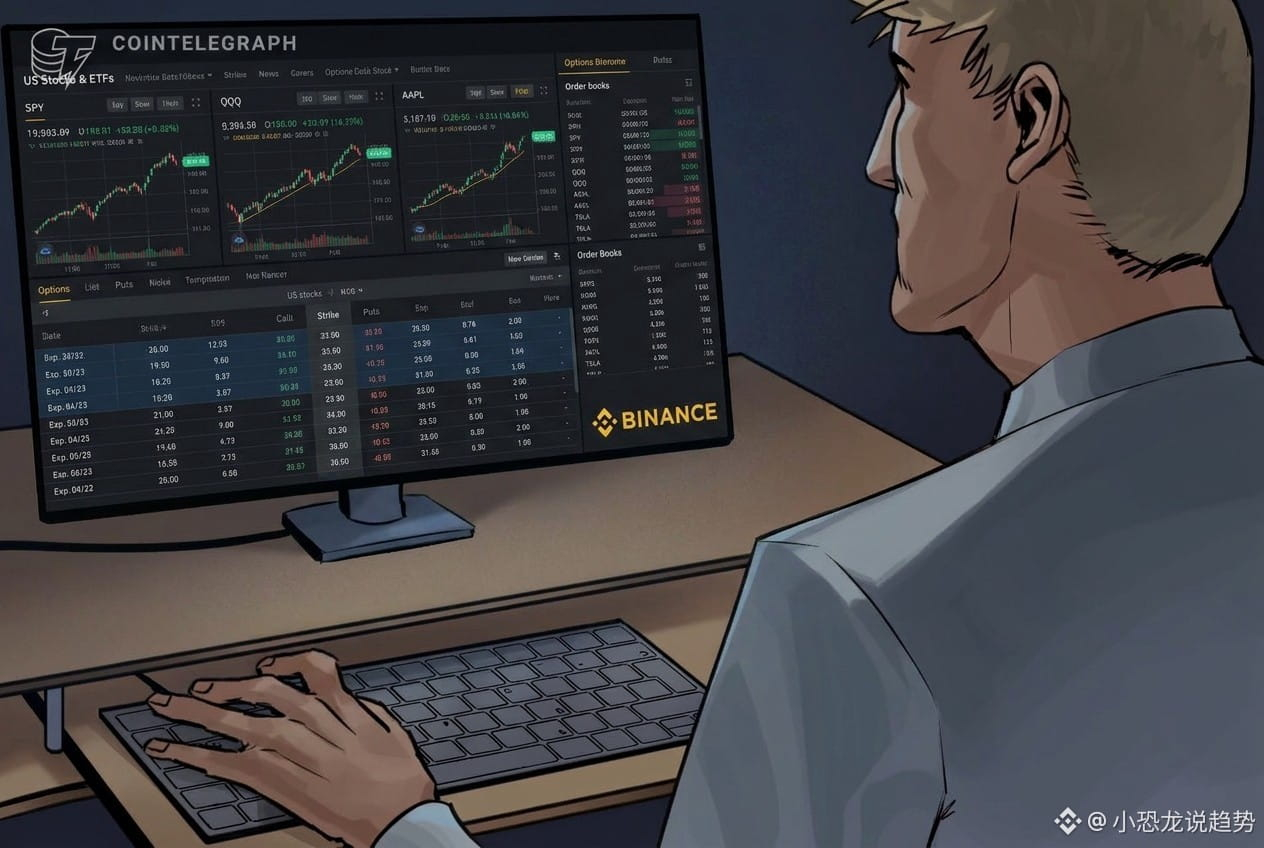
Binance is at it again. This time, it dives straight into U.S. stock options.
More than 1,000 option contracts on U.S. stocks and ETFs are now officially live, and users in non-U.S. regions can trade them too.
Orders route through a licensed broker in Abu Dhabi—Nest Trading. Clearing and custody are handled by Alpaca Securities, a U.S.-registered firm. Compliance setup is fully dialed in.
Unlike the contracts mentioned elsewhere, these options are physically settled. Exercising actually gives you the stocks, not some cash-settled, virtual gimmick.
Remember, Binance stock spot trading has already covered 7,000+ listings. With options now live, traditional finance’s puzzle gets another piece added.
Data says it best: in August, trading volume for TradFi perpetual contracts hit $43.3 billion—about 15 times that of January. You can literally see how fast the capital is moving in.
The tokenized stocks track is also surging. In one year, circulating market cap jumped from $34.6 million to $260 million. Monthly transfer volume rose 93%, the number of holders more than doubled (up 1.5x), reaching nearly 2.5 million.
Exchanges are all trying to squeeze into traditional finance. Whoever gets the pipeline connected first gets the profit.
For ordinary players, the barrier is genuinely lowering: you can now trade stocks, options, and crypto under one account.
But don’t rush in. Options are a double-edged sword. If you don’t understand the strike price or the expiration date, you’ll still lose—enough to make you question everything about your life.
Learn how premium and implied volatility work before you place a trade. Otherwise you’re basically paying tuition to the market.
Mainstream capital is flowing in. The wall between crypto and traditional finance is being dismantled.
What do you think the next thing exchanges will launch—futures, FX? Let’s chat in the comments.
Every day, I’ll keep you updated on exchange hot spots. Not just what’s happening in the news—more importantly, I’ll help you understand the logic and the opportunities behind it 👀🚀
Click the link below to follow me 👇🏻
👉 加入小恐龙粉丝群
#币安 #美股期权 #TradFi
Binance is at it again. This time, it dives straight into U.S. stock options.
More than 1,000 option contracts on U.S. stocks and ETFs are now officially live, and users in non-U.S. regions can trade them too.
Orders route through a licensed broker in Abu Dhabi—Nest Trading. Clearing and custody are handled by Alpaca Securities, a U.S.-registered firm. Compliance setup is fully dialed in.
Unlike the contracts mentioned elsewhere, these options are physically settled. Exercising actually gives you the stocks, not some cash-settled, virtual gimmick.
Remember, Binance stock spot trading has already covered 7,000+ listings. With options now live, traditional finance’s puzzle gets another piece added.
Data says it best: in August, trading volume for TradFi perpetual contracts hit $43.3 billion—about 15 times that of January. You can literally see how fast the capital is moving in.
The tokenized stocks track is also surging. In one year, circulating market cap jumped from $34.6 million to $260 million. Monthly transfer volume rose 93%, the number of holders more than doubled (up 1.5x), reaching nearly 2.5 million.
Exchanges are all trying to squeeze into traditional finance. Whoever gets the pipeline connected first gets the profit.
For ordinary players, the barrier is genuinely lowering: you can now trade stocks, options, and crypto under one account.
But don’t rush in. Options are a double-edged sword. If you don’t understand the strike price or the expiration date, you’ll still lose—enough to make you question everything about your life.
Learn how premium and implied volatility work before you place a trade. Otherwise you’re basically paying tuition to the market.
Mainstream capital is flowing in. The wall between crypto and traditional finance is being dismantled.
What do you think the next thing exchanges will launch—futures, FX? Let’s chat in the comments.
Every day, I’ll keep you updated on exchange hot spots. Not just what’s happening in the news—more importantly, I’ll help you understand the logic and the opportunities behind it 👀🚀
Click the link below to follow me 👇🏻
👉 加入小恐龙粉丝群
#币安 #美股期权 #TradFi
Robinhood’s chain earned $1.9 million in a day—single-day revenue hits a record, and it also pushed ARB up 30% along the way.
On-chain income breaks records, proving that trading and tokenized stocks are really hot. Turns out making money on-chain can be this profitable.
Funding can be this direct. When you see standout on-chain data, you immediately chase and buy related tokens. ARB goes up right along with it.
The most worth pondering here isn’t how much ARB rose, but that one trading platform’s on-chain revenue can outperform a bunch of other public chains.
When traditional platforms move onto the chain, the efficiency gap is obvious to the naked eye. Fees stay on-chain; the ecosystem can generate its own lifeblood. You don’t need to look at the big platforms’ faces.
The platform brings users onto the chain, and users leave the money on the chain. Once this flywheel starts turning, it has serious staying power.
Of course, hype comes fast and fades fast. There’s never a shortage of people chasing the highs, and there’s never a shortage of bag holders.
But don’t just look at the income numbers—look at whether revenue can be stable. Making $1.9 million in one day and making $1.9 million every day are two different things.
Besides enjoying the show, think about which chain can keep making money—that’s the real question.
Now, on-chain revenue data has become even more sensitive than the K-line chart—a barometer that everyone watches. All the capital is looking at it.
Have you ever chased a token driven by on-chain revenue? How did it turn out? Share your experience.
Click the avatar to watch the livestream.
Every day I’ll bring you to follow on-chain hot topics—not just what happens in the news, but also helping you understand the logic and opportunities behind it 👉🦖
#ARB #On-chain data
On-chain income breaks records, proving that trading and tokenized stocks are really hot. Turns out making money on-chain can be this profitable.
Funding can be this direct. When you see standout on-chain data, you immediately chase and buy related tokens. ARB goes up right along with it.
The most worth pondering here isn’t how much ARB rose, but that one trading platform’s on-chain revenue can outperform a bunch of other public chains.
When traditional platforms move onto the chain, the efficiency gap is obvious to the naked eye. Fees stay on-chain; the ecosystem can generate its own lifeblood. You don’t need to look at the big platforms’ faces.
The platform brings users onto the chain, and users leave the money on the chain. Once this flywheel starts turning, it has serious staying power.
Of course, hype comes fast and fades fast. There’s never a shortage of people chasing the highs, and there’s never a shortage of bag holders.
But don’t just look at the income numbers—look at whether revenue can be stable. Making $1.9 million in one day and making $1.9 million every day are two different things.
Besides enjoying the show, think about which chain can keep making money—that’s the real question.
Now, on-chain revenue data has become even more sensitive than the K-line chart—a barometer that everyone watches. All the capital is looking at it.
Have you ever chased a token driven by on-chain revenue? How did it turn out? Share your experience.
Click the avatar to watch the livestream.
Every day I’ll bring you to follow on-chain hot topics—not just what happens in the news, but also helping you understand the logic and opportunities behind it 👉🦖
#ARB #On-chain data
Verified
Goldman Sachs, Citi, UBS—21 Wall Street giants gather to team up and create a USD stablecoin, targeting a launch in the first half of 2027
How extraordinary is this lineup? Just pick any name—each one is at the very top of traditional finance’s pyramid. Now they’re all moving in to build stablecoins.
The new company will first issue a USD stablecoin, focusing on payments and digital-asset settlement. Euro tokens are also on the expansion shortlist.
In the past, stablecoins were something the crypto world played with on its own. Banks looked at them with disdain. Now they’re straight-up copying the playbook—and doing it with a straight face.
The key isn’t just which bank wants to test the waters, but that all 21 are doing it together. That’s like the entire Wall Street ecosystem stamping its approval: stablecoins are becoming legitimate payment infrastructure.
For retail users, don’t rush to shout “disruption.” First understand one thing: the track money rides on is shifting from traditional systems onto the blockchain—and faster than you’d expect.
A united front from the giants means compliance, custody, and settlement gaps will be filled quickly. The moat of established stablecoins is about to face a real challenger.
Banks entering the space also has a hidden motive: to seize back control of the payments conversation. If stablecoins are led by tech companies, banks will truly have to step aside.
Once a bank-backed stablecoin goes live, the fee structure and cross-border settlement landscape may need to be rewritten.
The most ironic part: the institutions that once said Bitcoin was a scam are now lining up to issue stablecoins. The “it’s good stuff” law applies on Wall Street too.
There’s another layer of meaning. Global regulation for stablecoins is being filled in everywhere. Wall Street’s move right now is about抢时间窗—seizing the time window. Place the first pieces on the board and you benefit first.
For the crypto community, an opponent of this caliber entering the arena is both pressure and endorsement. The compliance-bound ship has already set anchor—no one can stop it.
Do you think the stablecoin issued by banks can take back how much market share from established stablecoins? Let’s chat in the comments.
Click the avatar to watch the live stream.
Every day, I’ll take you to follow stablecoin hotspots—not just what’s happening in the news, but the logic and opportunities behind it 👉🦖
#稳定币 #Bitcoin
How extraordinary is this lineup? Just pick any name—each one is at the very top of traditional finance’s pyramid. Now they’re all moving in to build stablecoins.
The new company will first issue a USD stablecoin, focusing on payments and digital-asset settlement. Euro tokens are also on the expansion shortlist.
In the past, stablecoins were something the crypto world played with on its own. Banks looked at them with disdain. Now they’re straight-up copying the playbook—and doing it with a straight face.
The key isn’t just which bank wants to test the waters, but that all 21 are doing it together. That’s like the entire Wall Street ecosystem stamping its approval: stablecoins are becoming legitimate payment infrastructure.
For retail users, don’t rush to shout “disruption.” First understand one thing: the track money rides on is shifting from traditional systems onto the blockchain—and faster than you’d expect.
A united front from the giants means compliance, custody, and settlement gaps will be filled quickly. The moat of established stablecoins is about to face a real challenger.
Banks entering the space also has a hidden motive: to seize back control of the payments conversation. If stablecoins are led by tech companies, banks will truly have to step aside.
Once a bank-backed stablecoin goes live, the fee structure and cross-border settlement landscape may need to be rewritten.
The most ironic part: the institutions that once said Bitcoin was a scam are now lining up to issue stablecoins. The “it’s good stuff” law applies on Wall Street too.
There’s another layer of meaning. Global regulation for stablecoins is being filled in everywhere. Wall Street’s move right now is about抢时间窗—seizing the time window. Place the first pieces on the board and you benefit first.
For the crypto community, an opponent of this caliber entering the arena is both pressure and endorsement. The compliance-bound ship has already set anchor—no one can stop it.
Do you think the stablecoin issued by banks can take back how much market share from established stablecoins? Let’s chat in the comments.
Click the avatar to watch the live stream.
Every day, I’ll take you to follow stablecoin hotspots—not just what’s happening in the news, but the logic and opportunities behind it 👉🦖
#稳定币 #Bitcoin

Log in to explore more content