
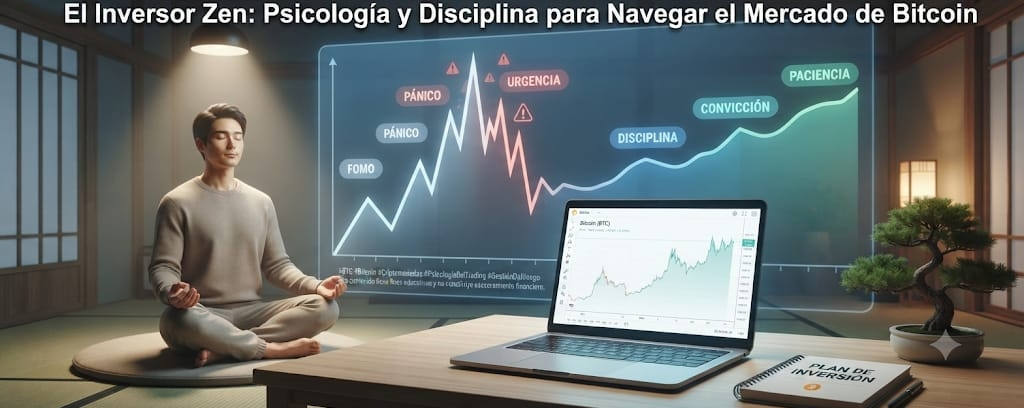

The cryptocurrency market, with #BTC as the main reference, is characterized by high volatility, accelerated cycles, and frequent changes in participants’ sentiment. In this environment, technical analysis, macroeconomic information, and understanding the technology are important; however, emotional management is often one of the most decisive factors in preserving capital and maintaining a coherent strategy.
Rapid rises can generate excitement and urgency. Sharp drops, on the other hand, can trigger fear, doubts, and impulsive decisions. That’s why developing a disciplined mindset isn’t about eliminating emotions, but about preventing them from directing every financial decision.
Important note: This content is for educational purposes and does not constitute financial advice. Digital assets can experience significant price variations, and there is a risk of loss.
1. The main challenge: your own behavior
When the value of a portfolio drops significantly, the challenge is not always in the chart, the news, or the activity of large market participants. Often, it lies in your personal reaction to uncertainty.
The human brain is prepared to respond quickly to threats and opportunities. In markets, that response can translate into rushed actions: buying out of fear of missing a run or selling to stop the discomfort of a decline.
Two biases are especially common:
FOMO: fear of missing out
Fear of Missing Out appears when an asset records a strong rise and the feeling arises that you need to act immediately. In the case of #BTC, fast-paced moves can attract attention, social media comments, and elevated expectations.
The risk is not in being interested in the asset, but in making a decision without a plan, without understanding the level of volatility, and without considering what would happen if the price changes direction shortly afterward.
Panic during corrections
Panic often shows up during sudden drops. A correction can make a temporary loss seem unbearable and lead to closing positions only to relieve emotional pressure.
Not all drops mean the same thing: they may result from taking profits, macroeconomic events, regulatory changes, lower liquidity, or a deeper shift in market sentiment. Acting without distinguishing the context can increase the risk of inconsistent decisions.
Practical principle: when a decision arises from urgency, euphoria, or fear, it’s best to pause and return to the initial plan before acting.
2. Discipline is more important than reacting quickly
Speed is not always an advantage. In a market that functions 24 hours a day, the feeling that you have to respond to every move can lead to overtrading, burnout, and increased exposure to risk beyond what was expected.
Discipline involves setting personal rules before emotional pressure appears. These rules can include:
Defining the objective of exposure: long-term investing, short-term trading, or diversification.
Determining how much financial and emotional risk you can take on.
Avoid using funds needed for essential expenses or upcoming commitments.
Document the reason for each trade and the conditions that would invalidate the original idea.
Review the strategy periodically, rather than changing it for every price candle.
Discipline does not guarantee positive results. Its value lies in improving consistency and reducing the likelihood that a specific emotion will determine a high-impact decision.
3. Separating conviction from attachment
Having a thesis about #BTC or any other asset should not turn into emotional attachment. Healthy conviction is based on information, a time horizon, risk tolerance, and a clear understanding of the factors that could change the outlook.
Attachment, on the other hand, appears when relevant signals are ignored because they contradict a prior position. It can show up as refusing to revisit assumptions, a need to “be right,” or the tendency to look only for information that confirms an existing opinion.
A more professional stance is to ask yourself:
What was my initial hypothesis?
What data supports it today?
What events could weaken it?
Does my exposure still align with my goals and my ability to absorb losses?
Updating a viewpoint is not a failure. It is part of responsible risk management.
4. The market does not reward impatience
Bitcoin and the crypto market can register major moves over very short timeframes. However, watching every price variation doesn’t necessarily provide clarity. In many cases, it increases anxiety and encourages reactive decisions.
A sustainable strategy requires distinguishing noise from signal. Not all news, viral posts, or intraday moves change the fundamentals of a long-term thesis. Likewise, not every fast rise confirms a lasting trend.
To reduce the influence of noise, it can help to:
Set specific times to review the market.
Limit exposure to content that fuels urgency or profit promises.
Log decisions and results to identify behavior patterns.
Maintain a time horizon consistent with the strategy you chose.
Accept that you don’t need to participate in every market move.
Patience does not mean passivity. It means acting according to a process, not impulses.
5. Risk management is also emotional management
Excessive exposure can turn a normal market fluctuation into an experience that’s hard to sustain. When a position is too large for your personal tolerance, even a moderate move can trigger impulsive decisions.
That’s why risk management is not limited to financial metrics. It also includes the ability to stay calm in adverse scenarios.
Before trading or increasing exposure, it’s worth assessing:
Could I absorb a significant loss without affecting my financial needs?
Do I understand the asset’s historical volatility and risks?
Am I acting based on a plan or reacting to the price?
What impact would this decision have on my emotional stability?
Do I have a clear reason to review or close the position if conditions change?
There is no universal formula for all profiles. Decisions depend on personal factors, such as goals, time horizon, experience, available liquidity, and risk tolerance.
6. Build a process before looking for results
The goal shouldn’t be to get every #BTC move right. Even the most experienced participants face unexpected scenarios. A more realistic approach is to build a process that allows you to make better-informed decisions over time.
That process can include independent research, diversification when it fits the goal, periodic risk evaluation, and clear limits to prevent impulsive decisions.
The quality of a decision shouldn’t be judged only by its immediate outcome. A trade may generate gains by chance, and a well-reasoned decision can still face an adverse result. What matters is whether the process was consistent, informed, and compatible with the risks taken.
Conclusion: calm, judgment, and consistency
The cryptocurrency market can test the patience of anyone. In particular, #BTC moves tend to intensify emotions and create a constant sense of urgency.
The zen investor approach isn’t about predicting the next market move or completely eliminating emotions. It’s about recognizing them, putting limits on their influence, and prioritizing a rational process.
Discipline, risk management, and the ability to review a thesis objectively do not eliminate uncertainty. But they can help you navigate it with greater clarity, responsibility, and consistency.
#BTC #Bitcoin #Criptomonedas #PsicologíaDelTrading #GestiónDeRiesgo $BTC

BTC
81,015.96
+4.15%