
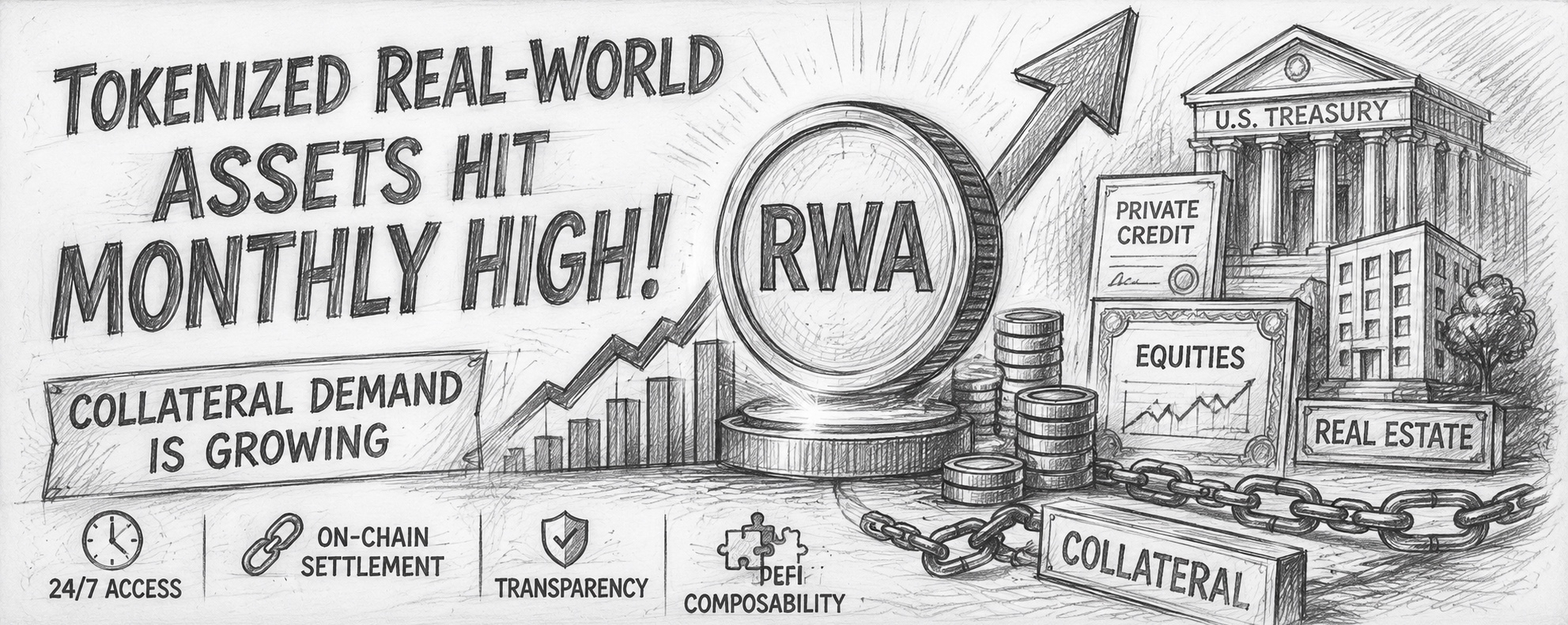


The tokenization of real-world assets (RWAs) is becoming one of the most important bridges between traditional finance and blockchain.
Recent DeFiLlama data shows the RWA market continuing to expand, with tokenized equities, funds, credit and other traditional assets gaining a larger on-chain footprint. DeFiLlama currently tracks more than $33.9 billion in total on-chain RWA market capitalization, with more than 200 asset issuers represented.
But the bigger story isn’t simply putting traditional assets on a blockchain.
The real opportunity is what those assets can do once they are on-chain.
Collateral Could Be the Key
Tokenized assets become significantly more useful when they can be used as collateral.
In traditional finance, collateral supports lending, borrowing, derivatives, margin trading and structured products. Bringing similar functionality on-chain could create a much deeper connection between traditional capital and DeFi.
Imagine holding a tokenized Treasury, private-credit position or equity exposure and being able to use that asset to borrow capital without selling it.
That creates a new layer of capital efficiency.
Research into RWA collateral shows that tokenized Treasuries, commodities, private credit, equities and real estate are increasingly being considered for lending, margin, reserves and yield strategies.
Equities Are Becoming a Major Part of the Story
Tokenized stocks and equity products have expanded rapidly.
DeFiLlama’s current equities dashboard tracks billions of dollars across tokenized public equities, equity indices and private-equity products.
This is important because equities were traditionally confined to centralized financial infrastructure.
On-chain representations can potentially introduce:
24/7 accessibility
Faster settlement
Programmable ownership
DeFi composability
New collateral opportunities
Global distribution, where regulations allow
The result is a financial asset that can potentially interact with blockchain-based markets rather than simply sitting inside a traditional brokerage account.
RWA Growth Needs Context
A rising RWA number is certainly encouraging, but investors should look beyond a single headline figure.
Different dashboards measure different things — including on-chain market capitalization, active market capitalization, DeFi TVL, collateral value and net flows.
These measurements do not represent exactly the same type of activity.
For example, DeFiLlama currently reports roughly $30.9 billion in active RWA market capitalization versus $33.9 billion in total on-chain RWA market capitalization.
That distinction matters.
Growth can come from new issuance, asset-price movements, additional products, new issuers or broader dashboard coverage. It doesn’t automatically mean that the same amount of capital is actively being used in DeFi.
The Biggest Opportunity: Composability
The most powerful part of tokenization may ultimately be composability.
A traditional financial asset normally exists within a relatively closed system.
A tokenized asset can potentially become part of an interconnected on-chain financial ecosystem.
For example:
Tokenized Treasury → collateral → borrowing → DeFi strategy → liquidity
That creates possibilities that are difficult to achieve through traditional financial infrastructure.
DeFiLlama’s research has highlighted how RWA tokenization has moved from a niche narrative toward a measurable financial-market segment, while also noting that legal structures, custody, liquidity and regulation remain important limitations.
The Friction Is Still Real
Tokenization doesn’t magically eliminate the problems associated with traditional assets.
Real-world assets still requireA
Legal ownership structures
Custody
Compliance
Investor eligibility
Reliable pricing
Redemption mechanisms
Liquidity
Regulatory clarity
This is why RWA adoption may develop differently from purely crypto-native assets.
The blockchain can provide the settlement and programmability layer, but the underlying asset still exists within the real world.
Why This Matters for Crypto
RWA growth could represent something bigger than another crypto narrative.
It could bring traditional financial assets directly into blockchain-based markets.
Treasuries, credit, equities, funds and commodities can potentially become programmable financial building blocks.
And when those assets can also serve as collateral, their utility increases dramatically.
Tokenization isn’t just about putting assets on-chain.
It’s about making traditionally isolated financial assets programmable, transferable and potentially usable across a new financial infrastructure. #btc #Binance #BinanceSquare #btc #crypto #jeevajvan