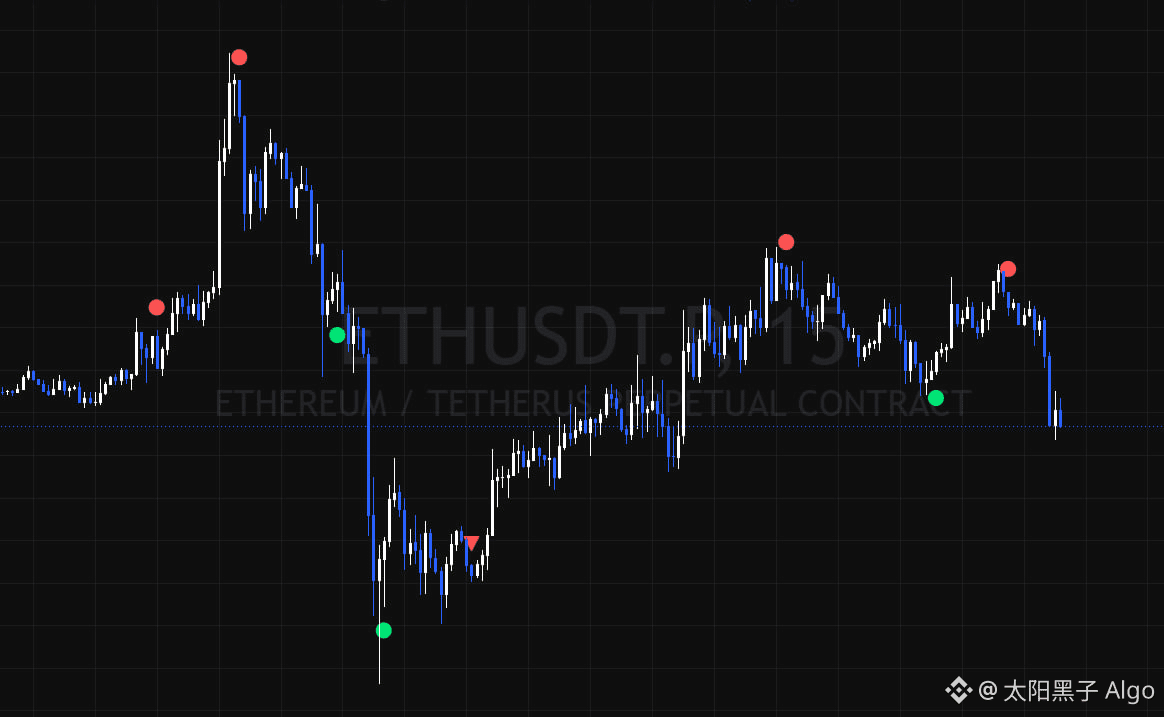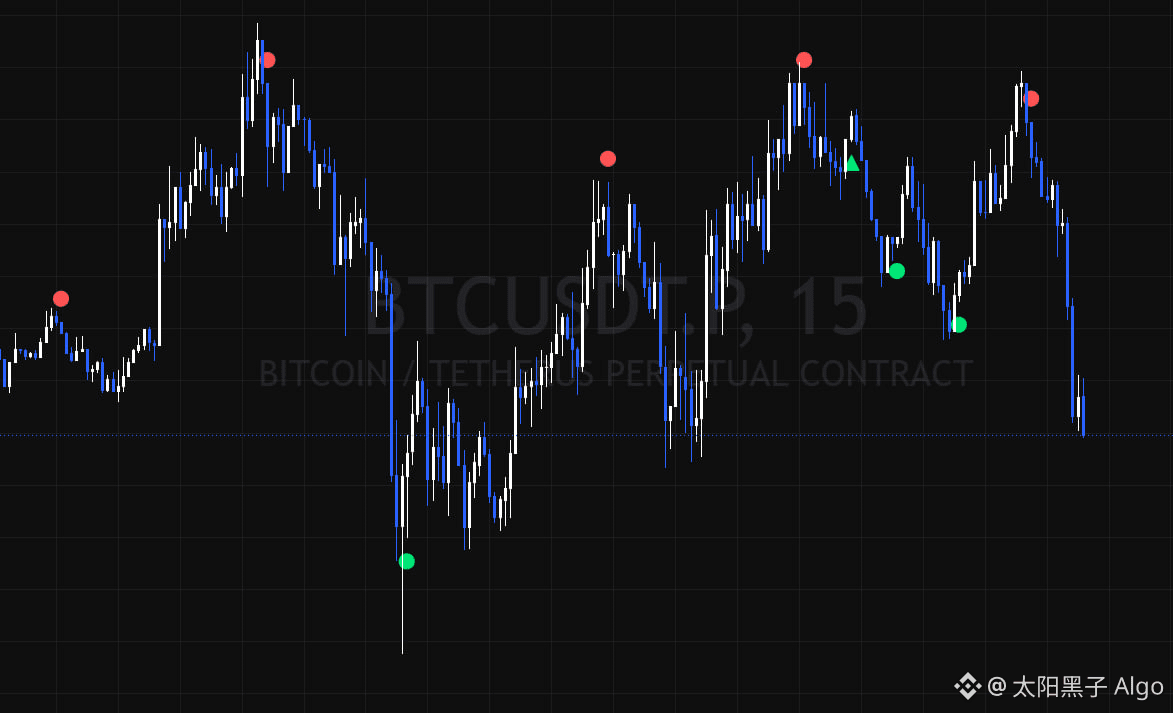
The chart above shows the BTC/ETH trading signals from the most recent 15-minute timeframe.
Let me share something: based on the chart above and the many charts in the channel, my signals will definitely appear near a certain extreme point (commonly known as bottom-picking or top-touching from the right side). So your stop-loss only needs to be placed at the nearest previous high/low relative to the signal candlestick—don’t fully follow the entry price recommendations from the group.
For example, suppose you want to open a long position on ETH, and the previous low is 2400. Then set your stop-loss at 2395–2398.
If you want to open a short position on ETH, and the previous high is 2400, then set your stop-loss at 2402–2405.
That’s basically it. Don’t widen your stop-loss out of fear—use the position sizing algorithm based on risk and loss (risk-based position sizing).
Risk-based position sizing algorithm: suppose you want to open an ETH short position.
1. First, confirm your per-trade risk (R), meaning how much you plan to lose on this trade—using 100U as an example.
2. Then confirm the entry price and stop-loss price—for instance, entry price is 2390, stop-loss price is 2400.
3. Calculate the stop-loss distance = the absolute value of (entry price − stop-loss price). That is 2390 − 2400 = -10, and the absolute value is 10.
4. Calculate the position size: position size = per-trade risk / stop-loss distance. So this trade is 100/10 = 10 (ETH).
5. Set the order type to a limit order, place an order at entry price 2390, enter the position size of 10 ETH, set the stop-loss at 2400, and the interface will show the expected loss for this order as 100U—then submit the order.
After that, do expectation management: assume that if you can’t get filled for N candlesticks, you cancel the order. I usually cancel after 9 candlesticks without fill. Using the 15-minute signal as an example, that’s 135 minutes. For any timeframe, you can apply the same cancel-order management logic.
Next is position management: assume this trade successfully enters. Based on the risk-reward plan, when you reach a certain floating profit target, you should move the stop to breakeven and reduce the position. I typically move to breakeven at +0.7R (70U) and cut the position in half at +1.5R (150U).
Finally: nobody can predict whether the next candlestick will go up or down. Whether you can profit in the long run depends on whether you can consistently and stably execute a trading system with positive expected value over the long term.
Let me share something: based on the chart above and the many charts in the channel, my signals will definitely appear near a certain extreme point (commonly known as bottom-picking or top-touching from the right side). So your stop-loss only needs to be placed at the nearest previous high/low relative to the signal candlestick—don’t fully follow the entry price recommendations from the group.
For example, suppose you want to open a long position on ETH, and the previous low is 2400. Then set your stop-loss at 2395–2398.
If you want to open a short position on ETH, and the previous high is 2400, then set your stop-loss at 2402–2405.
That’s basically it. Don’t widen your stop-loss out of fear—use the position sizing algorithm based on risk and loss (risk-based position sizing).
Risk-based position sizing algorithm: suppose you want to open an ETH short position.
1. First, confirm your per-trade risk (R), meaning how much you plan to lose on this trade—using 100U as an example.
2. Then confirm the entry price and stop-loss price—for instance, entry price is 2390, stop-loss price is 2400.
3. Calculate the stop-loss distance = the absolute value of (entry price − stop-loss price). That is 2390 − 2400 = -10, and the absolute value is 10.
4. Calculate the position size: position size = per-trade risk / stop-loss distance. So this trade is 100/10 = 10 (ETH).
5. Set the order type to a limit order, place an order at entry price 2390, enter the position size of 10 ETH, set the stop-loss at 2400, and the interface will show the expected loss for this order as 100U—then submit the order.
After that, do expectation management: assume that if you can’t get filled for N candlesticks, you cancel the order. I usually cancel after 9 candlesticks without fill. Using the 15-minute signal as an example, that’s 135 minutes. For any timeframe, you can apply the same cancel-order management logic.
Next is position management: assume this trade successfully enters. Based on the risk-reward plan, when you reach a certain floating profit target, you should move the stop to breakeven and reduce the position. I typically move to breakeven at +0.7R (70U) and cut the position in half at +1.5R (150U).
Finally: nobody can predict whether the next candlestick will go up or down. Whether you can profit in the long run depends on whether you can consistently and stably execute a trading system with positive expected value over the long term.