



📺 CRYPTO DAILY | EPISODE #24
🟣 POLKADOT — THE ETHEREUM CO-FOUNDER WHO DECIDED TO BUILD AN INTERNET OF BLOCKCHAINS
Gavin Wood helped build Ethereum, created the Solidity language, and wrote much of the technical foundation that made smart contracts a reality. Then he left — and decided to tackle an even bigger problem: why did every blockchain need to live like an island?
The answer became the @Polkadot Network : a network created not to be “just another blockchain,” but to connect several of them under a shared layer of security. Almost a decade later, the technology is still evolving — but the price of DOT tells a much harsher story.
👨💻 GAVIN WOOD — FROM ETHEREUM TO THE WEB3 VISION
Wood was a cofounder and CTO of Ethereum, the primary author of the Ethereum Yellow Paper, and one of the key figures in the development of the Ethereum Virtual Machine and Solidity.
After leaving the project, he founded Parity Technologies and published the Polkadot whitepaper in 2016.
The thesis was ambitious: Bitcoin proved money could be decentralized. Ethereum showed programs could too. The next step would be to allow different blockchains to communicate and share security.
In 2017, the Web3 Foundation was created in Switzerland to support this vision.
💰 2017 — $144 MILLION AND A BIG PROBLEM
The first DOT sale raised about $144 million, one of the largest ICOs of that year.
Soon after came a cruel irony: a bug in Parity’s multisig wallets froze more than $150 million in ETH from various users and projects. Part of the funds tied to the Polkadot ecosystem were stuck.
The project survived and kept being developed, but the episode quickly showed an uncomfortable truth about the industry:
code can be financial infrastructure — and a coding error can work like a vault door that never opens again.
⚙️ HOW POLKADOT WORKS
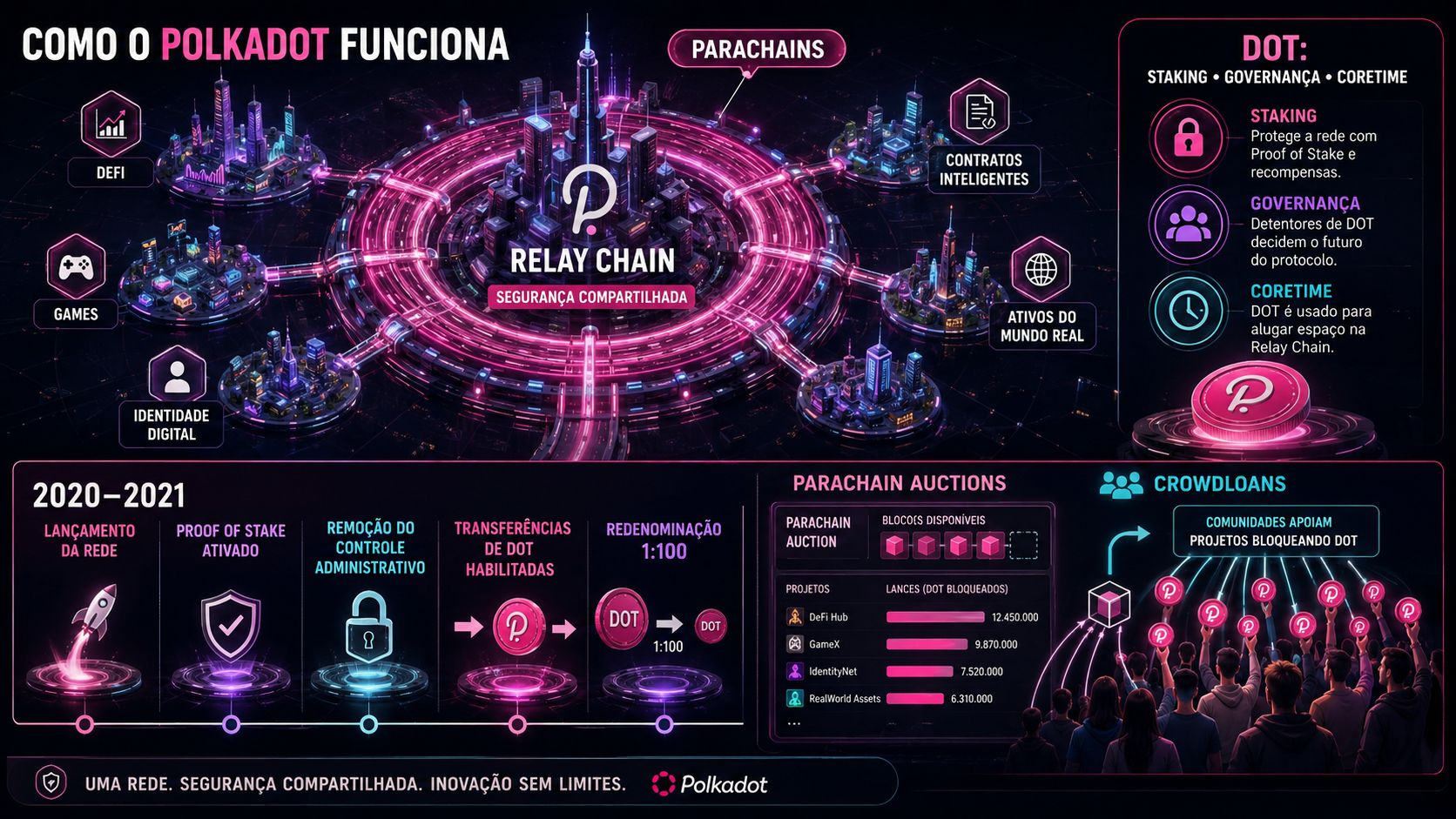
The simplest way to picture Polkadot is to think of it as a shared highway across multiple cities.
The Relay Chain works as the core infrastructure: it provides consensus and security.
The old parachains are specialized blockchains connected to this infrastructure. One can focus on DeFi, another on games, identity, smart contracts, or real-world assets.
Instead of each project building from scratch its own validator and security network, it can use Polkadot’s shared resources.
The DOT enters this economy as a token for staking, governance, and coretime acquisition.
🚀 2020–2021 — THE FINAL NETWORK FINALLY COMES ALIVE
Polkadot launched its network in 2020. In June that year, it moved to Proof of Stake and, in July, removed the initial administrative control, handing governance to the participants.
DOT transfers were enabled in August.
A few days later, a curious change happened: the redenomination of DOT, turning each old DOT into 100 new DOT. The proportional value of positions did not change; only the unit was changed.
In 2021 came the long-awaited parachain auctions, putting into practice one of the core ideas of the whitepaper.
Projects competed for space on the network, and communities locked DOT in crowdloans to back their favorites.
It was the height of the narrative of “internet of blockchains”.
📈 NOVEMBER 2021 — DOT REACHES $55
The enthusiasm took DOT to its all-time high of approximately $55 on November 4, 2021.
The market bet that Polkadot could become a fundamental layer for interoperability between networks.
But the model also revealed a problem: entering as a parachain was complex, expensive, and depended on auctions and leasing periods.
In a sector that was starting to value more flexible infrastructure, this rigidity started to weigh heavily.
📉 2022–2024 — WHEN THE NARRATIVE LOSES MOMENTUM
The crypto winter crushed almost the entire market, but Polkadot also suffered from a shift in attention.
Ethereum gained momentum with its Layer 2s. Solana returned to the center of speculation. New networks arrived promising a simpler experience.
Meanwhile, “parachain auctions” stopped looking revolutionary and started looking bureaucratic.
Polkadot itself decided to change.
In September 2024, the traditional auctions were shut down and replaced by Agile Coretime.
The logic became more like cloud computing: instead of renting a fixed space for long periods, projects can buy processing capacity in blocks or even on demand — basically a “pay for what you use” model for the blockchain.
🧠 JAM — GAVIN WOOD WANTS TO REBUILD POLKADOT AGAIN
In 2024, Gavin Wood presented JAM — Join-Accumulate Machine.
It’s not just an aesthetic update.
JAM proposes to deeply transform the Relay Chain into a more generic computational infrastructure, capable of executing permissionless services using coretime.
The idea mixes concepts that Wood helped develop in both Ethereum and Polkadot.
If approved by governance, JAM could become the next major architectural evolution of the network. DOT would remain the native token.
It’s almost as if, after building a highway for blockchains, Wood now wanted to turn the whole highway into a decentralized operating system.
🏦 2025–2026 — WALL STREET LOOKS AT DOT, BUT WITHOUT CONSENSUS
Institutional interest also showed up.
DOT-related ETF requests were filed in the United States. A 21Shares Polkadot ETF had its S-1 registration declared effective in March 2026.
At the same time, other initiatives didn’t move forward: in August 2026, Grayscale formally withdrew the filing for its Polkadot Trust ETF.
In other words: there is institutional interest, but still far from linear adoption.
📉 THE PROBLEM THE CHART DOESN’T HIDE
Despite all this engineering, in August 2026 DOT reached a new all-time low near $0.73.
In early September, it trades around the $0.80–0.90 area.
Compared to the $55 ATH, that means a drop of more than 98%.
One of the biggest differences between technical reputation and price performance among major projects in the market.
And here’s the central dilemma of Polkadot:
an architecture can be brilliant and still have the token not capture the same enthusiasm.
🌐 THE POLKADOT ECOSYSTEM
🔵 Polkadot SDK/Substrate — the framework used to build custom blockchains.
⏱️ Agile Coretime — replaced the rigid auctions system with flexible purchases of computational capacity.
🧪 Kusama — an experimental network where several ecosystem technologies were tested before Polkadot.
🧠 JAM — a proposal for a radical evolution of the core architecture.
🪙 DOT — used for staking, governance, and buying coretime.
🤔 IS IT WORTH INVESTING IN DOT? THE HONEST TAKE
Pros: Gavin Wood is one of the most important engineers in the history of the industry; Polkadot has real interoperability and shared security technology; Agile Coretime addressed one of the biggest criticisms of the parachain model; JAM shows the project is still willing to redesign its own architecture instead of protecting old decisions.
Attention: DOT is down more than 98% from the ATH; Polkadot has lost enormous narrative share to Ethereum L2s, Solana, and new Layer 1s; complex technology can make adoption harder; constant architectural changes also create execution risk; institutional interest is still inconsistent.
Honest conclusion: Polkadot might be one of the biggest examples that technical excellence doesn’t guarantee value appreciation. The project keeps building sophisticated infrastructure and doesn’t seem technologically abandoned — but now it needs to prove something harder than engineering capability:
that someone really needs to use all of this at a sufficient scale to bring economic relevance back to DOT.
This is not financial advice. DYOR.
🎯 TIMELINE
2016 → Gavin Wood publishes the Polkadot whitepaper
2017 → ICO raises ~ $144 million
2020 → Mainnet, Proof of Stake, and decentralized governance
Aug 2020 → Redenomination: 1 old DOT = 100 new DOT
2021 → Parachain auctions go live
Nov 4, 2021 → ATH: ~ $55
2022–2023 → Bear market and loss of narrative momentum
Sep 2024 → Auctions are replaced by Agile Coretime
2024 → Gavin Wood presents JAM
Mar 2026 → The 21Shares Polkadot ETF registration becomes effective
Aug 2026 → Grayscale withdraws its ETF filing; DOT hits a low near $0.73
Sep 2026 → DOT trades around $0.80–0.90
🔚 CLOSING
Gavin Wood helped create Ethereum because he believed blockchain could do more than move money. Then he created Polkadot because he believed no blockchain should need to run alone.
Now, with JAM, it’s basically trying to reinvent the project once again.
The question is simple:
Polkadot has been years ahead of the market — or did it spend so long building the future that the market decided to take a different path?
#Polkadot #dot #JAM #DocumentarioIndependente #BinanceSquare

🤝 SUPPORT CRYPTO DAILY
If you found this content valuable, like, comment, share, or repost. Every interaction helps this documentary keep growing.
Exclusively educational and informative content. This is not investment advice.
Sources consulted: Polkadot Wiki, Polkadot Whitepaper, Web3 Foundation, Parity Technologies, SEC/EDGAR, CoinMarketCap, CoinDesk.
Crypto Daily | Episode #24 of many.
A documentary about the money of the future — told today.