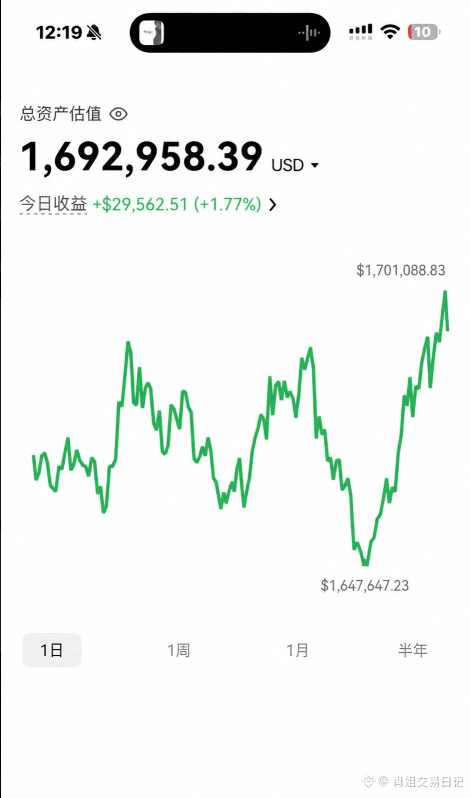
A few little trading facts about the crypto market—most people don’t know them, but anyone who’s truly fallen into a trap understands.
First, averaging down isn’t “buy more the more it drops.”
What’s truly hard about averaging down isn’t the math—it’s the mindset. The more you average down, the heavier your position becomes. If it keeps falling, the so-called “lowering your cost basis” can quickly turn into “amplifying your losses.” Averaging down is possible, but you must set a limit.
Second, small profits rolling can be terrifying.
If you have 100k U and make 1% a day, compounding over 250 trading days, the theory says you could grow to around 1.3 million U. But in reality, when people earn 1%, they still want to earn 5%—yet when they lose 1%, they stubbornly hold on. The hardest part of compounding isn’t calculating—it’s execution.
Third, you can make money even with a low win rate.
With a 60% win rate, as long as the payoff ratio is reasonable, you can still make money in the long run. What really causes people to lose money is often not the win rate—it’s taking small wins and letting losses grow, or failing to cut losses when you should.
Fourth, the higher the leverage, the easier emotions get out of control.
At 100x or 125x, what’s magnified isn’t just returns, but volatility and liquidation risk too. Leverage is just a tool—the core is position sizing and risk control.
In the end, trading isn’t about who finds more opportunities—it’s about who can control position size, control their hands, and stay in the game long enough.
There will always be new market cycles. If your principal is gone, the next wave won’t matter to you. #以太坊ETF连续11日净流入
First, averaging down isn’t “buy more the more it drops.”
What’s truly hard about averaging down isn’t the math—it’s the mindset. The more you average down, the heavier your position becomes. If it keeps falling, the so-called “lowering your cost basis” can quickly turn into “amplifying your losses.” Averaging down is possible, but you must set a limit.
Second, small profits rolling can be terrifying.
If you have 100k U and make 1% a day, compounding over 250 trading days, the theory says you could grow to around 1.3 million U. But in reality, when people earn 1%, they still want to earn 5%—yet when they lose 1%, they stubbornly hold on. The hardest part of compounding isn’t calculating—it’s execution.
Third, you can make money even with a low win rate.
With a 60% win rate, as long as the payoff ratio is reasonable, you can still make money in the long run. What really causes people to lose money is often not the win rate—it’s taking small wins and letting losses grow, or failing to cut losses when you should.
Fourth, the higher the leverage, the easier emotions get out of control.
At 100x or 125x, what’s magnified isn’t just returns, but volatility and liquidation risk too. Leverage is just a tool—the core is position sizing and risk control.
In the end, trading isn’t about who finds more opportunities—it’s about who can control position size, control their hands, and stay in the game long enough.
There will always be new market cycles. If your principal is gone, the next wave won’t matter to you. #以太坊ETF连续11日净流入