

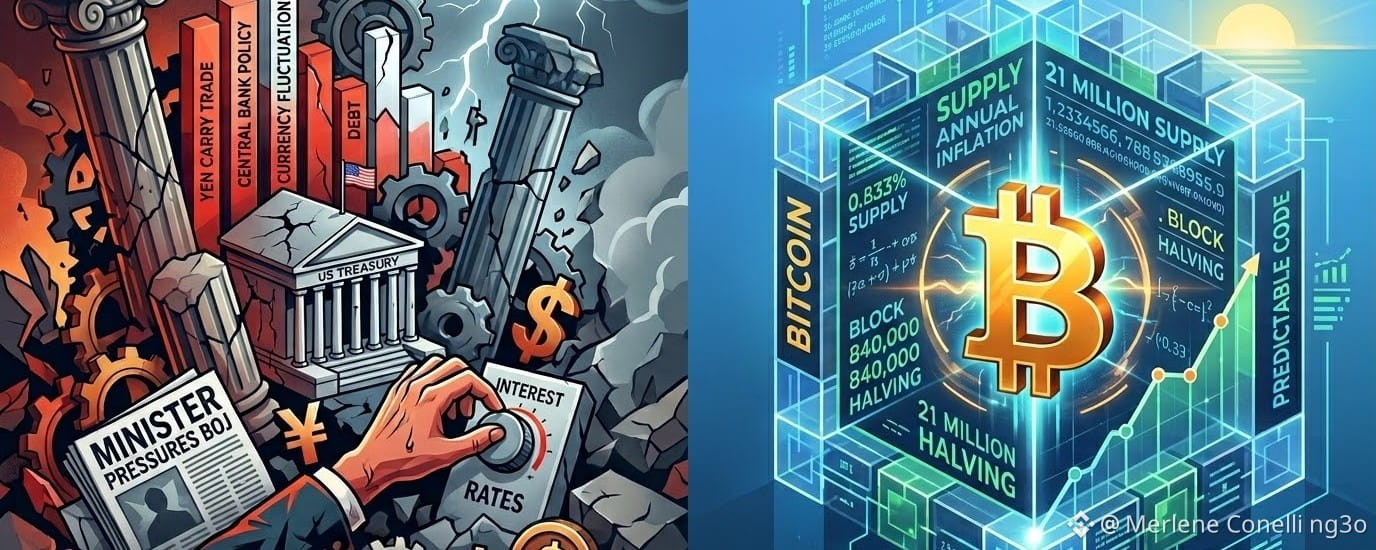

Markets don’t tolerate uncertainty, but traditional finance is generating it from all directions right now—even through institutions that set the rules themselves.
According to a report by NHK, U.S. Treasury Secretary Scott Bessent urged Japan to speed up its interest-rate hikes in order to stop the yen’s depreciation. He is a policymaker from the world’s largest economy who openly influences another country’s monetary policy.
⚙️ Code logic versus “manual control”
Compare this political pressure with Bitcoin’s monetary model ($BTC ):
Mathematical certainty: BTC issuance is strictly limited to 21 million coins.
Algorithmic schedule: After the 4th halving (April 2024), the BTC network’s inflation is only ~0.83% per year (a total of 3.125 BTC is mined per block) and does not depend on government decisions or G20 summits.
However, algorithmic predictability of supply is not the same as immunity to global liquidity.
📊 Numbers and mechanics: Why the market fears a repeat of August 2024?
The main bridge between TradFi and crypto right now is the Yen Carry Trade (borrowing cheap yen to buy higher-yielding assets).
1. Pressure on the Bank of Japan (BOJ): Amid calls from the US, the market is pricing in a nearly 90% chance of a BOJ rate hike at the September meeting. The yield on 10-year Japanese government bonds (JGBs) has already reached a psychological 3.0% — the highest level in decades.
2. Deleveraging and a cascade: For years, hundreds of billions of dollars were funneled in at nearly 0% in yen and flowed into BTC, stocks, and bonds. Higher rates in Japan force investors to urgently close these positions by buying back the yen.
3. Margin calls and BTC: During a liquidity squeeze, institutional players lock in profits or sell the most liquid, round-the-clock assets (primarily Bitcoin) to meet margin requirements in other sectors.
💡 Historical precedent: In August 2024, even a BOJ rate hike of just 15 bps caused BTC to drop by >20% within a few days due to a panic unwinding of the carry trade.
📌 ConclusionBitcoin’s long-term bullish thesis is unshakable: its scarcity is built in. However, in the short term, BTC is still traded like a high-beta (high-volatility) risk asset, sensitive to shocks in the redistribution of global liquidity.
Be on alert, watch central bank meetings, and stick to risk management! ⚠️
💬 What do you think: will BTC be able to hold the current levels if the BOJ really raises rates this month? Share your thoughts in the comments! 👇
#BTC #TradFi #MacroEconomy #BinanceSquare #Bitcoin