INSTITUTIONAL REPRICING IS NOT A PUMP: THIS IS HOW PRICE ADJUSTMENTS WILL WORK BASED ON REAL UTILITY
Once the regulatory framework is finalized and Wall Street capital takes control, the repricing of infrastructure tokens will not respond to retail speculation, but to liquidity mechanics and supply absorption.
1. The Depth Paradox (Avoiding Slippage)
For a bank or the DTCC to liquidate billions of dollars within seconds using a bridge token, that asset must have a high unit price by design. A low price with thin order books would cause destructive slippage. To move real volume, liquidity requires revaluation.
2. Supply Absorption (Supply Lock)
As RWA tokenization and corporate nodes freeze tokens as collateral, the liquid supply on exchanges drops dramatically. Any institutional order flips the supply-and-demand curve.
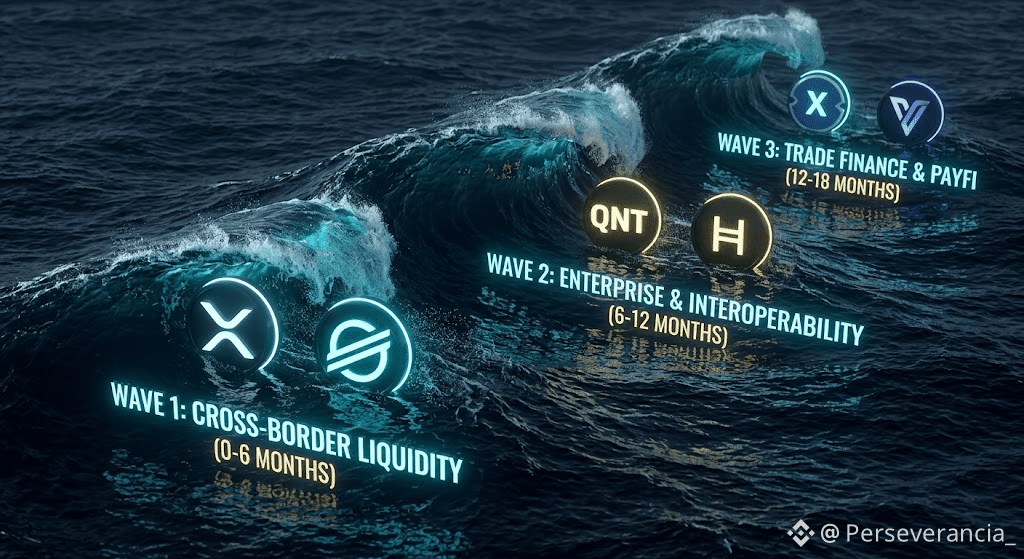
THE 3 WAVES OF ADOPTION AND THEIR TIMELINES
Wave 1: Fast Track (0 to 6 months) | $XRP and $XLM
Cross-border payment giants. With proven infrastructure and ETFs already in motion, removing accounting bottlenecks will immediately free banks for large-scale settlement use. They are the first to absorb the monetary mass.
Wave 2: Enterprise Integration (6 to 12 months) | #QNT and $HBAR
QNT connects public and private networks through Overledger. With a maximum supply of only 14.6M tokens, its mathematical scarcity creates a violent percentage impact in the face of license demand. HBAR scales alongside global corporate governance.
Wave 3: Foreign Trade and PayFi (12 to 18 months) | #XDC and #VELO
XDC leads the digitization of foreign trade backed by the MLETR standard (digital promissory notes and letters of credit). VELO strengthens liquidity for regional payments in emerging markets.
Reflection: XRP and XLM will move most of the global institutional capital. However, QNT’s supply scarcity or XDC’s commercial focus will deliver the most aggressive percentage multipliers.
Once the regulatory framework is finalized and Wall Street capital takes control, the repricing of infrastructure tokens will not respond to retail speculation, but to liquidity mechanics and supply absorption.
1. The Depth Paradox (Avoiding Slippage)
For a bank or the DTCC to liquidate billions of dollars within seconds using a bridge token, that asset must have a high unit price by design. A low price with thin order books would cause destructive slippage. To move real volume, liquidity requires revaluation.
2. Supply Absorption (Supply Lock)
As RWA tokenization and corporate nodes freeze tokens as collateral, the liquid supply on exchanges drops dramatically. Any institutional order flips the supply-and-demand curve.
THE 3 WAVES OF ADOPTION AND THEIR TIMELINES
Wave 1: Fast Track (0 to 6 months) | $XRP and $XLM
Cross-border payment giants. With proven infrastructure and ETFs already in motion, removing accounting bottlenecks will immediately free banks for large-scale settlement use. They are the first to absorb the monetary mass.
Wave 2: Enterprise Integration (6 to 12 months) | #QNT and $HBAR
QNT connects public and private networks through Overledger. With a maximum supply of only 14.6M tokens, its mathematical scarcity creates a violent percentage impact in the face of license demand. HBAR scales alongside global corporate governance.
Wave 3: Foreign Trade and PayFi (12 to 18 months) | #XDC and #VELO
XDC leads the digitization of foreign trade backed by the MLETR standard (digital promissory notes and letters of credit). VELO strengthens liquidity for regional payments in emerging markets.
Reflection: XRP and XLM will move most of the global institutional capital. However, QNT’s supply scarcity or XDC’s commercial focus will deliver the most aggressive percentage multipliers.