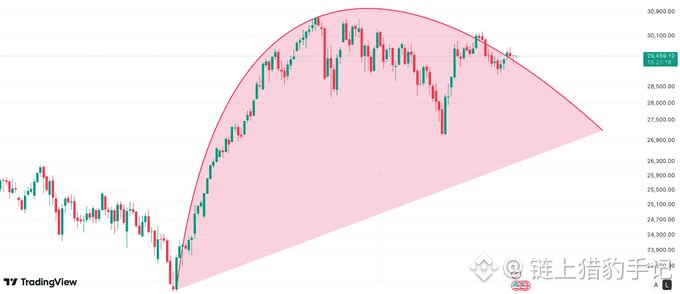
The Nasdaq is currently oscillating around the 30,000 mark. What we truly need to be wary of is several pushes toward 30,000 that fail to attract any obvious incremental inflows.
Judging from the price action, the recent highs keep moving lower, and the price is again being suppressed by the descending trendline from the arc top.
The arc top hasn’t been fully confirmed yet, but the market has already shifted from a one-way uptrend into high-level rotation. September is very likely to determine the next medium-term direction.
The September FOMC decision isn’t about rate cuts—it’s about whether to raise rates or keep them unchanged.
After Waller’s remarks skewed hawkish, expectations for rate hikes have clearly heated up.
If the employment data comes in strong, Treasury yields and the US dollar could keep rising, putting further pressure on technology stock valuations.
If employment cools moderately and inflation declines in tandem, with the Fed holding steady, the market would only then have room to repair. But if employment suddenly deteriorates, rate tailwinds may not be able to sustain the stock market—capital may instead shift to trading a downturn.
The external environment is also not easy.
The US-Iran conflict keeps flaring up, oil prices have moved back to a higher range, and cooling inflation will be even harder. The Fed’s room to turn more dovish will also be limited.
So in September, my baseline view for the Nasdaq is that it will trade sideways but weak.
The 29,700 to 30,100 range is the main pressure zone. If it cannot reclaim the level with volume, then any rebound there is more suitable for cutting positions rather than chasing.
If it breaks below 29,000, first watch 28,500. If the daily chart closes while volume expands and 28,500 is lost, the arc top would be considered further confirmed. On the downside, look at around 28,000 and 27,200. On the other hand, only if it regains and holds above 30,100 will the top-side risk ease, giving the index a chance again to challenge 30,900.
In September, the priority is defense. But you don’t need to bet on a crash in advance. Whether the pattern at the top matters is less important—when the rebound lacks volume and support is broken, that’s the true signal to turn bearish.
#XRP两周上涨40%未平仓合约下降 #恒生指数跌1% #美股收跌亚马逊遭FTC起诉
Judging from the price action, the recent highs keep moving lower, and the price is again being suppressed by the descending trendline from the arc top.
The arc top hasn’t been fully confirmed yet, but the market has already shifted from a one-way uptrend into high-level rotation. September is very likely to determine the next medium-term direction.
The September FOMC decision isn’t about rate cuts—it’s about whether to raise rates or keep them unchanged.
After Waller’s remarks skewed hawkish, expectations for rate hikes have clearly heated up.
If the employment data comes in strong, Treasury yields and the US dollar could keep rising, putting further pressure on technology stock valuations.
If employment cools moderately and inflation declines in tandem, with the Fed holding steady, the market would only then have room to repair. But if employment suddenly deteriorates, rate tailwinds may not be able to sustain the stock market—capital may instead shift to trading a downturn.
The external environment is also not easy.
The US-Iran conflict keeps flaring up, oil prices have moved back to a higher range, and cooling inflation will be even harder. The Fed’s room to turn more dovish will also be limited.
So in September, my baseline view for the Nasdaq is that it will trade sideways but weak.
The 29,700 to 30,100 range is the main pressure zone. If it cannot reclaim the level with volume, then any rebound there is more suitable for cutting positions rather than chasing.
If it breaks below 29,000, first watch 28,500. If the daily chart closes while volume expands and 28,500 is lost, the arc top would be considered further confirmed. On the downside, look at around 28,000 and 27,200. On the other hand, only if it regains and holds above 30,100 will the top-side risk ease, giving the index a chance again to challenge 30,900.
In September, the priority is defense. But you don’t need to bet on a crash in advance. Whether the pattern at the top matters is less important—when the rebound lacks volume and support is broken, that’s the true signal to turn bearish.
#XRP两周上涨40%未平仓合约下降 #恒生指数跌1% #美股收跌亚马逊遭FTC起诉