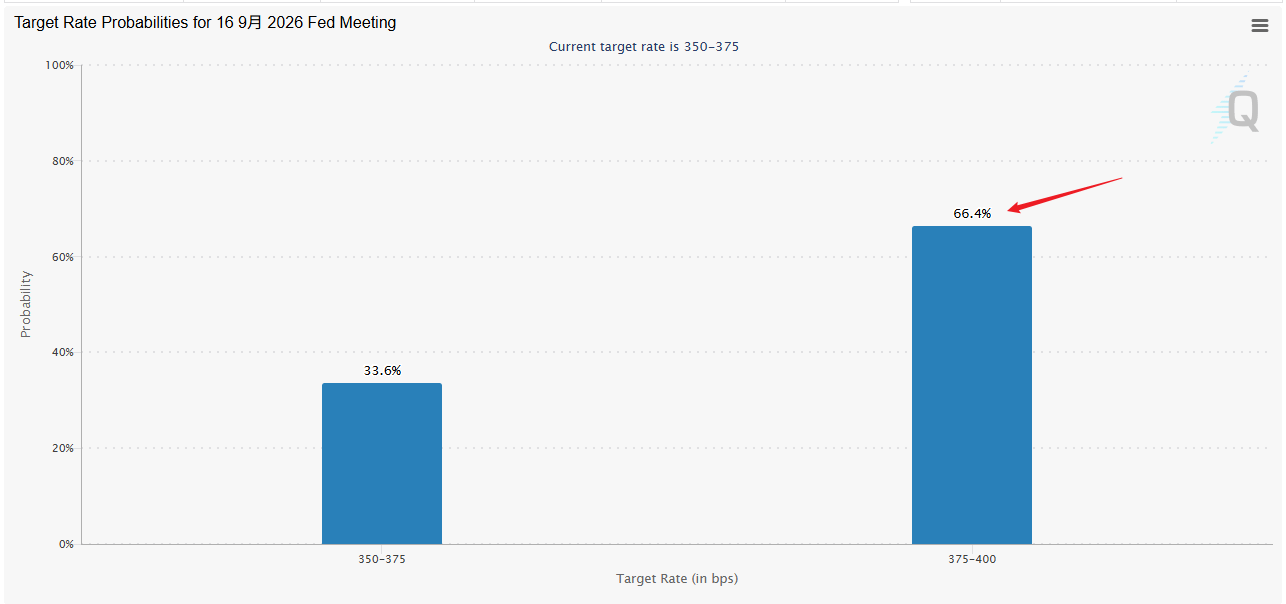
Right now, a lot of people are worried: if a rate hike is possible in September, does that mean this round of the bull market for BTC and ETH is about to end?
At present, the market is pricing in a 66% probability of a rate hike in September. So let’s think objectively: can the Federal Reserve really raise rates, and dare it to keep raising them consistently?
Let’s say—if the Fed really does raise rates in September, then what would it change?
There’s one key point everyone needs to understand: even if the Federal Reserve hasn’t formally started raising rates yet, the market has already completed part of that “indirect” rate hike in advance.
After Mr. Wosch’s remarks, the yield on the two-year U.S. Treasury notes jumped straight up by 15 basis points—meaning the market has already, in a tangible way, priced in a rate hike. No matter whether you actually raise rates or not, the market has already done it.
The negative impact from rate hikes has already been reflected in the market to a certain extent. The declines that needed to happen have already happened once.
Under these circumstances, even if rate hikes are actually implemented later on, the impact won’t be that big, because expectations have already been priced in for the most part in advance.
Let me say it again: even if this round of pullback didn’t come with the hawkish remarks from Wosch, the adjustment would have come sooner or later; the comments just served as the match that lit the fuse.
After a big burst of上涨, the market itself needs to consolidate and wash out profits; that’s the market’s normal pattern.
Also, there’s another very important piece of news: yesterday, Bettencourt publicly spoke at the G20 summit. He clearly stated that the Treasury buyback policy will continue to be carried out,
Even when facing the public criticism from his own mentor, DeLokenmiler, he directly pushed back, showing that this policy will be carried forward resolutely.
When discussing solutions to America’s enormous debt, he clearly stated that they would rely on economic growth to resolve the debt.
But the reality is right in front of us: just the United States’ annual debt interest is close to $1.1 trillion, accounting for 20% of government fiscal revenue. To digest the debt through economic growth, GDP growth would need to reach at least 20% just to cover it. But the U.S. current potential GDP growth rate is only around 2%. To increase it by 10 times is, in reality, almost impossible.
The implication is that everyone in the market can see it clearly. Bettencourt’s point is that the United States will not default, but he chose to take the route of diluting the debt with inflation.
Coming back to this trading idea: after btc and eth surge, you see pullbacks and ongoing choppy consolidation—that’s normal. There’s no need to be overly anxious.
For short-term friends, focus on the range-based rhythm—sell high and buy low;
For those doing medium- to long-term trades: every time there’s a big pullback, it’s an opportunity to build positions in batches, because it’s almost certain that btc and eth will run bullish by the end of the year.
Tonight, the job vacancies data will be released. This will officially kick off this week’s nonfarm data week. Whether the Fed will hike in September will entirely depend on how this series of data looks.
Tonight job vacancies, tomorrow the small nonfarm, and Friday the big nonfarm—data will roll out step by step, continuously revising the market’s expectations for rate hikes.
After the follow-up data comes out, I will sync it with everyone as soon as possible. Please stay tuned. $BTC