
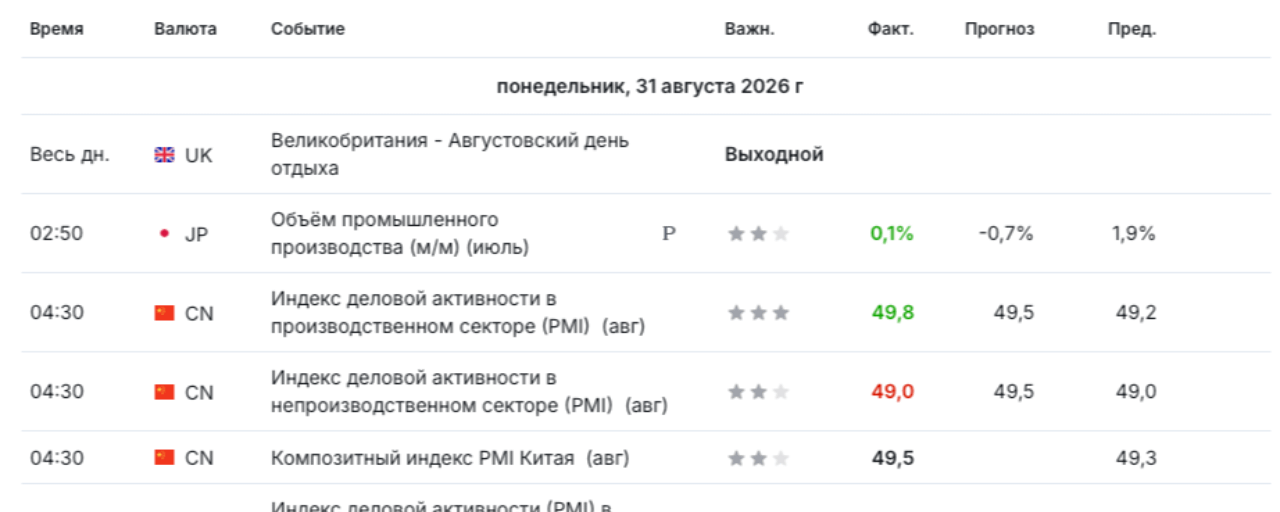


A complete economic calendar of events on August 31 - September 6, 2026 capable of affecting the crypto market.
The week turns out to be busy, but the main focus is on Friday. On this day, a large block of U.S. labor market data will be released for August: the change in non-farm payrolls, the unemployment rate, and average hourly earnings. This is the key macro block of the week for expectations about the U.S. Fed rate, the trajectory of the U.S. Dollar Index DXY, and the behavior of risk assets.
The second most important days are Tuesday and Thursday. On Tuesday, the market will receive the U.S. manufacturing ISM and the JOLTS job openings figure. On Thursday, a block will come out for the U.S. services sector, the traditional initial claims for unemployment benefits, data on the trade balance, productivity and labor costs, as well as the U.S. Federal Reserve balance.
Schedule for the week:
Monday, 31 August:
Today the block of China’s business activity indices for August has already been released. Important due to China’s role in the global economy and for assessing global demand. Manufacturing PMI came in slightly better than expectations: 49.8 versus the forecast of 49.5; non-manufacturing PMI came in weaker than the forecast: 49.0 versus 49.5; composite PMI was 49.5. Overall, the picture is mixed: industry is a bit better than expected, but the services sector and overall business activity remain weak. There are no clear signals for the market at the moment.
Tuesday, 1 September:
- 04:45 Kyiv and Moscow time / 06:45 Astana time - China manufacturing sector business activity index from Caixin for August.
- 08:00 Kyiv and Moscow time / 10:00 Astana time - Japan Bank’s baseline consumer price index on an annual basis. Important due to the role of the yen in the DXY calculation and expectations regarding the Bank of Japan’s policy.
- 12:00 Kyiv and Moscow time / 14:00 Astana time - Inflation block for the EU for August: headline consumer price index, core consumer price index, monthly consumer price index, and the unemployment rate. Important due to the role of the euro in the DXY calculation and for assessing the next policy of the European Central Bank.
- 16:05 Kyiv and Moscow time / 18:05 Astana time - Speech by the U.S. Fed vice chair for supervision Barr.
- 16:45 Kyiv and Moscow time / 18:45 Astana time - U.S. manufacturing sector business activity index for August.
❗️- 17:00 Kyiv and Moscow time / 19:00 Astana time - ISM U.S. manufacturing business activity index, employment index in the manufacturing sector, and prices index in the manufacturing sector. Important for assessing recession risks and inflation pressure in the U.S.
❗️- 17:00 Kyiv and Moscow time / 19:00 Astana time - JOLTS U.S. job openings data for July. One of the key indicators of the state of the U.S. labor market.
Wednesday, 2 September:
❗️- 15:15 Kyiv and Moscow time / 17:15 Astana time - Change in employment in the U.S. non-farm sector according to ADP for August. A preliminary indicator ahead of the official U.S. labor market data.
- 16:45 Kyiv and Moscow time / 18:45 Astana time - Bank of Canada interest rate decision and the accompanying statement. Important due to the role of the Canadian dollar in the DXY calculation.
- 17:00 Kyiv and Moscow time / 19:00 Astana time - U.S. industrial orders for July. Important for assessing business activity and demand conditions in the U.S. economy.
- 17:30 Kyiv and Moscow time / 19:30 Astana time - Canada Bank press conference.
- 21:00 Kyiv and Moscow time / 23:00 Astana time - Release of the “Beige Book” by the Fed. Important for assessing the condition of the U.S. economy by region.
Thursday, 3 September:
- 04:45 Kyiv and Moscow time / 06:45 Astana time - China services sector business activity index from Caixin for August. Important due to China’s role in the global economy and for assessing domestic demand.
- 09:30 Kyiv and Moscow time / 11:30 Astana time - Switzerland consumer price index for August. Important due to the role of the Swiss franc in the DXY calculation.
- 11:00 Kyiv and Moscow time / 13:00 Astana time - EU services sector business activity index and composite PMI for August. Important due to the role of the euro in the DXY calculation.
- 11:30 Kyiv and Moscow time / 13:30 Astana time - UK services sector business activity index and composite PMI for August. Important due to the role of the pound sterling in the DXY calculation.
❗️- 15:30 Kyiv and Moscow time / 17:30 Astana time - A major data block for the U.S.:
-- Number of initial claims for unemployment benefits.
-- Total number of people receiving unemployment benefits.
-- Trade balance.
-- Import volume.
-- Export volume.
-- Productivity level in the non-farm sector.
-- Labor costs.
Jobless claims are important for assessing the resilience of the labor market, while productivity and labor costs are for evaluating inflation pressure via the labor market.
- 15:30 Kyiv and Moscow time / 17:30 Astana time - Speech by U.S. Fed member Waller.
- 16:45 Kyiv and Moscow time / 18:45 Astana time - Business activity index in the U.S. services sector and the composite business activity index from S&P Global for August.
- 17:00 Kyiv and Moscow time / 19:00 Astana time - ISM’s non-manufacturing (services) purchasing managers index for the U.S., employment index, and prices index in the non-manufacturing sector. Important for assessing the state of the services sector, the labor market, and inflation pressure.
❗️- 23:30 Kyiv and Moscow time / 01:30 the next day in Astana - U.S. Federal Reserve balance.
Friday, 4 September:
- 11:50 Kyiv and Moscow time / 13:50 Astana time - Speech by the Bank of England Governor Bailey. Important due to the role of the pound sterling in the DXY calculation.
❗️- 15:30 Kyiv and Moscow time / 17:30 Astana time - A major block of U.S. labor market data for August:
-- Change in employment in the non-farm sector.
-- Unemployment rate.
-- Average hourly earnings.
-- Change in employment in the private non-farm sector.
-- Labor force participation rate.
This, to repeat, is the main macro block of the week for expectations regarding the U.S. Fed rate, DXY dynamics, and crypto market behavior.