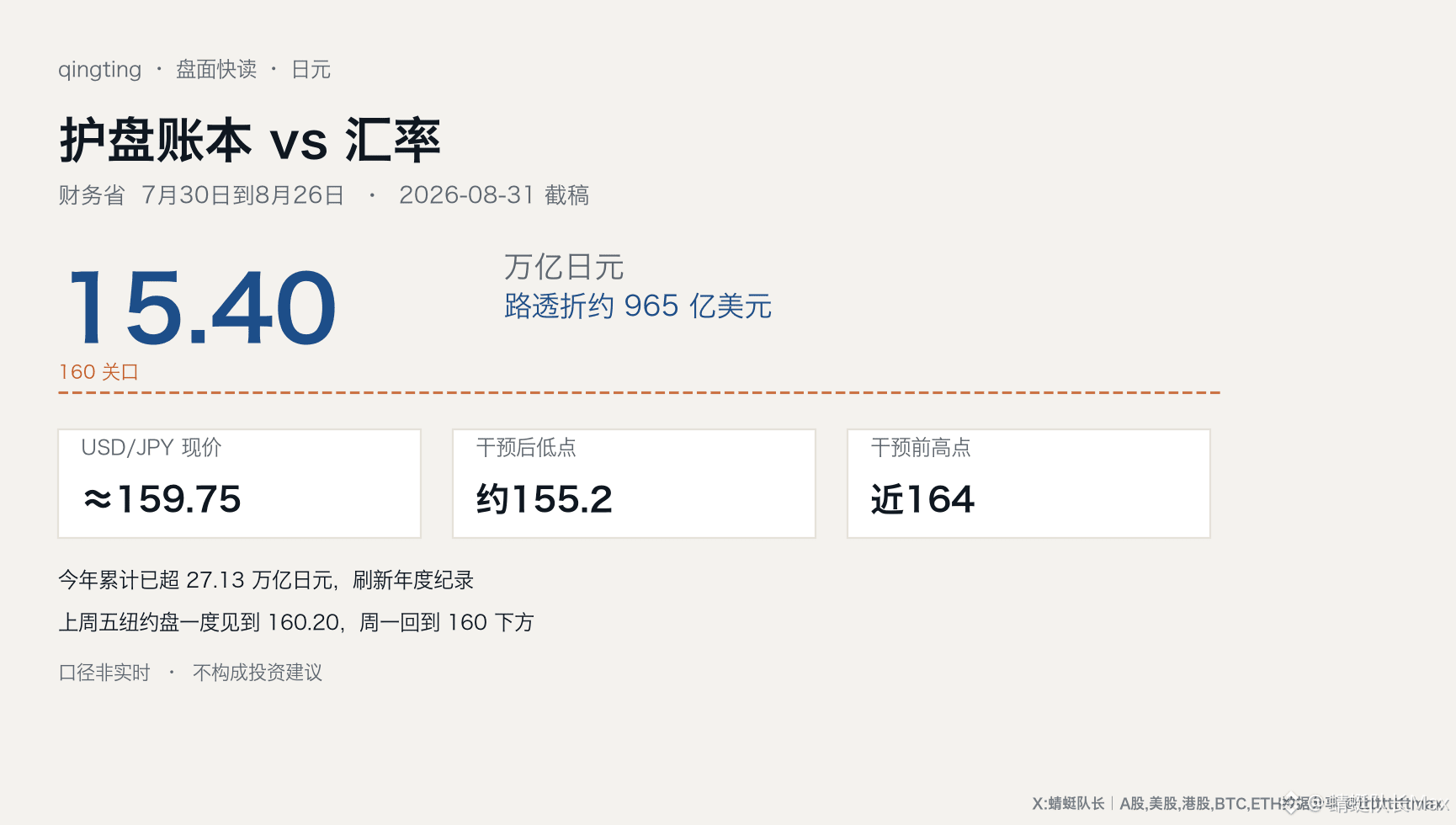
Write the plaza topic as a $97 billion rescue to stabilize the market. The Finance Ministry’s ledger shows 15.3993 trillion yen. Reuters converted it at the then exchange rate to about $96.5 billion. The money has already gone out—on Monday, USD/JPY is still around 159.75. Is the rescue meant to protect the trend, or just a four-week window?
See the cover for the price chart. The intervention figures come from the total of July 30 to August 26 disclosed by Japan’s Ministry of Finance on August 28. The exchange rate uses quotes near the time of publication from Investing and Google Finance—around 159.75; the session high in New York on Friday was 160.20.
【Ledger】
This is the highest record for a single month of yen purchases and dollar sales. The round from late April to early May was 11.73 trillion yen. Written by Kyodo Shimbun: after this round, the cumulative total for 2026 reaches 27.1342 trillion yen, setting a yearly record. Nikkei converted the two rounds into roughly $170 billion. Daily breakdown details have to wait until the quarterly report in early November.
In late July, USD/JPY pushed toward 164, around a 39-year and 8-month high. According to the Finance Ministry and Japanese media, on the night of July 30 the dollar suddenly dropped by about 5 yen, falling below 158. On July 31, coordinated intervention by Japan and the U.S. was confirmed—Finance Minister Kamiyama Satsuki and U.S. Treasury Secretary Bessent confirmed on August 3. The U.S. side used the Exchange Stabilization Fund to sell euros and buy yen. South Korea also synchronized by buying won. After the intervention, the yen briefly moved into the 155 to 155.5 area.
【Where will it stand after four weeks】
Kyodo Shimbun wrote on August 28 that at the time the exchange rate was still in the 159 range, and the depreciation trend had not changed. Last Friday’s New York session saw USD/JPY trade roughly from 159.41 to 160.20. In the European session on Monday, FXStreet wrote that it had fallen back to around 159.50. By press time it was about 159.75—160 was gained and lost. The BOJ’s monthly report was interpreted by the market as 96,000 billion yen on a single day on July 30, far above the 6.3 trillion yen single-day record confirmed on April 30. Until the quarterly table is released, this is only for comparison.
【How to read it】
Buying huge amounts can knock 164 back to 155—but if you can’t buy the spread, it disappears by itself. The Japan-U.S. interest-rate differential is still there; Middle East risk premium keeps lifting oil prices; and currencies of importers are more easily resold again. 160 is a psychological line, and it also marks lost ground after the intervention. Only if the close stays back below 158 consecutively can we talk about whether this round of money is still strong enough to hold it down. If the market stays above 160 at the close, it will price the next round by trading time for space.
【The real question】
Do you think the next shot will be fired above 160, or is it only worth watching when it returns near 164? “Do it again at 160.” / “First look at the rate differential,” and report the invalidation level.
$JPY $USD #日元 #汇率 #intervention
Dragonfly Captain|A finance blogger who likes analyzing data and candlestick charts.
Not investment advice. The price and the USD-conversion figures are not real-time.
See the cover for the price chart. The intervention figures come from the total of July 30 to August 26 disclosed by Japan’s Ministry of Finance on August 28. The exchange rate uses quotes near the time of publication from Investing and Google Finance—around 159.75; the session high in New York on Friday was 160.20.
【Ledger】
This is the highest record for a single month of yen purchases and dollar sales. The round from late April to early May was 11.73 trillion yen. Written by Kyodo Shimbun: after this round, the cumulative total for 2026 reaches 27.1342 trillion yen, setting a yearly record. Nikkei converted the two rounds into roughly $170 billion. Daily breakdown details have to wait until the quarterly report in early November.
In late July, USD/JPY pushed toward 164, around a 39-year and 8-month high. According to the Finance Ministry and Japanese media, on the night of July 30 the dollar suddenly dropped by about 5 yen, falling below 158. On July 31, coordinated intervention by Japan and the U.S. was confirmed—Finance Minister Kamiyama Satsuki and U.S. Treasury Secretary Bessent confirmed on August 3. The U.S. side used the Exchange Stabilization Fund to sell euros and buy yen. South Korea also synchronized by buying won. After the intervention, the yen briefly moved into the 155 to 155.5 area.
【Where will it stand after four weeks】
Kyodo Shimbun wrote on August 28 that at the time the exchange rate was still in the 159 range, and the depreciation trend had not changed. Last Friday’s New York session saw USD/JPY trade roughly from 159.41 to 160.20. In the European session on Monday, FXStreet wrote that it had fallen back to around 159.50. By press time it was about 159.75—160 was gained and lost. The BOJ’s monthly report was interpreted by the market as 96,000 billion yen on a single day on July 30, far above the 6.3 trillion yen single-day record confirmed on April 30. Until the quarterly table is released, this is only for comparison.
【How to read it】
Buying huge amounts can knock 164 back to 155—but if you can’t buy the spread, it disappears by itself. The Japan-U.S. interest-rate differential is still there; Middle East risk premium keeps lifting oil prices; and currencies of importers are more easily resold again. 160 is a psychological line, and it also marks lost ground after the intervention. Only if the close stays back below 158 consecutively can we talk about whether this round of money is still strong enough to hold it down. If the market stays above 160 at the close, it will price the next round by trading time for space.
【The real question】
Do you think the next shot will be fired above 160, or is it only worth watching when it returns near 164? “Do it again at 160.” / “First look at the rate differential,” and report the invalidation level.
$JPY $USD #日元 #汇率 #intervention
Dragonfly Captain|A finance blogger who likes analyzing data and candlestick charts.
Not investment advice. The price and the USD-conversion figures are not real-time.