
【Understand the new USDD’s mechanism in three parts】
Among the seven TRON-related stocks, what’s a bit harder to understand is USDD
Even if you know about it up to the point of “TRON’s stablecoin”...
🔹How is USDD issued?
🔹What if it deviates from $1?
🔹How is it different from USDT and USDC?
Not many people might be able to explain it this far
To understand the current new USDD, there are three key points ☝️
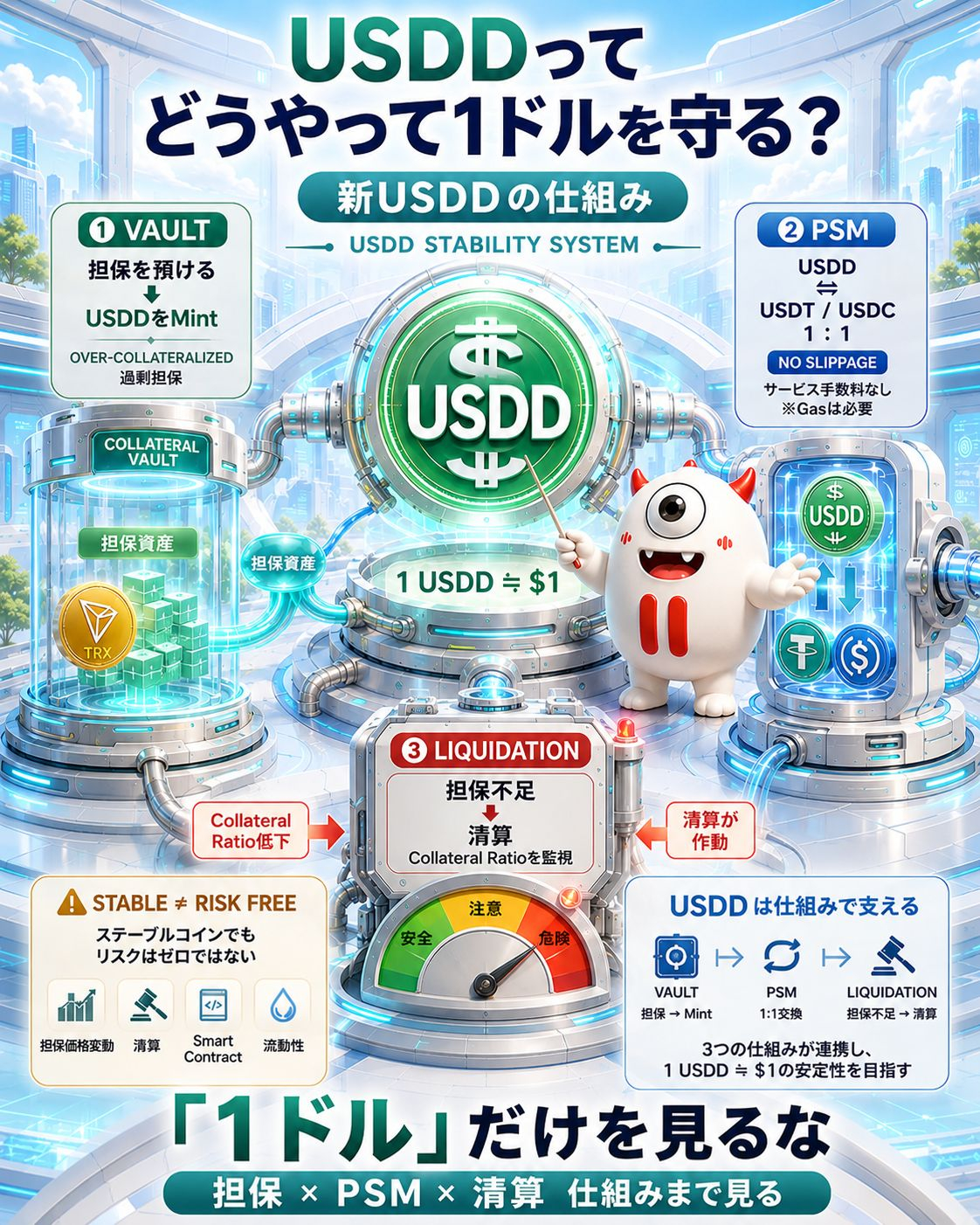
① Vault | Minting USDD by using crypto assets as collateral
A new USDD over-collateralized system that uses crypto assets as collateral
Users can deposit supported assets into the Vault, and then Mint USDD using that collateral
The important point is that it’s not that “TRX is being exchanged into USDD”
Since it’s structured so that you deposit collateral to create a debt called USDD, if the collateral price drops and the Collateral Ratio falls below the liquidation threshold, it may become subject to liquidation
So, the party that mints USDD needs to look not only at “1 USDD ≒ 1 dollar,” but also at their own collateral ratio
② PSM|Exchange USDD and other stablecoins 1:1
Another important one is the PSM (Peg Stability Module)
In the official Docs, it explains that USDD can be exchanged 1:1 for corresponding stablecoins like USDT and USDC, with no service fees and no slippage
For example, even if the market price of USDD deviates from $1, a 1:1 exchange via the PSM becomes the entry point for arbitrage trading, and it’s one of the mechanisms that helps maintain the peg
※ Network Gas is required
※ The amount available for exchange is limited by the PSM’s Available balance
③ Liquidation|Don’t leave collateral shortages unaddressed
If the value of the collateral falls and the Vault can no longer maintain the required collateral ratio, the liquidation mechanism will be triggered
It’s designed to prevent a collateral shortfall from spreading to the entire system by processing the debt using the liquidated collateral
So the new USDD is
To deposit collateral
↓
Mint USDD
↓
Use the PSM to support the $1 peg
↓
If there isn’t enough collateral, liquidation
It consists of multiple mechanisms like that
What we should pay attention to here is that “a stablecoin = a price that absolutely never moves from $1” is not the case
USDD also has smart contract risks, collateral asset price fluctuations, liquidation risks, liquidity, and other points that should be checked
When looking at USDD, don’t focus only on the yield, but also
“What is issued against what collateral?”
“How is there a mechanism to get it back to $1?”
“When something goes wrong, who will absorb the losses?”
It’s important to keep looking at it up to that point
When choosing a stablecoin, which do you value the most: “collateral,” the “peg-keeping mechanism,” or “liquidity”?