


Bitcoin’s challenge to $81,000 fails; it slips back below $78,000 again over the weekend
Bitcoin ($BTC) bulls ran into resistance at the $81,000 level. After U.S. Federal Reserve Chairman Kevin Warsh issued hawkish signals at the Jackson Hole global central bank conference, and U.S. spot Bitcoin ETFs ended a streak of nine consecutive trading days of net inflows, Bitcoin fell back below $78,000 over the weekend. The market then began to show short-term profit-taking pressure.
On August 28, Bitcoin briefly surged to about $81,455, setting a recent swing high, but the price then quickly pulled back, with a day’s low touching around $76,877. Wosch emphasized that inflation has not yet returned to the Federal Reserve’s 2% target at a sufficient pace. As a result, market expectations for a September rate hike rose, weighing on the performance of risk assets.
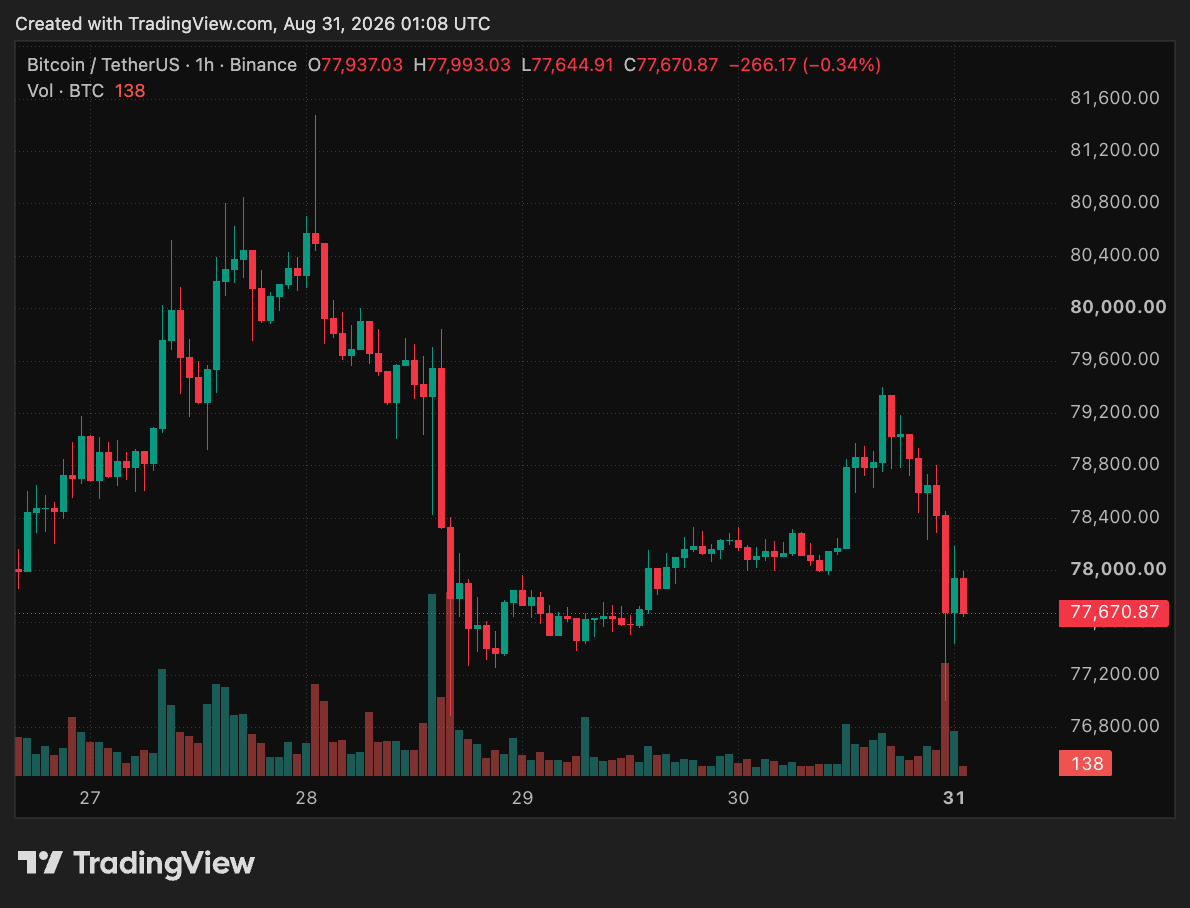 Image source: TradingView
As of the morning of August 31, TradingView data shows that bitcoin was trading at about $77,671. Bitcoin rebounded to around $79,300 near the weekend, but then saw heavy sell pressure again, with the price quickly dropping below $78,000.
Currently, $80,000 has again become an important dividing line between bulls and bears. If bitcoin can regain and hold above $80,000, the next target would be back at $81,300, and the $82,000 to $83,000 range. If the $77,000 support fails, the market may further test the $75,000 to $75,500 range.
Spot ETF ends nine-day net inflow streak, with $201.9 million withdrawn in a single day
As bitcoin’s price weakened, inflows into U.S. spot bitcoin ETFs also reversed. According to Farside Investors data, on August 28, U.S. spot bitcoin ETFs recorded a total net outflow of $201.9 million, officially ending the streak of nine consecutive trading days of net inflows that began on August 17.
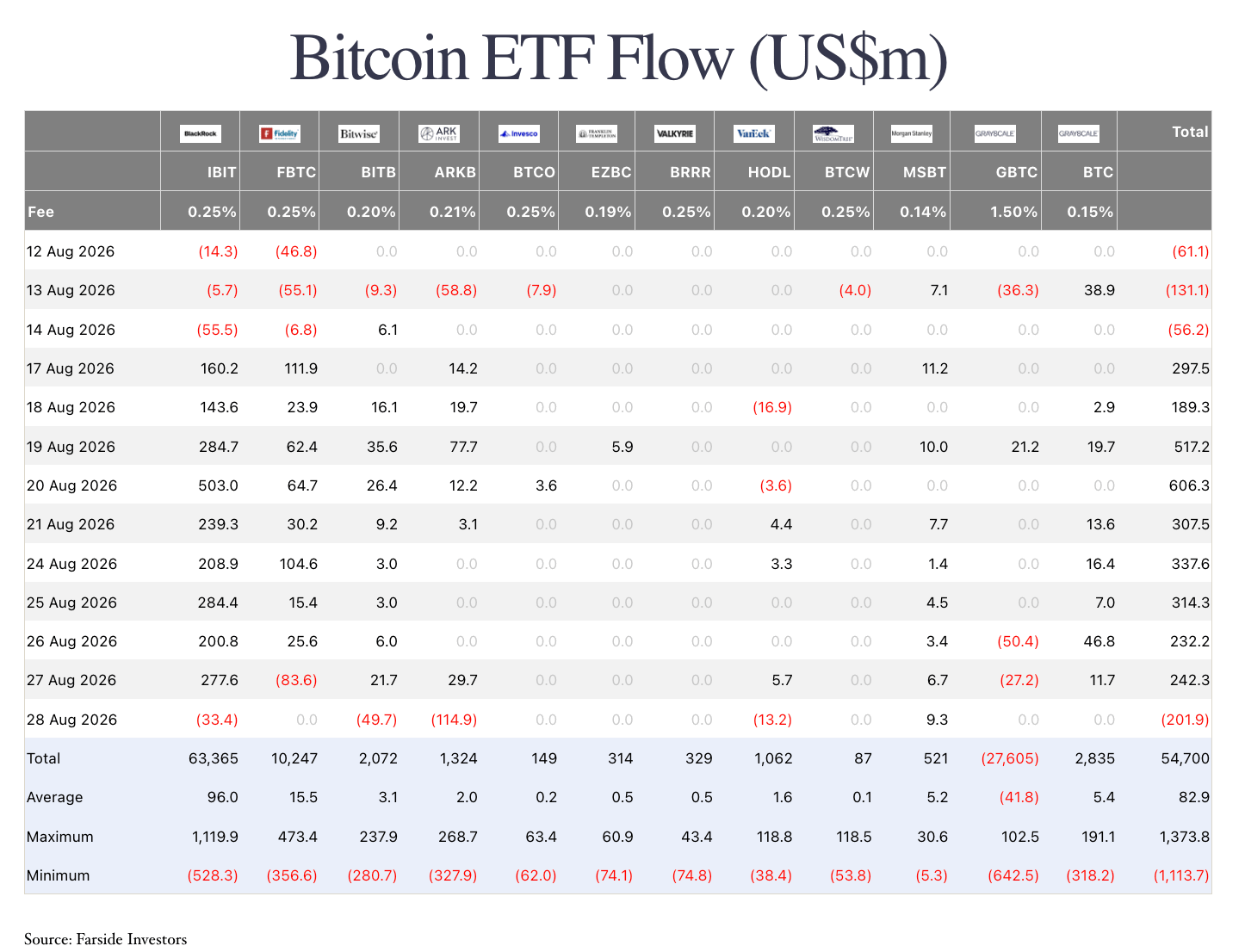 Image source: Farside Investors On August 28, U.S. spot bitcoin ETFs recorded a total net outflow of $201.9 million, officially ending the streak of nine consecutive trading days of net inflows that began on August 17.
During this nine-day streak of consecutive inflows, spot bitcoin ETFs have cumulatively attracted about $3.04 billion. Of that, the largest single-day net inflow occurred on August 20, reaching $606.3 million. From August 24 to 27, inflows were $337.6 million, $314.3 million, $232.2 million, and $242.3 million, respectively.
On August 28, fund flows weakened across the board. ARK Invest’s ARKB had a net outflow of $114.9 million, the largest withdrawal product of the day; Bitwise’s BITB had a net outflow of $49.7 million; BlackRock’s IBIT had a net outflow of $33.4 million; and VanEck’s HODL also saw an outflow of $13.2 million.
Among the few products that maintained positive inflows that day was Morgan Stanley’s MSBT, recording a net inflow of $9.3 million. Fidelity’s FBTC, Grayscale’s GBTC, and other bitcoin-related products saw no obvious fund movement.
Worth noting is that the $201.9 million one-day net outflow is about 6.6% of the cumulative $3.04 billion net inflow over the previous nine trading days. The current scale is still insufficient to prove that institutional funds have fully pulled out. For the week of August 24 to 28, U.S. spot bitcoin ETFs overall still recorded about $924.5 million in net inflows.
$81,000 forms a supply wall, and profit-taking pressure begins to show up
Bitcoin has repeatedly failed to break through the $80,000 to $81,000 area, causing this price range to gradually form a clear resistance. Market data shows that a large amount of bitcoin holdings are concentrated around $80,000 to $82,000, meaning that when the price returns to this range, some investors who were previously trapped or are looking to take profits may choose to sell. The 50-week moving average is also located around $81,000, further increasing technical pressure.
Another factor affecting the market comes from derivatives. On August 28, about 81,700 bitcoin options contracts expired, with a notional value of roughly $6.44 billion. Among them, the $75,000 and $80,000 strike prices are significant concentration zones. As large options expiry approaches and related hedging and position-adjustment demand gradually fades, bitcoin’s price could also have more room for volatility.
On the other hand, Waller’s hawkish comments have prompted the market to reassess the outlook for U.S. interest rates. The odds of a September rate hike once rose from about 35% to nearly 56%, putting bitcoin under double pressure from both the broader macroeconomy and short-term positioning.
Related news: Bitcoin breaks below $78,000! Fed Chair Waller turns hawkish, rate-hike odds surge past 56%
$77,000 becomes the short-term line of defense; if it breaks, $75,000 may be tested again
Bitcoin’s price is currently in a critical range. The $80,000 level, which previously broke through a target, has turned back into short-term resistance, while around $77,000 is an important support that bulls need to hold.
If bitcoin can regain $80,000 and further break above the August 28 highs of about $81,300 to $81,500, the market may have another chance to challenge the $82,000 to $83,000 range. Conversely, if the price continues to stay below $80,000 and effectively breaks below $77,000, the next more notable support would likely be in the $75,000 to $75,500 area.
In terms of technical indicators, bitcoin’s RSI is around 69.7, having cooled off from the overheated zone above 80 earlier this week. ADX is also close to 39.5, indicating that the current trend strength is still relatively high. If the correction expands further, roughly $73,670 to $75,157 may become the next support zone worth watching.
However, during the nine consecutive trading days of net inflows, spot bitcoin ETFs have still accumulated more than $3 billion in inflows. The one-day outflow on August 28 is relatively limited in scale. The current market is undergoing profit-taking and repricing after a rapid rally; whether it can hold above $77,000 will be an important indicator to watch to see if this correction further expands.
“End of 9-day net inflows! U.S. spot bitcoin ETF sees daily outflow of over $200 million; $77,000 is the short-term line of defense.” This article was first published on “Crypto City.”