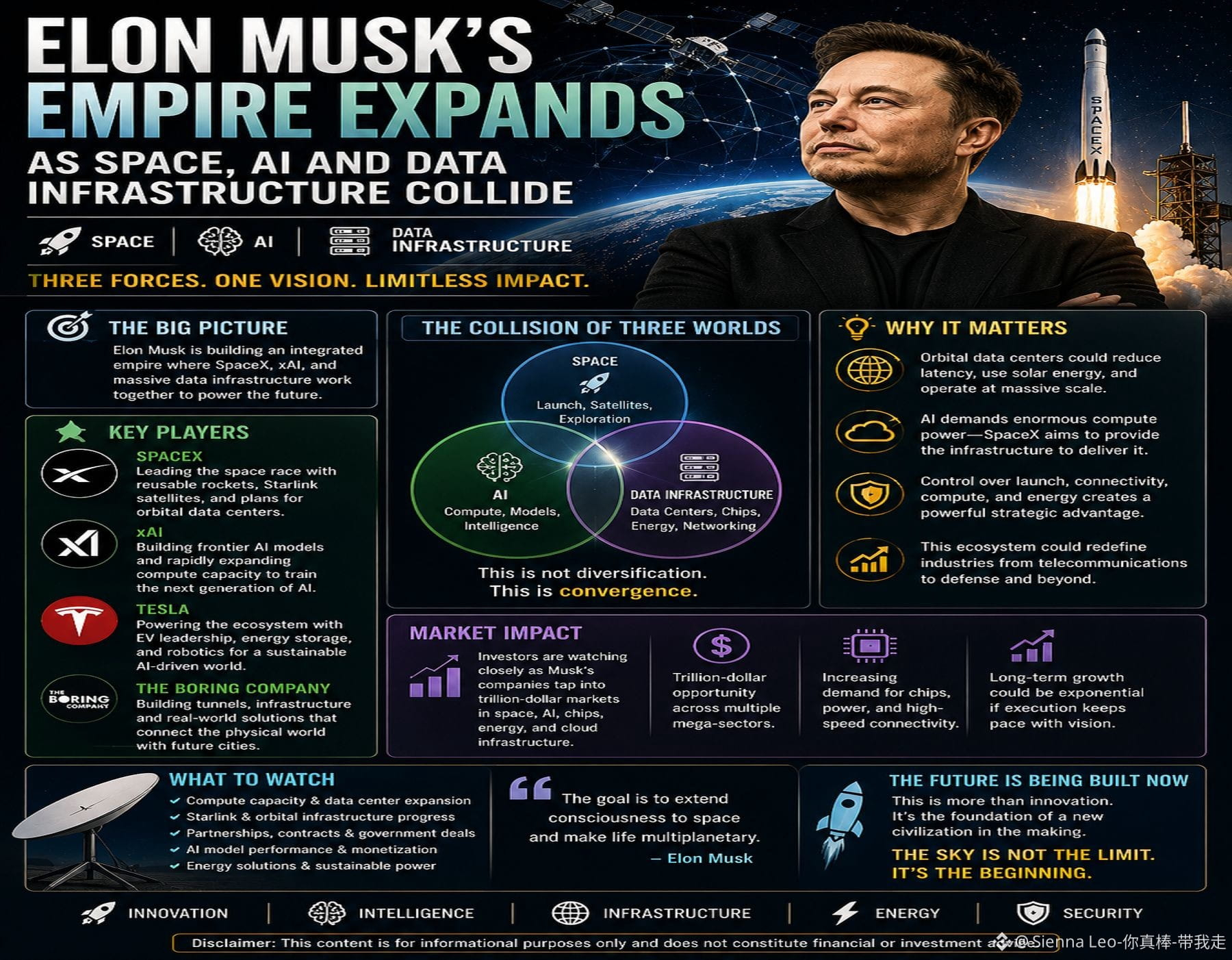

🚀 Elon Musk’s Empire Expands as Space, AI and Data Infrastructure Collide 🚀
Imagine a rocket launch site where the next mission is not carrying astronauts or satellites, but the computing power needed to train the next generation of AI. That once sounded futuristic. Musk is now building toward it.
The biggest shift is happening inside SpaceX itself. After acquiring xAI earlier this year, SpaceX has turned AI compute into a major part of its infrastructure strategy, with ambitions extending from Earth-based data centers toward space.
The scale is becoming difficult to ignore. Musk has said SpaceX plans to expand computing capacity dramatically, while the company is already operating large AI facilities and selling compute capacity to outside customers.
Then comes the more unusual piece: orbital data centers. Musk argues that technologies developed for Starlink could help support AI infrastructure in space, potentially changing how computing power, energy and connectivity interact.
This is why the story is bigger than rockets or chatbots. SpaceX is increasingly connecting satellites, launch systems, AI models, chips, energy storage and data centers into one vertically integrated ecosystem.
The market question is whether this integration creates a genuine infrastructure advantage or simply concentrates enormous capital and execution risk inside one empire.
Investors should watch compute capacity, energy availability, chip supply, commercial customers and the economics of orbital infrastructure rather than focusing only on Musk’s ambitious projections.
The real disruption may not be AI in space, but the collision of space, AI and infrastructure into one business model.
❓Could SpaceX eventually become as important to global AI infrastructure as it is to the launch industry?
Disclaimer: This article is for informational purposes only and is not financial or investment advice.
#SpaceX #AI #ElonMusk #Write2Earn #GrowWithSAC
Imagine a rocket launch site where the next mission is not carrying astronauts or satellites, but the computing power needed to train the next generation of AI. That once sounded futuristic. Musk is now building toward it.
The biggest shift is happening inside SpaceX itself. After acquiring xAI earlier this year, SpaceX has turned AI compute into a major part of its infrastructure strategy, with ambitions extending from Earth-based data centers toward space.
The scale is becoming difficult to ignore. Musk has said SpaceX plans to expand computing capacity dramatically, while the company is already operating large AI facilities and selling compute capacity to outside customers.
Then comes the more unusual piece: orbital data centers. Musk argues that technologies developed for Starlink could help support AI infrastructure in space, potentially changing how computing power, energy and connectivity interact.
This is why the story is bigger than rockets or chatbots. SpaceX is increasingly connecting satellites, launch systems, AI models, chips, energy storage and data centers into one vertically integrated ecosystem.
The market question is whether this integration creates a genuine infrastructure advantage or simply concentrates enormous capital and execution risk inside one empire.
Investors should watch compute capacity, energy availability, chip supply, commercial customers and the economics of orbital infrastructure rather than focusing only on Musk’s ambitious projections.
The real disruption may not be AI in space, but the collision of space, AI and infrastructure into one business model.
❓Could SpaceX eventually become as important to global AI infrastructure as it is to the launch industry?
Disclaimer: This article is for informational purposes only and is not financial or investment advice.
#SpaceX #AI #ElonMusk #Write2Earn #GrowWithSAC