

After BTC started rising again recently, everyone has started discussing the four-year cycle again.
Are the previous lows truly the real bottom of this cycle, and is there still a lower level afterward? These are questions I’ve been talking about a lot recently myself.
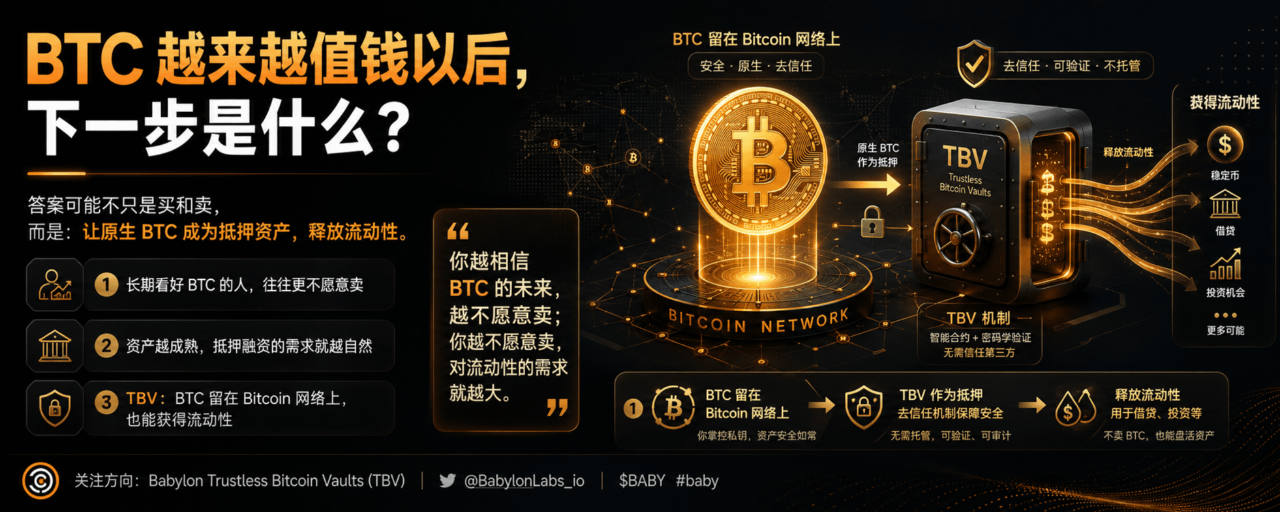
But these past couple of days, I suddenly thought of a longer-term question: if in the future Bitcoin really becomes more and more valuable, then for the demand surrounding BTC, sooner or later it won’t stay only at “buy” and “sell,” will it?
🤔🤔🤔
The more valuable an asset becomes, the less willing long-term holders are to sell.
Say someone has 10 BTC and still believes in Bitcoin long term. At that point, if they suddenly need a sum of cash, the most direct way is, of course, to sell part of the BTC.
But if you already believe it will keep appreciating in the future, why sell it in the first place?
This logic is actually easy to understand in traditional finance. If you own a house, you don’t necessarily sell it just because you need money; if you own stocks, you wouldn’t always liquidate them every time you need liquidity. Once an asset is mature enough, borrowing against collateral is a very natural demand.
I think Bitcoin will most likely reach that stage ahead.
In fact, the more expensive BTC gets, the more attractive BTC-based lending becomes, because long-term holders are even less willing to sell, and the need for “liquidity without selling assets” becomes stronger.
And it’s based on this logic that I’ve started paying attention to Babylon Trustless Bitcoin Vaults (TBV) recently.
In the past, if you wanted to use BTC in DeFi, think about it: many times you first had to bridge it, wrap it into another form of BTC, or hand it over to a custodian.
But for people who truly plan to hold native BTC long term, this has always felt a bit awkward: I hold BTC because I believe in Bitcoin, yet when I want to use that asset, I have to turn it into something else first—that just feels strange.
So what TBV wants to solve is exactly this problem!
The idea is very straightforward: BTC stays on the Bitcoin network, while this portion of BTC is used as collateral to obtain liquidity.
In other words, someone who is bullish on Bitcoin long term doesn’t necessarily need to solve cash-flow needs through “selling coins.”
I think what’s really worth looking at here isn’t just “there’s another lending product”—it’s that Bitcoin’s narrative may be gradually changing.
Over the past decade or more, everyone has been working on: how to buy BTC, and how to hold BTC long term.
But if in the future Bitcoin’s asset size keeps expanding, then a big problem that likely comes next is: with so much BTC that’s been held long term, how do we truly get it into the financial system?
You can use a house as collateral, stocks can be pledged, and even government bonds can become collateral assets.
So if Bitcoin ultimately really becomes a global store-of-value asset, with native BTC becoming collateral, I think that would be a very natural path forward.
Moreover, there’s a logic in here that I really resonate with: the more you believe in BTC’s future, the less willing you are to sell it casually; the less you want to sell, the greater your need for liquidity becomes.
That’s also why when I’ve been looking at TBV recently, I find myself thinking one layer deeper than just viewing it as another DeFi product.
And if we look at Bitcoin’s longer-term outlook, I think this direction is worth continued attention.
Bitcoin’s next stage may not only be about discussing “how high BTC can go.” Instead, it may start answering: once BTC is truly worth more and more, how should we use it?
If we can ultimately manage to both preserve native BTC and unlock the liquidity behind it, then lending and borrowing based on Bitcoin, in my view, would be a very interesting market.
You can also keep an eye on the progress on TBV lately @BabylonLabs_io ; in my personal view, it still has very significant development potential and room to grow!
We’re keeping a close watch!