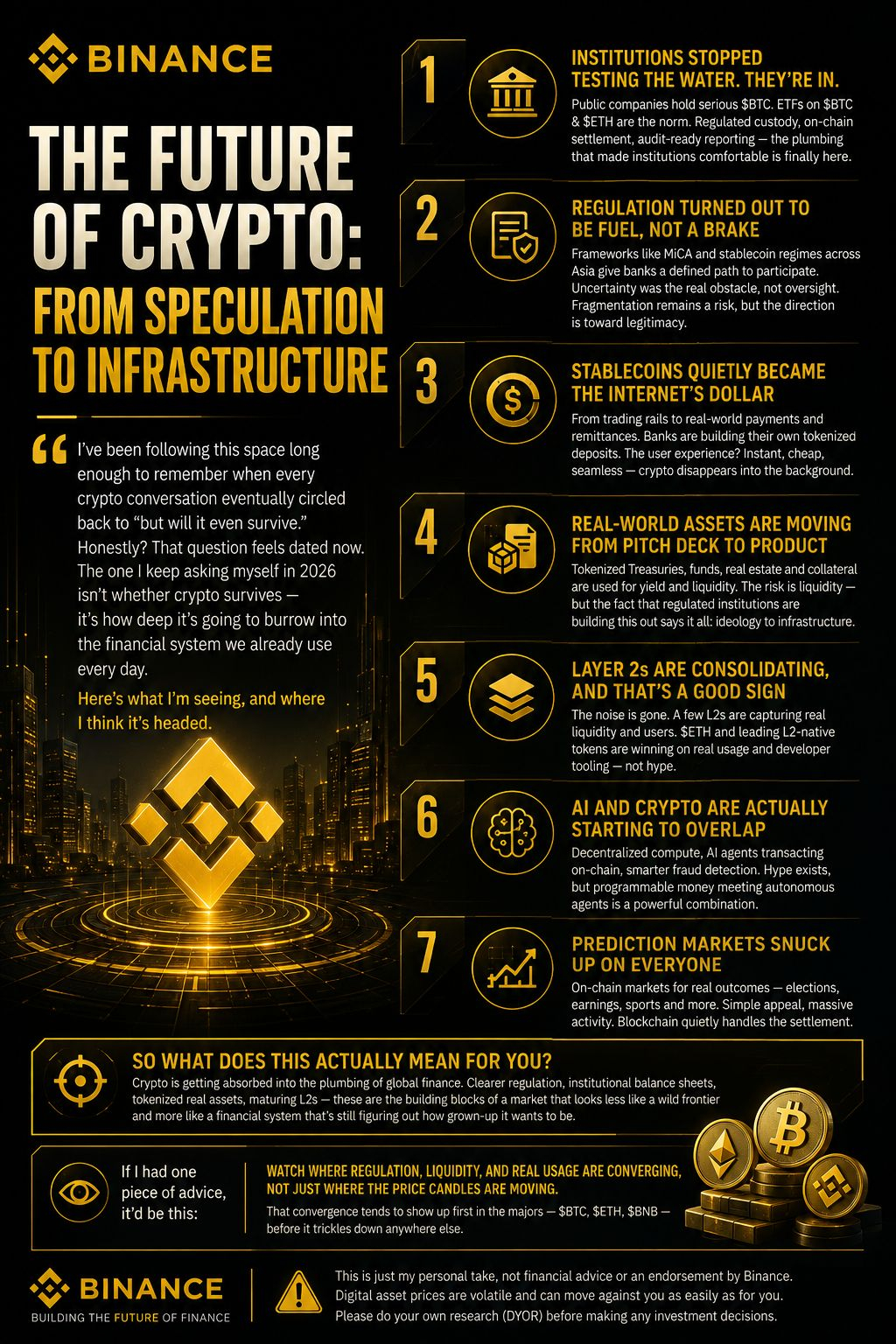
I've been following this space long enough to remember when every crypto conversation eventually circled back to "but will it even survive." Honestly? That question feels dated now. The one I keep asking myself in 2026 isn't whether crypto survives — it's how deep it's going to burrow into the financial system we already use every day. Here's what I'm seeing, and where I think it's headed.
1. Institutions stopped testing the water. They're in.
Remember when "institutional adoption" meant a bank quietly running a pilot program and issuing a cautious press release about it? That era is basically over. Public companies are sitting on a serious chunk of circulating Bitcoin supply on their balance sheets now, and pension funds, hedge funds, asset managers — they're not experimenting anymore, they're allocating. ETFs wrapped around $BTC and $ETH have become the boring, normal on-ramp. And "boring" is honestly the compliment here.
What actually changed isn't vibes, it's plumbing. Regulated custody, on-chain settlement, audit-ready reporting — the unglamorous infrastructure that lets a risk-averse institution touch this asset class without blowing up their compliance framework.
2. Regulation turned out to be fuel, not a brake
I used to assume clearer rules would slow this industry down. I was wrong, or at least the story is more complicated than that. Frameworks like MiCA in Europe, and the stablecoin regimes taking shape across Asia, are giving banks an actual defined path to offer custody and settlement services. It turns out uncertainty was the real obstacle the whole time, not oversight itself.
I'm not going to pretend it's all smooth — the US, EU, and Asia are still pulling in somewhat different directions, and that fragmentation is a genuine risk for anyone building across borders. But the general direction is toward legitimacy, and that's not nothing.
3. Stablecoins quietly became the internet's dollar
Stablecoins used to just be the thing you parked funds in between trades. Now they're doing real work — cross-border payments, remittances, and banks are literally building their own tokenized deposit systems because stablecoins proved the model first. There's an interesting tension brewing there: bank-issued dollar tokens versus crypto-native ones, competing for the same job.
For regular users, this mostly shows up as "wait, that transfer was instant and basically free" — without anyone needing to think about crypto at all. When a technology disappears into the background like that, it usually means it actually won.
4. Real-world assets are moving from pitch deck to product
Tokenized Treasuries, tokenized funds, tokenized collateral — these aren't proof-of-concept demos anymore, institutions are actually using them for yield and liquidity. The idea is simple enough: take things that already exist, bonds, funds, real estate, and make them programmable and divisible on-chain.
I'll be honest, the risk is real too. If these tokenized assets never attract genuine secondary trading and just sit there illiquid, the whole use case falls flat. But the fact that regulated institutions are building toward it at all says something — this has quietly gone from ideology to infrastructure.
5. Layer 2s are consolidating, and that's a good sign
There used to be a new L2 announced every other week. Now the landscape is settling around a smaller group of networks that are actually absorbing most of the liquidity and users — think $ETH and the handful of L2-native tokens that came out on top. This is just what happens when a technology matures: the noise fades and a few players win on real usage and developer tooling instead of novelty.
6. AI and crypto are actually starting to overlap, not just share headlines
Cut through the branding and there's something real happening — decentralized compute networks, AI agents that can transact on-chain by themselves, smarter fraud detection built into on-chain systems. I'll admit a lot of "AI x crypto" content out there is still more narrative than substance. But programmable money meeting autonomous agents is genuinely one of the more interesting corners of this space right now.
7. Prediction markets snuck up on everyone
On-chain markets where people bet on real outcomes — elections, earnings reports, whatever — have grown into one of the more active parts of DeFi lately. What I like about this one is that it doesn't require anyone to "believe in crypto" first. The appeal is dead simple, and the blockchain is just doing the settlement work quietly underneath.
So what does this actually mean for you?
None of this promises returns, and volatility isn't going anywhere — that's still just the nature of this asset class. But the story underneath has shifted. Crypto is getting absorbed into the plumbing of global finance rather than sitting outside it as an alternative. Clearer regulation, institutional balance sheets, tokenized real assets, maturing L2s — these are the building blocks of a market that looks less like a wild frontier and more like a financial system that's still figuring out how grown-up it wants to be.
If I had one piece of advice, it'd be this: watch where regulation, liquidity, and real usage are converging, not just where the price candles are moving. That convergence tends to show up first in the majors — $BTC, $ETH, $BNB — before it trickles down anywhere else.
This is just my personal take, not financial advice or an endorsement by Binance. Digital asset prices are volatile and can move against you as easily as for you. Please do your own research (DYOR) before making any investment decisions.