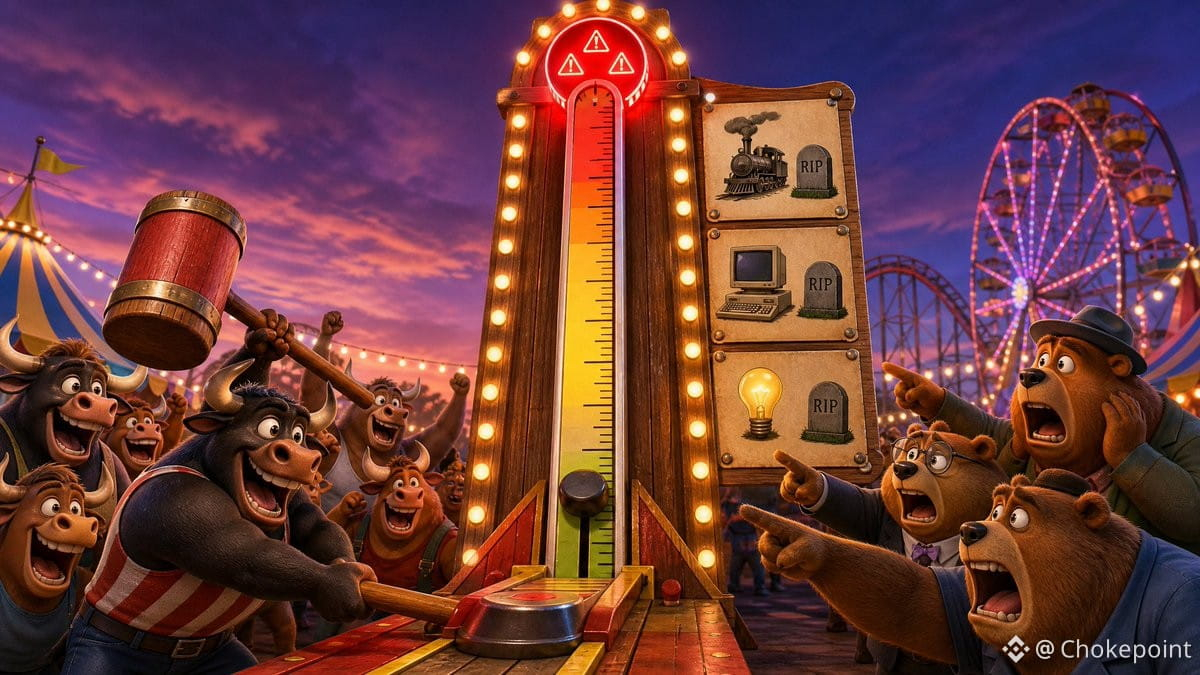
Every American capex bubble eventually pops — railroads, electrification, dot-com. But almost none popped when investors expected. That's the part the bubble callers keep missing.
There's a historical pattern: the rule of 25. Across 250 years, the US economy has absorbed spending on a transformational technology equal to roughly 25% of GDP before things get dangerous. Railroads hit it before the 1873 panic. Internet infrastructure hit it before dot-com burst. Same threshold, different decade.
Where is AI right now? With GDP near $30 trillion, the danger zone sits around $7.5 trillion in cumulative spend. AI is nowhere close. At the current pace, it doesn't trip the rule of 25 until the early 2030s — six or seven years into the boom.
$NVDA just guided to 70% revenue growth for fiscal 2028. Alphabet Cloud grew 82%. The spending is starting to turn into profit, which is exactly what a boom needs to keep running.
The bubble is real. It will pop. History couldn't be clearer on that. It's just unlikely to pop at the quarter pole. And right now, that's where we are.
$NVDA $SPY $QQQ
There's a historical pattern: the rule of 25. Across 250 years, the US economy has absorbed spending on a transformational technology equal to roughly 25% of GDP before things get dangerous. Railroads hit it before the 1873 panic. Internet infrastructure hit it before dot-com burst. Same threshold, different decade.
Where is AI right now? With GDP near $30 trillion, the danger zone sits around $7.5 trillion in cumulative spend. AI is nowhere close. At the current pace, it doesn't trip the rule of 25 until the early 2030s — six or seven years into the boom.
$NVDA just guided to 70% revenue growth for fiscal 2028. Alphabet Cloud grew 82%. The spending is starting to turn into profit, which is exactly what a boom needs to keep running.
The bubble is real. It will pop. History couldn't be clearer on that. It's just unlikely to pop at the quarter pole. And right now, that's where we are.
$NVDA $SPY $QQQ