
最佳第6人
1.8k Posts

最佳第6人
 Square Verified+
以市场为师,与趋势为友。尊重常识,尊重规律,尊重市场,尊重人性,遵守纪律。我相信我就是万中无一的交易天才,币圈气运之子,Web3天命第六人。
Open Trade
Frequent Trader
5.3 Years
2.5K+ Following
60.4K+ Followers
35.8K+ Liked
Posts
Portfolio
All
Quotes
Videos
Live
PINNED
gogo
Hitmans Lounge
·
--
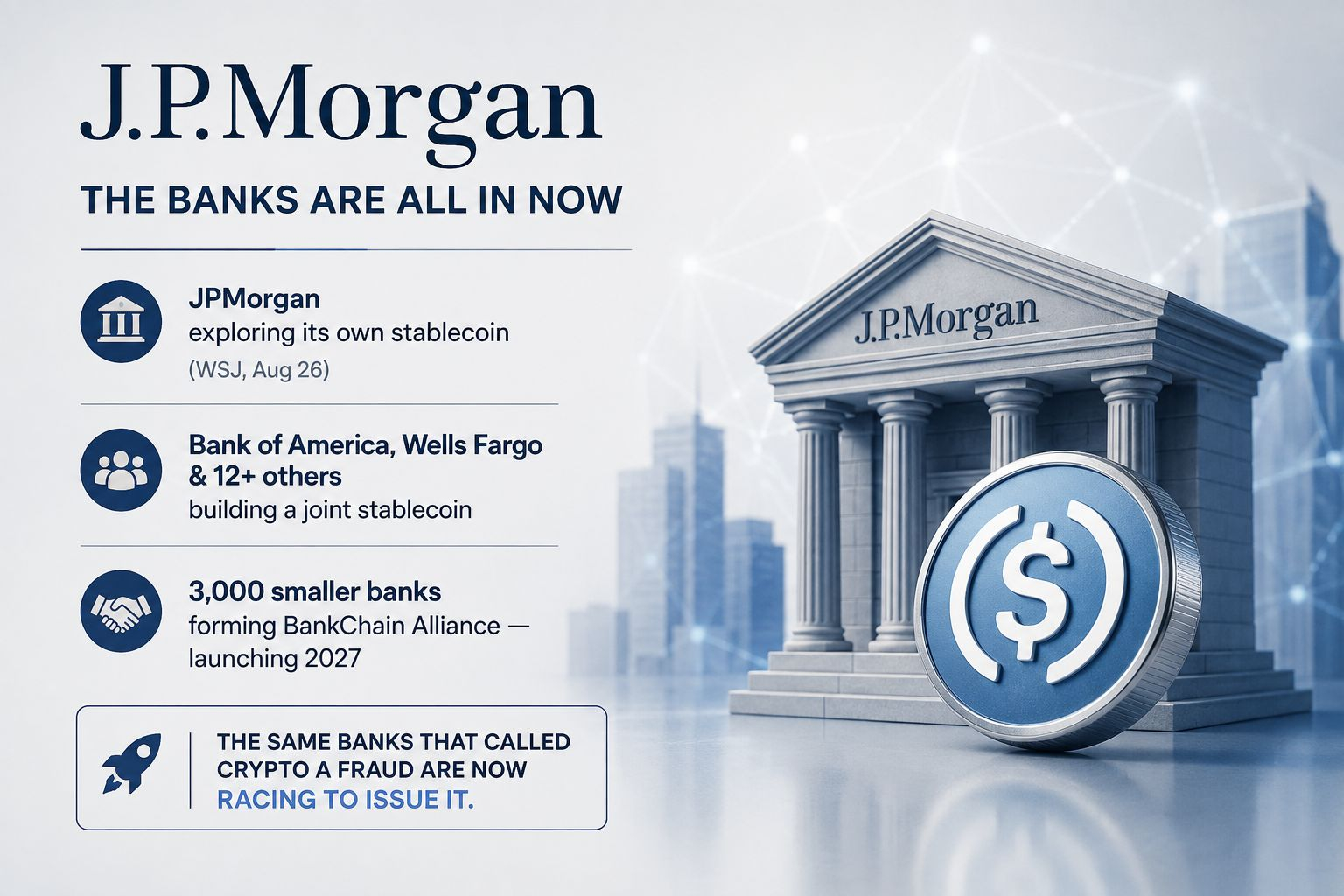
Bullish🏦💥 THE BANKS ARE ALL IN NOW
🔹 JPMorgan exploring its own stablecoin (WSJ, Aug 26)
🔹 Bank of America, Wells Fargo & 12+ others building a joint stablecoin
🔹 3,000 smaller banks forming BankChain Alliance — launching 2027
The same banks that called crypto a fraud are now racing to issue it. 👀🚨
#Stablecoin #JPMorgan #Crypto #Web3 #JPMorgan
$DEXE $HEMI $EDEN
🔹 JPMorgan exploring its own stablecoin (WSJ, Aug 26)
🔹 Bank of America, Wells Fargo & 12+ others building a joint stablecoin
🔹 3,000 smaller banks forming BankChain Alliance — launching 2027
The same banks that called crypto a fraud are now racing to issue it. 👀🚨
#Stablecoin #JPMorgan #Crypto #Web3 #JPMorgan
$DEXE $HEMI $EDEN



CR

CR Insights
·
--
🎁 COMMENT & CLAIM — BINANCE GIFT DROP 🎁
We’re making this one simple 👀
💬 Drop a comment below — just say yes
🎁 Then claim your gift!
A few lucky comments will get a surprise gift! 👀
No complicated steps.
No long forms.
Just comment yes , stay active, and keep an eye on the replies.
Let’s see who’s actually here 👇🔥
We’re making this one simple 👀
💬 Drop a comment below — just say yes
🎁 Then claim your gift!
A few lucky comments will get a surprise gift! 👀
No complicated steps.
No long forms.
Just comment yes , stay active, and keep an eye on the replies.
Let’s see who’s actually here 👇🔥

dt

DT_Singh
·
--
The person who bought $SOL at 75, today their face is finally smiling 😂
From 75.39 (Sell Avg) to 108.44 — that means a 43% move! And this isn’t some random pump—it's a STEADY climb:
• 7 Days: +32%
• 30 Days: +43%
• 90 Days: +31%
BUT — 1 Year: -44% — which means old holders are still in the “waiting to come to breakeven” mode 💀
Look at the chart—the pattern shows consistent higher lows and consistent higher highs. This has a “recovery” vibe, not a “pump and dump” vibe.
Funny part:
People who entered at 75 and saw it drop to 65 thinking “Should I sell?”—today are seeing a 40% profit.
And people buying at 108 right now will have to think, “Wasn’t the top last week?”
In the order book, there are 47.78% sellers—so the “booking profit” mode is strong. When so many people are selling at the top, what happens next?
This is what happens with Solana too—slow recovery ↗️, then a crash in a day or two ↘️, then back to recovery 😅
Did someone recently enter with SOL? Or are you still waiting for the recovery to complete? 👇
#SOL #solanAnalysis #RecoveryStory #CryptoReality
From 75.39 (Sell Avg) to 108.44 — that means a 43% move! And this isn’t some random pump—it's a STEADY climb:
• 7 Days: +32%
• 30 Days: +43%
• 90 Days: +31%
BUT — 1 Year: -44% — which means old holders are still in the “waiting to come to breakeven” mode 💀
Look at the chart—the pattern shows consistent higher lows and consistent higher highs. This has a “recovery” vibe, not a “pump and dump” vibe.
Funny part:
People who entered at 75 and saw it drop to 65 thinking “Should I sell?”—today are seeing a 40% profit.
And people buying at 108 right now will have to think, “Wasn’t the top last week?”
In the order book, there are 47.78% sellers—so the “booking profit” mode is strong. When so many people are selling at the top, what happens next?
This is what happens with Solana too—slow recovery ↗️, then a crash in a day or two ↘️, then back to recovery 😅
Did someone recently enter with SOL? Or are you still waiting for the recovery to complete? 👇
#SOL #solanAnalysis #RecoveryStory #CryptoReality
done

Shaheen 69
·
--
🎁 BINANCE PUT ALL THE GIFTS IN ONE BASKET! 🟡
Imagine one basket filled with Airdrops, Red Packets, Trading Rewards, Token Vouchers, CreatorPad rewards, Write-to-Earn opportunities and VIP benefits. 🚀
That’s what makes the Binance ecosystem exciting — it’s not only about trading, but also about discovering new opportunities, participating in campaigns and sharing rewards with the community.
And today, Shaheen69 is opening the gift basket for YOU! 🎉
I’m sharing Red Packet rewards with all of you as a small thank-you for your continued support and love. ❤️
Good luck everyone! 🍀
Who will grab the reward? 👀
#Binance #BNB #redpacket
Imagine one basket filled with Airdrops, Red Packets, Trading Rewards, Token Vouchers, CreatorPad rewards, Write-to-Earn opportunities and VIP benefits. 🚀
That’s what makes the Binance ecosystem exciting — it’s not only about trading, but also about discovering new opportunities, participating in campaigns and sharing rewards with the community.
And today, Shaheen69 is opening the gift basket for YOU! 🎉
I’m sharing Red Packet rewards with all of you as a small thank-you for your continued support and love. ❤️
Good luck everyone! 🍀
Who will grab the reward? 👀
#Binance #BNB #redpacket

gogogo

Bilverse
·
--
🧧 BIG SOL IS WAITING INSIDE THESE RED PACKETS… 🧧
The Solana Red Packets are ready with BIG Rewards sitting inside! 💜💚
💰 Want to claim yours?
👇 3 SIMPLE STEPS:
1️⃣ FOLLOW my account
2️⃣ ❤️ LIKE this post
3️⃣ 💬 COMMENT “294” below to claim 🎁
Don’t wait until the Red Packets are gone. 👀
SOL community, make some noise! ⚡️
Click here to DOUBLE your Rewards! 🧧🚀
🌌 SOL TO THE MOON 🚀
#SOL #RedPacketMission #Bilverse #CryptoCommunity
The Solana Red Packets are ready with BIG Rewards sitting inside! 💜💚
💰 Want to claim yours?
👇 3 SIMPLE STEPS:
1️⃣ FOLLOW my account
2️⃣ ❤️ LIKE this post
3️⃣ 💬 COMMENT “294” below to claim 🎁
Don’t wait until the Red Packets are gone. 👀
SOL community, make some noise! ⚡️
Click here to DOUBLE your Rewards! 🧧🚀
🌌 SOL TO THE MOON 🚀
#SOL #RedPacketMission #Bilverse #CryptoCommunity



阿布拉@ABL阿布辣2020

ABL阿布辣2020
·
--
“Reuters” reveals Meta’s predicament after AI layoffs:
Cybersecurity incidents up 40%, time spent cleaning up up 70%
In recent months, social media giant Meta has repeatedly carried out mass layoffs to develop AI. In a follow-up report published by Reuters on August 26, it noted that Meta CEO Mark Zuckerberg had already proposed an AI transformation plan as early as January this year. The initiative, code-named Organization Transformation (OT), aims to move Meta toward an “AI-native” operating model, where AI takes over much of the daily work originally handled by employees, leaving only smaller teams with higher talent density to oversee operations. After news of Meta’s layoffs plan leaked in March, employee morale was hit hard, and supervisors were even told to play down the handling—only informing teams that their future roles would “evolve” because of AI.
According to an internal post by Meta’s CTO Andrew in June, the amount of code written by employees using AI has grown year over year by up to 220%, but the number of new features or upgrades that were actually deployed to benefit users has grown by only 36%. Instead of improving performance, the wave of AI-assisted coding has raised concerns about reliability, leading to “large-scale, disruptive AI agent behavior.” As a result, major technical and cybersecurity incidents increased by 40% compared with the same period last year, and the time employees spent “cleaning up” issues surged by 70%.$AAPL.US
Cybersecurity incidents up 40%, time spent cleaning up up 70%
In recent months, social media giant Meta has repeatedly carried out mass layoffs to develop AI. In a follow-up report published by Reuters on August 26, it noted that Meta CEO Mark Zuckerberg had already proposed an AI transformation plan as early as January this year. The initiative, code-named Organization Transformation (OT), aims to move Meta toward an “AI-native” operating model, where AI takes over much of the daily work originally handled by employees, leaving only smaller teams with higher talent density to oversee operations. After news of Meta’s layoffs plan leaked in March, employee morale was hit hard, and supervisors were even told to play down the handling—only informing teams that their future roles would “evolve” because of AI.
According to an internal post by Meta’s CTO Andrew in June, the amount of code written by employees using AI has grown year over year by up to 220%, but the number of new features or upgrades that were actually deployed to benefit users has grown by only 36%. Instead of improving performance, the wave of AI-assisted coding has raised concerns about reliability, leading to “large-scale, disruptive AI agent behavior.” As a result, major technical and cybersecurity incidents increased by 40% compared with the same period last year, and the time employees spent “cleaning up” issues surged by 70%.$AAPL.US
White Shark @白鲨观点

白鲨观点
·
--
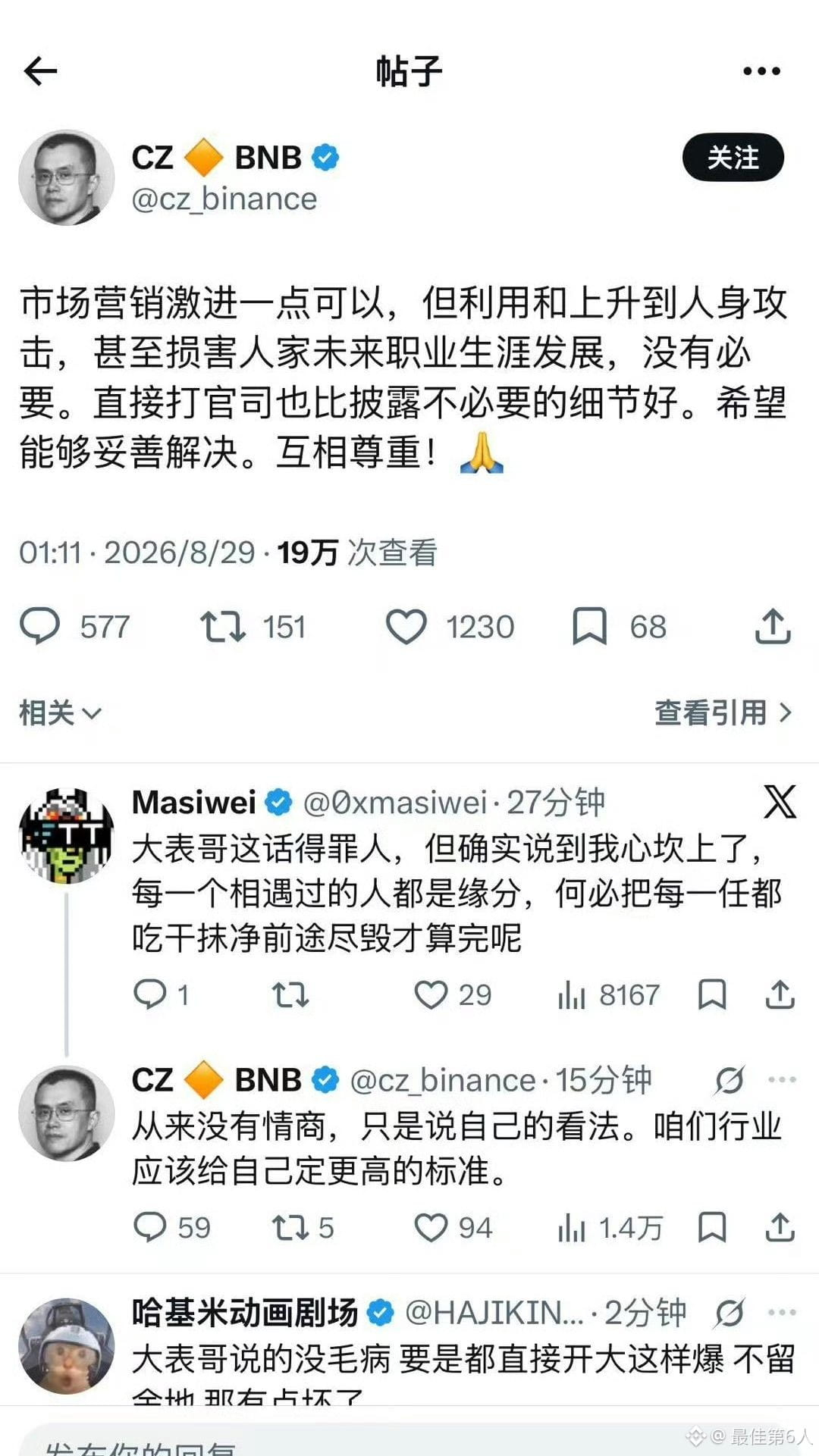
Sun Yuchen’s piece titled “My Girlfriend Jing Tian” has cornered all the trending topics on the entire Chinese internet. My first reaction was to laugh; and as I kept laughing, I thought—this is just too “Sun Yuchen.”
A man with a net worth of $8.5 billion, for more than $30 million in bride price, lays out details of his ex-girlfriend’s private life for the whole internet to watch. You say he’s short on money? No way. You say he’s deeply devoted? Even the ending has a line that says, “This article is entirely fictional.”
It’s like the pump-and-dump tactics commonly seen in the crypto circle—you think it’s value discovery, but in reality it’s attention being cashed out. Sun Yuchen has always understood this: the Buffett lunch was filmed and then he didn’t go, using the heat for two waves; he paid $6.2 million for a banana and ate it publicly, getting headlines everywhere. His life is a continuous “market-making” of attention—every incident is like an “on-chain” moment, turning controversy, gossip, and shock value into traffic and exposure.
But you need to see the essence clearly: attention can pump prices, and it can also dump them. The most worth-guarding in this incident isn’t the melodramatic plot—it’s that the founder’s public-opinion risk is now transmitting to related assets. Tron TRX, HTX, and the Trump coin he’s deeply tied to are, in essence, “Sun Yuchen concept stocks.” When the founder’s public image shifts from “the king of crypto marketing” to “the male lead in a relationship dispute,” the fragility of the chip structure gets amplified.
More subtly, there’s the detail that’s been mentioned again and again: when Jing Tian asked him, “Can you come to Beijing?” he went silent. Behind that silence lie questions about travel restrictions, regulatory risk, and asset liquidity. For someone who can’t even get back to the capital, how much of his wealth is paper glory, and how much is real cash in hand—let the market weigh it.
Gossip is for looking at, not for paying for the story. The iron rules of the crypto world have never changed: the more noisy the founder is, the more calmly you must think. He’s cashed in all that attention—yet you might end up becoming the cost of the attention economy.
#孙割 #景甜 #Binance #BTC
A man with a net worth of $8.5 billion, for more than $30 million in bride price, lays out details of his ex-girlfriend’s private life for the whole internet to watch. You say he’s short on money? No way. You say he’s deeply devoted? Even the ending has a line that says, “This article is entirely fictional.”
It’s like the pump-and-dump tactics commonly seen in the crypto circle—you think it’s value discovery, but in reality it’s attention being cashed out. Sun Yuchen has always understood this: the Buffett lunch was filmed and then he didn’t go, using the heat for two waves; he paid $6.2 million for a banana and ate it publicly, getting headlines everywhere. His life is a continuous “market-making” of attention—every incident is like an “on-chain” moment, turning controversy, gossip, and shock value into traffic and exposure.
But you need to see the essence clearly: attention can pump prices, and it can also dump them. The most worth-guarding in this incident isn’t the melodramatic plot—it’s that the founder’s public-opinion risk is now transmitting to related assets. Tron TRX, HTX, and the Trump coin he’s deeply tied to are, in essence, “Sun Yuchen concept stocks.” When the founder’s public image shifts from “the king of crypto marketing” to “the male lead in a relationship dispute,” the fragility of the chip structure gets amplified.
More subtly, there’s the detail that’s been mentioned again and again: when Jing Tian asked him, “Can you come to Beijing?” he went silent. Behind that silence lie questions about travel restrictions, regulatory risk, and asset liquidity. For someone who can’t even get back to the capital, how much of his wealth is paper glory, and how much is real cash in hand—let the market weigh it.
Gossip is for looking at, not for paying for the story. The iron rules of the crypto world have never changed: the more noisy the founder is, the more calmly you must think. He’s cashed in all that attention—yet you might end up becoming the cost of the attention economy.
#孙割 #景甜 #Binance #BTC


@超人不会飞2020 continues fixed-interval investment

超人不会飞2020
·
--
[Replay] 🎙️ Day 15 of Investing in BTC via Weekly Dollar-Cost Averaging with Super 100U
03 h 45 m 25 s · 11.7k listens


Verified
In my view, Dusk Network has managed to stand out among numerous privacy public chains primarily because it precisely addresses the most difficult contradiction in real-world asset (RWA) tokenization: how to meet stringent regulatory compliance requirements while ensuring commercial privacy. After taking a deep dive into its underlying architecture, I’ve found that this isn’t a simple stacking of features, but a deep native integration from the consensus layer all the way to the application layer.
First, Dusk’s Succinct Attestation (SA) consensus mechanism lays the foundation for enterprise-grade applications. Unlike the probabilistic finality of traditional public chains, SA provides deterministic finality—meaning once a transaction is confirmed, it becomes irreversible. This perfectly matches the strict need for settlement certainty in traditional finance. Even better, its introduced “blind attestation” mechanism uses zero-knowledge proofs to verify the eligibility of validators. While safeguarding network security, it also completely hides validators’ staked amounts and identities, preventing leakage of commercial intent at the foundational level.
On the execution layer, Dusk, through the combination of the Zedger architecture and the Piecrust virtual machine, achieves truly confidential smart contracts. Zedger is designed specifically for regulated assets, with transfer restrictions, corporate actions such as profit distributions, and other behaviors directly encoded on-chain. Meanwhile, the Piecrust virtual machine—by optimizing cryptographic primitives—significantly reduces the verification cost of zero-knowledge proofs. With this design, complex financial logic can run inside a “black box”; the network only verifies the correctness of results without exposing sensitive holdings or strategy data.
However, what truly sets Dusk apart from other privacy chains is its brilliant real-world capability for “selective disclosure.” Relying on the Citadel identity protocol and the Phoenix privacy model, Dusk builds a complete zero-knowledge compliance system. In RWA trading scenarios, institutions don’t need to publicly disclose trade details to the entire network. They only need to provide zero-knowledge proofs to regulators or auditors, thereby proving compliance with regulatory requirements such as KYC/AML and MiCA without revealing specific amounts and identities. This mechanism of “confidentiality to the public, transparency to regulators” is precisely the key that enables Dusk to carry trillion-level compliant financial assets.
#dusk $DUSK @Dusk
First, Dusk’s Succinct Attestation (SA) consensus mechanism lays the foundation for enterprise-grade applications. Unlike the probabilistic finality of traditional public chains, SA provides deterministic finality—meaning once a transaction is confirmed, it becomes irreversible. This perfectly matches the strict need for settlement certainty in traditional finance. Even better, its introduced “blind attestation” mechanism uses zero-knowledge proofs to verify the eligibility of validators. While safeguarding network security, it also completely hides validators’ staked amounts and identities, preventing leakage of commercial intent at the foundational level.
On the execution layer, Dusk, through the combination of the Zedger architecture and the Piecrust virtual machine, achieves truly confidential smart contracts. Zedger is designed specifically for regulated assets, with transfer restrictions, corporate actions such as profit distributions, and other behaviors directly encoded on-chain. Meanwhile, the Piecrust virtual machine—by optimizing cryptographic primitives—significantly reduces the verification cost of zero-knowledge proofs. With this design, complex financial logic can run inside a “black box”; the network only verifies the correctness of results without exposing sensitive holdings or strategy data.
However, what truly sets Dusk apart from other privacy chains is its brilliant real-world capability for “selective disclosure.” Relying on the Citadel identity protocol and the Phoenix privacy model, Dusk builds a complete zero-knowledge compliance system. In RWA trading scenarios, institutions don’t need to publicly disclose trade details to the entire network. They only need to provide zero-knowledge proofs to regulators or auditors, thereby proving compliance with regulatory requirements such as KYC/AML and MiCA without revealing specific amounts and identities. This mechanism of “confidentiality to the public, transparency to regulators” is precisely the key that enables Dusk to carry trillion-level compliant financial assets.
#dusk $DUSK @Dusk
·
--
🎙️ Superman 100U fixed investment in BTC on day 12, DUSK long or short

End
02 h 23 m 12 s
7.5k
15
Today, as the public-chain track grows increasingly crowded, Dusk Network has chosen an exceptionally difficult path: trying to completely solve the zero-sum game of “compliance and privacy” at the very base of Layer 1. This is not a simple technical upgrade, but a full-scale rearchitecture of traditional public-chain design.
Dusk’s core ambition is “auditable privacy.” Unlike Oasis, which isolates privacy within ParaTime, Dusk embeds zero-knowledge proofs into the protocol layer, enabling default-confidential financial logic through confidential smart contracts (XSC). This means regulators can verify the legitimacy of transactions via cryptography without peeking into commercial secrets. This “do hard privacy first, then talk compliance” approach precisely targets the pain points of RWA (real-world asset) tokenization, offering what is, in theory, a perfect solution for regulated on-chain finance.
However, ideals are full and reality is harsh. This kind of underlying rework brings extremely high engineering friction. By abandoning the EVM state model and switching to the UTXO-based Rusk virtual machine, developers must relearn an entirely new programming paradigm—debugging can feel like “groping for an elephant in a dark box.” Even more fatal are the performance bottlenecks: the high computational cost of zero-knowledge proofs rapidly inflates the ledger, makes node synchronization difficult, and still leaves a significant gap from institutional-grade high-frequency clearing.
Looking back at token value, $DUSK faces a severe test. Its long, 36-year token release schedule creates persistent inflation pressure. Without sufficient real RWA settlement volume to generate enough Gas burn, the token is all too likely to become merely a PoS staking tool. Although the team is working to reduce friction—by collaborating with the Dutch exchange NPEX and launching DuskEVM to bring in real business—the high concentration of the stakes remains the ever-hanging sword of Damocles.
Dusk isn’t just racing for throughput; it is seriously answering a fundamental question: can on-chain finance be both verifiable and hideable? Can it become “basic, boring infrastructure” in the eyes of regulated institutions? In the end, it doesn’t depend on the technical whitepaper—it depends on whether it can make financial institutions willing to pay for this “compliant privacy” and truly run massive settlement volumes. Until real clearing volume arrives, maintaining due reverence may be the best strategy for investors.
#dusk $DUSK @Dusk
Dusk’s core ambition is “auditable privacy.” Unlike Oasis, which isolates privacy within ParaTime, Dusk embeds zero-knowledge proofs into the protocol layer, enabling default-confidential financial logic through confidential smart contracts (XSC). This means regulators can verify the legitimacy of transactions via cryptography without peeking into commercial secrets. This “do hard privacy first, then talk compliance” approach precisely targets the pain points of RWA (real-world asset) tokenization, offering what is, in theory, a perfect solution for regulated on-chain finance.
However, ideals are full and reality is harsh. This kind of underlying rework brings extremely high engineering friction. By abandoning the EVM state model and switching to the UTXO-based Rusk virtual machine, developers must relearn an entirely new programming paradigm—debugging can feel like “groping for an elephant in a dark box.” Even more fatal are the performance bottlenecks: the high computational cost of zero-knowledge proofs rapidly inflates the ledger, makes node synchronization difficult, and still leaves a significant gap from institutional-grade high-frequency clearing.
Looking back at token value, $DUSK faces a severe test. Its long, 36-year token release schedule creates persistent inflation pressure. Without sufficient real RWA settlement volume to generate enough Gas burn, the token is all too likely to become merely a PoS staking tool. Although the team is working to reduce friction—by collaborating with the Dutch exchange NPEX and launching DuskEVM to bring in real business—the high concentration of the stakes remains the ever-hanging sword of Damocles.
Dusk isn’t just racing for throughput; it is seriously answering a fundamental question: can on-chain finance be both verifiable and hideable? Can it become “basic, boring infrastructure” in the eyes of regulated institutions? In the end, it doesn’t depend on the technical whitepaper—it depends on whether it can make financial institutions willing to pay for this “compliant privacy” and truly run massive settlement volumes. Until real clearing volume arrives, maintaining due reverence may be the best strategy for investors.
#dusk $DUSK @Dusk
Partly True
I reran Dusk’s testnet—not to look at the prices, but to confirm one thing: when compliance and privacy are hard-coded into Layer 1, has the ledger structure really changed?
In the past, we always treated confidentiality and compliance as mortal enemies. But Dusk is trying to sort out this relationship from the ground up. Traditional public chains rely on “full transparency” to reduce verification costs; however, real-world financial markets simply can’t afford the cost of having order flow and positions exposed. Dusk’s Confidential Security Contracts (XSC) provide the answer: using zero-knowledge proofs, automatic enforcement of compliance rules such as eligibility and limits without exposing sensitive data.
But privacy isn’t magic—it brings very high engineering hurdles. Dusk’s Rusk virtual machine completely abandons EVM’s state model. Writing transfer contracts now requires rethinking the underlying note structure. When debugging confidential transfers, event logs automatically hide amounts—great for audits, but troubleshooting feels like trying to find your way in a black box.
I compared Oasis and Concordium as well. Oasis isolates confidential state within the ParaTime layer; the main chain remains transparent and it is EVM-compatible, so migration costs are low. Concordium, on the other hand, handles on-chain identity first and only then discusses privacy. Dusk goes the opposite way: it insists that the entire settlement layer runs in encrypted state. This path—“hard privacy first, then compliance interfaces”—does fit the settlement logic of security tokens, but the trade-off is heavy: during node synchronization, the ledger grows extremely fast, and the zero-knowledge proof delay is on the order of seconds even on standard machines, still far from institutional-grade high-frequency settlement.
So Dusk’s real test isn’t benchmark scores. It’s whether it can become “basic, boring infrastructure” in the eyes of regulated institutions—not some exotic frontier technology. And how much friction cost are financial users actually willing to pay for this kind of privacy?
Coming back to the token itself, the logic behind $DUSK doesn’t deviate. If there isn’t real institutional settlement volume to back it up, it can only be a staking-yield instrument. I won’t ignore that risk just because the technical approach looks clean. Dusk isn’t racing to maximize throughput—it’s seriously answering this question: can on-chain finance be both verifiable and private? As for the answer, we’ll have to wait for real settlement volume to verify.
#dusk $DUSK @Dusk
In the past, we always treated confidentiality and compliance as mortal enemies. But Dusk is trying to sort out this relationship from the ground up. Traditional public chains rely on “full transparency” to reduce verification costs; however, real-world financial markets simply can’t afford the cost of having order flow and positions exposed. Dusk’s Confidential Security Contracts (XSC) provide the answer: using zero-knowledge proofs, automatic enforcement of compliance rules such as eligibility and limits without exposing sensitive data.
But privacy isn’t magic—it brings very high engineering hurdles. Dusk’s Rusk virtual machine completely abandons EVM’s state model. Writing transfer contracts now requires rethinking the underlying note structure. When debugging confidential transfers, event logs automatically hide amounts—great for audits, but troubleshooting feels like trying to find your way in a black box.
I compared Oasis and Concordium as well. Oasis isolates confidential state within the ParaTime layer; the main chain remains transparent and it is EVM-compatible, so migration costs are low. Concordium, on the other hand, handles on-chain identity first and only then discusses privacy. Dusk goes the opposite way: it insists that the entire settlement layer runs in encrypted state. This path—“hard privacy first, then compliance interfaces”—does fit the settlement logic of security tokens, but the trade-off is heavy: during node synchronization, the ledger grows extremely fast, and the zero-knowledge proof delay is on the order of seconds even on standard machines, still far from institutional-grade high-frequency settlement.
So Dusk’s real test isn’t benchmark scores. It’s whether it can become “basic, boring infrastructure” in the eyes of regulated institutions—not some exotic frontier technology. And how much friction cost are financial users actually willing to pay for this kind of privacy?
Coming back to the token itself, the logic behind $DUSK doesn’t deviate. If there isn’t real institutional settlement volume to back it up, it can only be a staking-yield instrument. I won’t ignore that risk just because the technical approach looks clean. Dusk isn’t racing to maximize throughput—it’s seriously answering this question: can on-chain finance be both verifiable and private? As for the answer, we’ll have to wait for real settlement volume to verify.
#dusk $DUSK @Dusk
Log in to explore more content