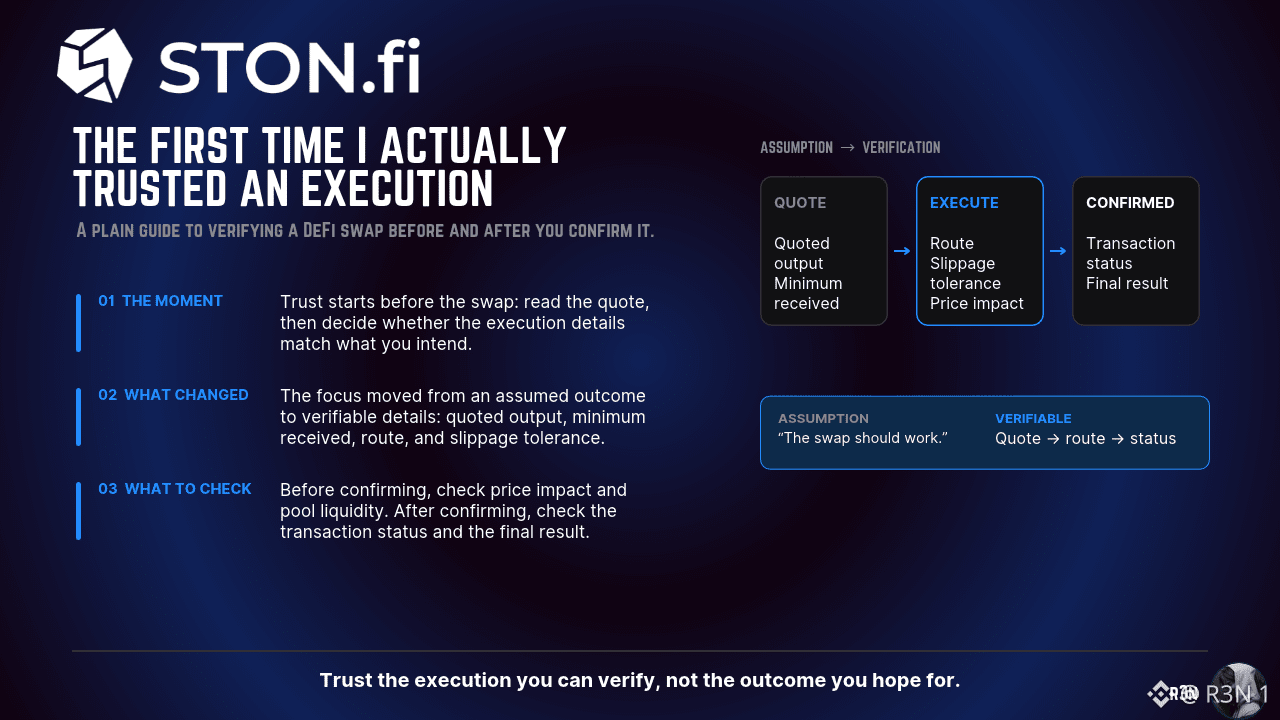
I spent a long time in DeFi with a specific background anxiety around execution. Not dramatic fear. Just a low-level expectation that the amount I saw on the confirmation screen and the amount that actually arrived would be different by some percentage I couldn't predict and couldn't control. Slippage settings helped. They didn't eliminate the uncertainty. They just moved the line. The anxiety came from enough experiences where the gap between expected and received was large enough to notice and small enough to not know whether to blame the market, the interface, or the route. The uncertainty about which variable was responsible made it impossible to address. What changed my default assumption was running cross-chain swaps through Omniston on @ston_fi repeatedly and noticing the same thing each time. The amount confirmed was the amount that arrived. Not approximately. Not within a tolerance I had set and accepted. The same figure. I understand mechanically why this happens. The resolver commits to delivering the quoted amount. The HTLC structure enforces that commitment or returns the original assets. The outcome is conditional on delivery rather than probabilistic around it. The architecture produces consistency that AMM-based execution can't guarantee under the same conditions. What I didn't expect was how much that consistency changed the way I think about execution quality as a variable. Once you've run enough swaps where the quote matches the result you start noticing how unusual that actually is compared to everything you used to accept as normal. The anxiety doesn't disappear entirely. But it moves from execution to analysis — which is where it belongs. Try cross-chain swaps → https://app.ston.fi/swap?mode=cross-chain #BTC Price Analysis# $SOL #TON ecosystem, here to discover the latest projects# $PI