
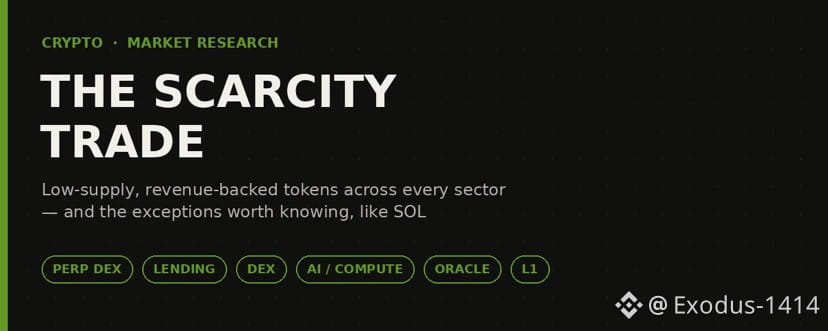

Every cycle produces a “smart money” narrative. Heading into the next leg of this bull run, one is gaining real traction: tokens with a low, capped supply (under 10 billion units), genuine product revenue, and a mechanism that actively shrinks circulating supply using that revenue.
The filter is strict on purpose. A mid-2026 review of eleven major “buyback and burn” tokens found only two were verifiably net-deflationary once new emissions were counted — the rest are running a marketing narrative on top of supply that’s still quietly growing. So below, sector by sector, are the names that genuinely clear the bar — plus a few well-known exceptions: tokens that break one rule of the thesis but are too important, or too instructive, to leave out.
🚨Perpetuals / Derivatives —$HYPE (Hyperliquid)
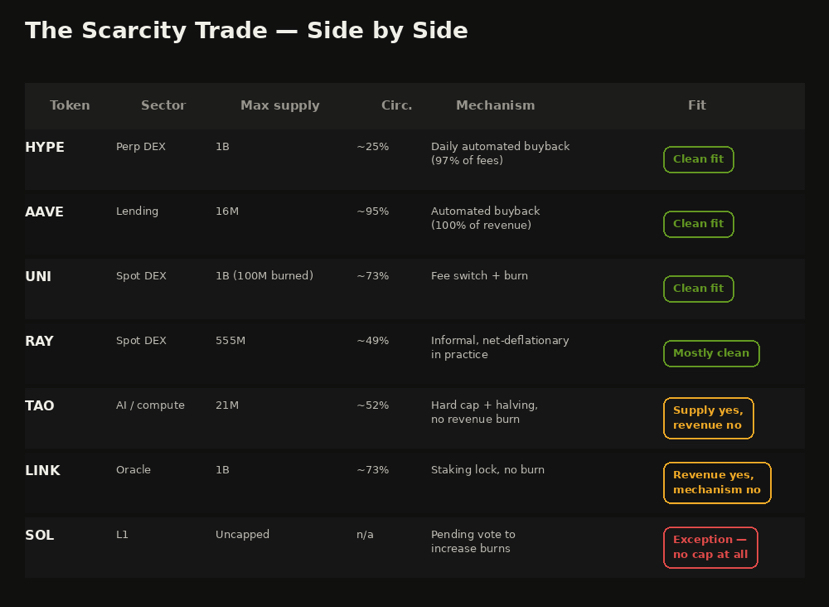
Max supply: 1,000,000,000 (hard-capped) · Circulating: ~252M
Hyperliquid dominates on-chain perpetuals with roughly 70% share of the decentralized perps market and $170B+ in 30-day volume. Roughly 97% of protocol fees flow automatically into daily, non-discretionary open-market HYPE buybacks — no governance vote needed per cycle. Cumulative revenue passed $1 billion in mid-2026, generated by a self-funded team of about a dozen people. Around 4.6% of original supply has already been absorbed by buybacks.
Risk: Only ~25% circulating; buyback pace is tied directly to trading volume, which is cyclical.
🫡Lending / Credit —$AAVE (Aave)
Max supply: 16,000,000 (~95% circulating — one of the smallest hard caps of any major protocol token)
The largest DeFi lending protocol, $12B+ TVL. Under “Aavenomics 3.0” (mid-2026), 100% of Aave Protocol and GHO stablecoin revenue routes automatically into on-chain AAVE buybacks — roughly $400M annualized, removing an estimated ~292 AAVE per day. All-time protocol fees exceed $2.2 billion. Standard Chartered began formal analyst coverage on AAVE in mid-2026.
Risk: Buyback budget is revenue-linked and governance-adjustable — it was already trimmed once, from $50M/year to $30M/year.
🛫Decentralized Exchanges — UNI (Uniswap) and RAY (Raydium)
UNI — Max supply: 1,000,000,000, with 100M permanently burned (Dec 2025) · ~730M circulating
Uniswap processes $1T+ annualized volume across 40+ chains. The “UNIfication” vote (99.9% support) activated a long-delayed fee switch and burned $596M worth of UNI in one shot — converting UNI from a pure governance token into a genuine cash-flow asset for the first time. Net Unichain sequencer revenue now feeds an ongoing burn.
Risk: The ongoing burn rate (excluding the one-time event) is modest — roughly 4–5M UNI/year against continued Foundation spending of up to 20M UNI on growth.
RAY — Max supply: 555,000,000 (~49% circulating)
Raydium is one of the founding pillars of Solana DeFi and remains a core liquidity engine for the entire ecosystem, having processed $640B+ in volume in 2025 alone.
It’s riding a genuinely strong tailwind: as of August 28, 2026, Solana DeFi carries $5.9B+ in TVL, $3.4B+ in daily DEX volume, nearly $16B in stablecoin supply, and 2.65M active addresses — and Solana’s own DEX activity has now outpaced major centralized exchanges for nine straight weeks, with spot Solana ETFs pulling their strongest single-day inflows since December 2025 this month.
Raydium sits right at the center of that flow, powering swaps, concentrated liquidity, and token launches (via LaunchLab) across the chain. On the token side, RAY has no formally announced burn program, but independent research flagged it as one of the rare tokens that’s quietly net-deflationary anyway, in practice, without needing a press release. Worth watching closely as Solana’s broader momentum builds.
Layer 1 Blockchains — $SOL (Solana) — the sector leader that just proved it
Supply: No hard cap, but disinflationary by design — and now tightening faster, as of today.
Solana is the strongest-performing major L1 of 2026 on almost every fundamental metric that matters: DEX volumes have outpaced major centralized exchanges for nine straight weeks, spot Solana ETFs just posted their strongest single-day inflows since December 2025, and the ecosystem carries $5.9B+ in DeFi TVL, $3.4B+ in daily DEX volume, and nearly $16B in stablecoin supply as of late August 2026. This isn’t a narrative token — it’s the chain actual usage is flowing to.
And as of today, August 29, 2026, Solana backed that up with action: in its first-ever binding on-chain governance vote, validators passed SGP-0002, doubling Solana’s annual disinflation rate from 15% to 30% and pulling the network’s 1.5% terminal inflation floor forward from 2032 to 2029 — permanently removing an estimated 18.9 million SOL (~$1.4B) from the projected long-term issuance schedule.
It cleared the required two-thirds supermajority by the narrowest possible margin, with a major validator flipping its vote in the final hour to push it through. A companion fee-burn proposal (SGP-0003) fell just short this round, but the core result stands: Solana’s largest stakeholders just voted, live, to make SOL scarcer. This is the L1 to watch — scarcity earned through governance, backed by the deepest usage in the sector.
Decentralized AI / Compute — #TAO (Bittensor) — sector leader, imperfect fit
Max supply: 21,000,000 (hard-capped, Bitcoin-style halving; ~10.9M circulating, ~52% of max)
TAO is the leading decentralized-AI token, powering 128+ specialized “subnets” where miners are paid for useful machine-learning output. Its first halving (Dec 2025) cut daily emissions from 7,200 to 3,600 TAO, and 65–70%+ of circulating supply is staked, creating a genuinely thin float.
Why it’s an exception, not a clean pick: Unlike HYPE, AAVE, or UNI, TAO’s external revenue is small and largely unaudited. One independent bear-case analysis estimated a major subnet’s real customer revenue at just $1.3–2.4M/year against $22–40 in token emissions paid out for every $1 earned — a heavy subsidy, not organic demand, at least for now. The scarcity mechanics are real; the revenue side of the thesis is still unproven at scale. Include TAO for the supply discipline and AI-sector optionality, not as a “real revenue” case yet.
🚨Oracles / Middleware — #LINK (Chainlink) — sector leader, imperfect fit
Max supply: 1,000,000,000 (~727M circulating)
Chainlink secures $33B+ in value across DeFi and has expanded into tokenized funds (Amundi’s Spiko, $400M+ AUM in three weeks) and cross-chain infrastructure (CCIP, 35 chains). Its Economics 2.0 staking model locks LINK to secure oracle services, with 45M LINK currently staked.
Why it’s an exception, not a clean pick: LINK has no burn mechanism — staking locks tokens but doesn’t remove them from total supply, and roughly 300M tokens (Chainlink Labs’ allocation) remain undisclosed on any public vesting schedule, a real dilution overhang. Reported protocol revenue (~$4.6M) is tiny relative to the $30T+ in transaction value the network claims to secure. Best read as “massive adoption, thin direct token capture” — the opposite problem from TAO.
🚨🚨Layer 1 Blockchains — #solana (Solana) — the headline exception
Supply: No hard cap (inflationary issuance, currently disinflationary)
Solana doesn’t belong in a “fixed low supply” list by the letter of the rule — it has no maximum supply, unlike every other name here. It’s included because it’s arguably the most important exception in the entire thesis: in August 2026, two live governance votes (SGP-0002 and SGP-0003) proposed doubling Solana’s disinflation rate and sharply increasing daily token burns, aimed at tightening supply as network usage grows. Solana’s DEX volumes have surpassed major centralized exchanges for nine straight weeks, and spot Solana ETFs pulled in their strongest single-day inflows since December 2025 in August.
Why it’s here anyway: If SGP-0002/0003 pass, SOL would take a real structural step toward the same “usage funds scarcity” model as HYPE and UNI — just starting from an uncapped base rather than a hard one. It’s the clearest live example of a major L1 trying to retrofit this thesis onto itself. Worth tracking the vote outcome specifically, not assuming it’s already deflationary.
Sectors Worth Naming — and Why They Don’t Fit (Yet)
• Payments (#Xrp🔥🔥 , XLM, HBAR): All disqualified by supply alone — XRP’s 100B max, HBAR’s 50B max, and Stellar’s 50B max are far outside the sub-10B threshold, regardless of adoption quality.
• RWA / Tokenization (#ONDO ): Strong real-world-asset narrative and growing institutional adoption, but ~4.9B circulating supply with no burn mechanism disqualifies it from the scarcity thesis specifically — a good sector, not a scarcity play.
• AI agents / newer perp challengers (Aster, NEAR,Lighter): Too early — Lighter has burned ~6.6% of its supply via buybacks and is worth watching, but track record and audited revenue are thin next to HYPE’s.
The Honest Take
Scarcity amplifies existing demand — it doesn’t create it. A token can have a perfect supply cap and still lose value if usage declines, because a buyback engine funded by falling fees simply decelerates. Historically, about 70% of tokens running buyback programs still failed to outperform Bitcoin. Before treating any name above as a thesis to act on:
• Check the net supply change (burns minus new emissions), not the burn headline alone
• Check whether the mechanism is protocol-enforced (Aave, Hyperliquid) or discretionary and reversible by governance (most others)
• Check whether “revenue” is real, audited, external customer revenue — or largely the protocol paying itself in its own token (TAO’s core risk right now)
🚨🚨🚨This article is for informational purposes only and does not constitute financial, investment, or trading advice. Token metrics (supply, revenue, burn rates) change frequently and should be independently verified before making any decision. Not a recommendation to buy, hold, or sell any asset. DYOR.