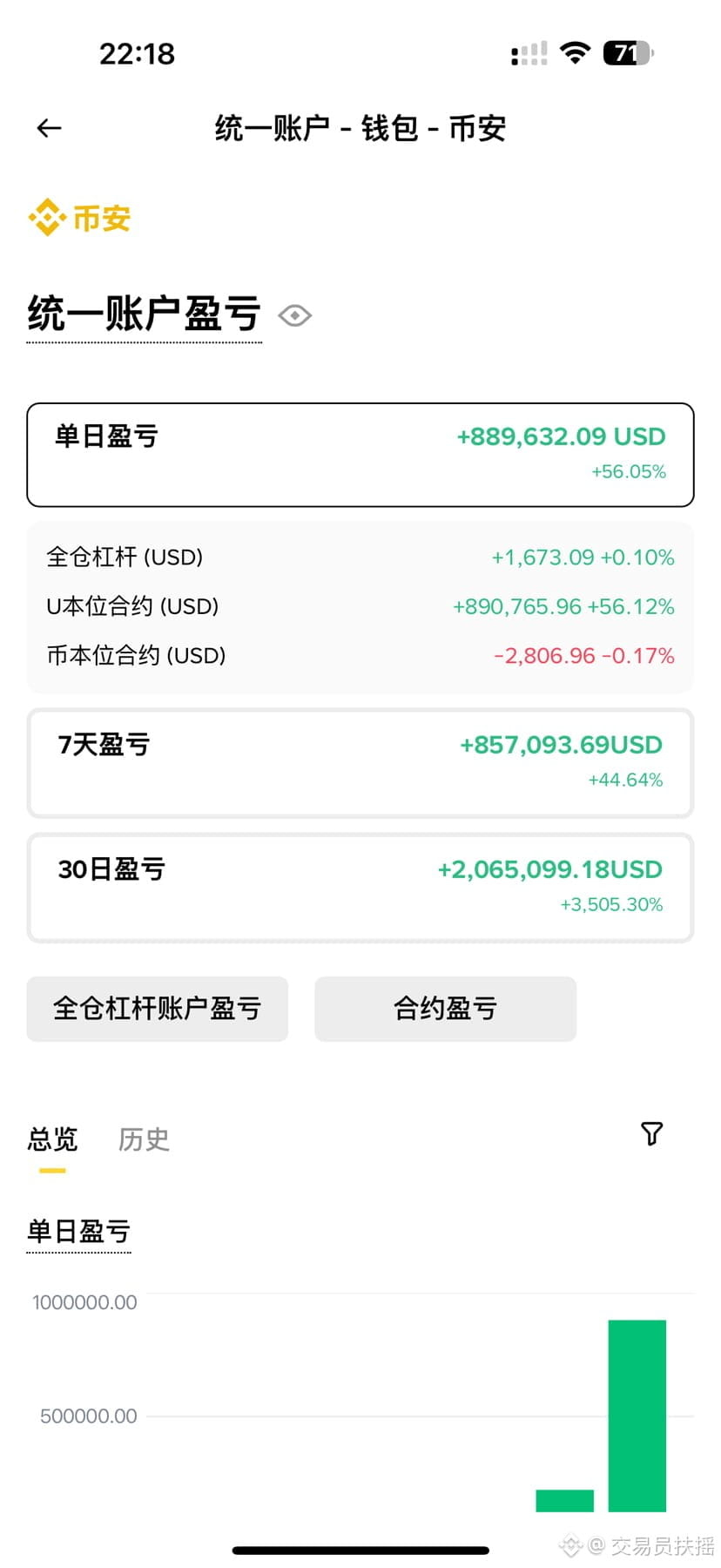
Turning a small bankroll around is not that hard—the real difficulty is whether you can resist making impulsive moves.
If your capital is under 1000U, I’d advise you not to think about doubling overnight first. In the crypto space, people who truly grow small funds don’t rely on luck; they control the risk of every single trade.
I once had a follower who started with 900U. They didn’t chase the latest trends, didn’t go all-in. Instead, by following three rules step by step, they slowly grew the account to nearly 30,000U. The key isn’t that number—it’s that throughout the whole process, not once did a mistake eliminate them.
Rule one: split your funds into three parts—never go all-in.
One portion for short-term trades, one to wait for trend opportunities, and one as “life-saving” capital that you try not to move most of the time. With a small bankroll, the biggest fear is making one wrong move with a heavy position, so you always need to leave yourself an exit.
Rule two: if there’s no opportunity, go flat.
The market doesn’t have action every day. If you can’t make sense of it, don’t trade. If the signal is unclear, wait. Only act when a real opportunity appears—not just to trade for the sake of trading. After you’ve earned profits, you can also withdraw some appropriately and take part of it out for real.
Rule three: stop-loss and take-profit must be decided in advance.
Before you buy, think through what you’ll do if you’re wrong—how you’ll exit—and what you’ll do if you’re right—how you’ll take profit. When the stop-loss hits, you leave. When your profit target is reached, you realize it in batches—never average down to “tough it out,” and never chase higher just because prices are rising.
For a small bankroll, the most important thing has never been how fast you make money. It’s always about making sure you don’t get zeroed out by a single mistake.
Whether it’s going from 900U to 30,000U, or starting with a few thousand and growing from there, the core isn’t getting rich overnight—it’s controlling risk and patiently waiting, so your principal and profits gradually compound.
If you also want to take fewer detours and steady your turnaround,
come find me anytime—we’ll apply the method together.
If your capital is under 1000U, I’d advise you not to think about doubling overnight first. In the crypto space, people who truly grow small funds don’t rely on luck; they control the risk of every single trade.
I once had a follower who started with 900U. They didn’t chase the latest trends, didn’t go all-in. Instead, by following three rules step by step, they slowly grew the account to nearly 30,000U. The key isn’t that number—it’s that throughout the whole process, not once did a mistake eliminate them.
Rule one: split your funds into three parts—never go all-in.
One portion for short-term trades, one to wait for trend opportunities, and one as “life-saving” capital that you try not to move most of the time. With a small bankroll, the biggest fear is making one wrong move with a heavy position, so you always need to leave yourself an exit.
Rule two: if there’s no opportunity, go flat.
The market doesn’t have action every day. If you can’t make sense of it, don’t trade. If the signal is unclear, wait. Only act when a real opportunity appears—not just to trade for the sake of trading. After you’ve earned profits, you can also withdraw some appropriately and take part of it out for real.
Rule three: stop-loss and take-profit must be decided in advance.
Before you buy, think through what you’ll do if you’re wrong—how you’ll exit—and what you’ll do if you’re right—how you’ll take profit. When the stop-loss hits, you leave. When your profit target is reached, you realize it in batches—never average down to “tough it out,” and never chase higher just because prices are rising.
For a small bankroll, the most important thing has never been how fast you make money. It’s always about making sure you don’t get zeroed out by a single mistake.
Whether it’s going from 900U to 30,000U, or starting with a few thousand and growing from there, the core isn’t getting rich overnight—it’s controlling risk and patiently waiting, so your principal and profits gradually compound.
If you also want to take fewer detours and steady your turnaround,
come find me anytime—we’ll apply the method together.