
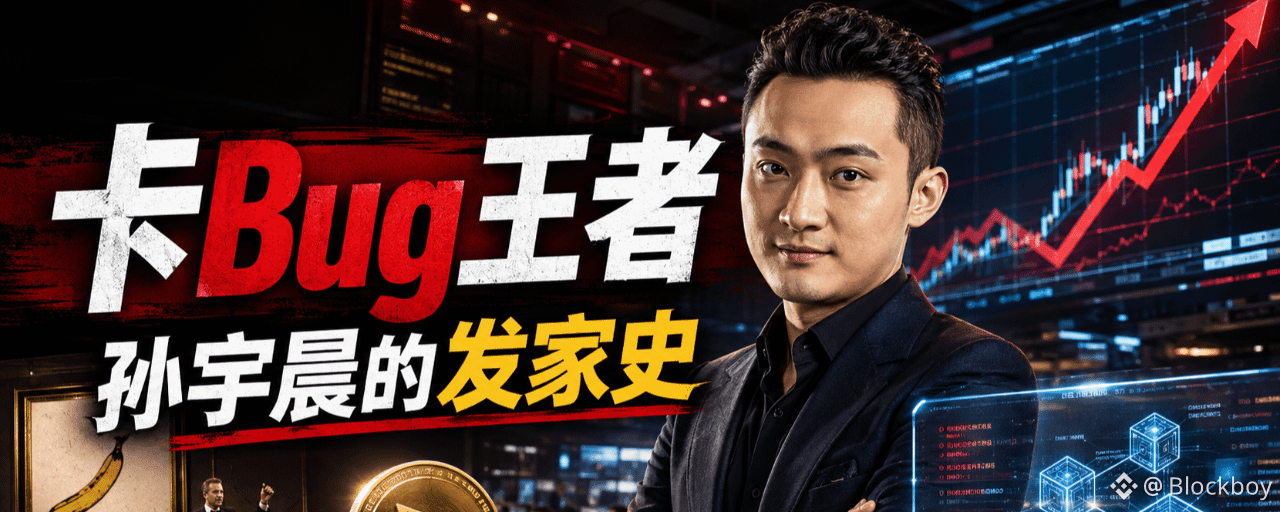

In June 2019, Wang Sicong reposted a news story on his Moments, captioned with seven Chinese characters: “This isn’t just a dumbass, is it.”
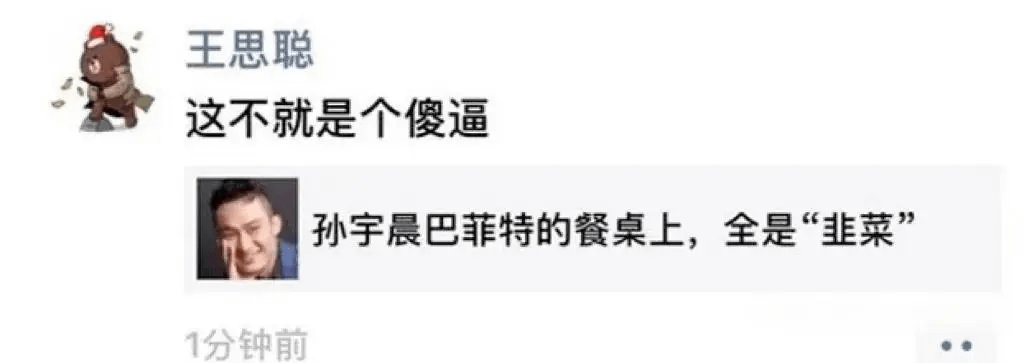
At the time, no one thought there was anything wrong with that remark. A 90s-born man who made his name by issuing tokens—who had just spent $4.56 million to win a Warren Buffett lunch—was, in the eyes of the nation’s “Mr. Right,” nothing more than a joke. Sun Yuchen responded across the distance: “Using dad’s money and you still dare to insult someone who uses their own.” Everyone assumed he was just being stubborn with words.
Seven years later. On August 6, 2026, Forbes’ real-time billionaire list was updated: Sun Yuchen, age 36, with a net worth of $8.5 billion—about RMB 57.4 billion—ranked 435th worldwide; and the family of Wang Jianlin, age 71, with $4.4 billion, ranked 973rd worldwide.
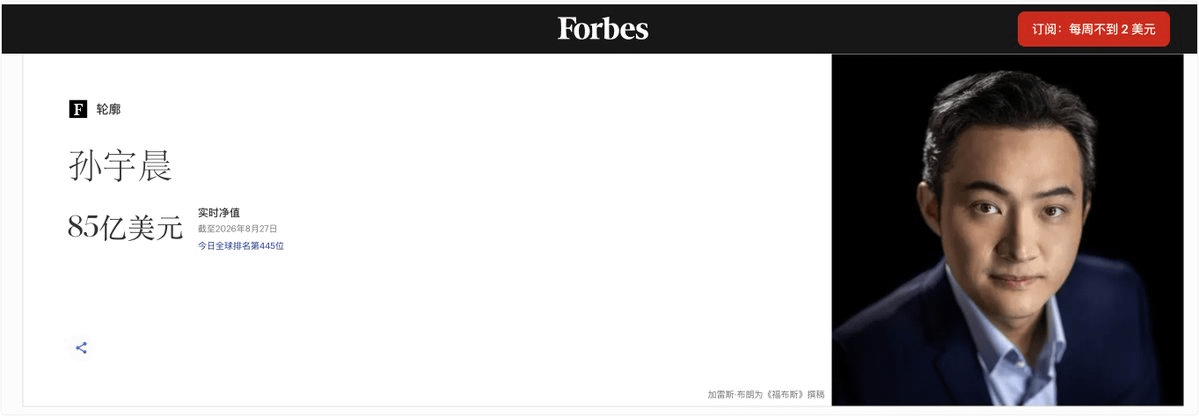
The person who was once cursed as "idiot X" had a net worth already twice that of the family doing the cursing. Wang Sicong has also emptied all his board positions in the Wanda group, turning from a "default successor" into a peripheral shareholder.
Sun Yuchen posted a long article titled (A new generation makes a new version god). In it, he wrote: "Arrogance is always the first asset to be cleared."
This ending is too much like a wish-fulfillment novel. But wish-fulfillment novels only take care of the result, not the process. The real story is: why could this teenager from an ordinary family in Xining, Qinghai, play and win against the whole world?
Because he is so good at finding bugs—and absolutely a king in that area.
He neither creates rules nor fully follows them. In his entire life, he only does one thing—find the loophole in the rules, then sprint ahead within that crack. He did it in the college entrance exam, he did it in entrepreneurship, and even when dealing with the U.S. president's family, he did it the same way.
On the college entrance exam, he exploited a bug
First, let's talk about his starting point. In 1990, Sun Yuchen was born in an ordinary working family in Xining, Qinghai, and at age 4 moved with his family to Huizhou, Guangdong. His family background was average and so were his grades. In the second semester of his sophomore year, his score was only around 390 points. In the normal plot, this score wouldn't get him into any top university.
But he found a rule loophole: the National New Concept Essay Competition. The winner of first prize could receive independent admissions qualifications at Peking University, essentially a green channel that doesn't require competing purely on raw scores.
So he started studying contest strategies, polishing his writing style piece by piece. In 2007, he won first prize in the New Concept Essay Competition, smoothly gaining admission to Peking University.
This wasn't over. After entering Peking University's Department of Chinese, he found it was too hard to get top grades—experts in the Chinese department were everywhere. What to do? Change majors. He switched to the Department of History because history made it easier to secure top rankings through hard work and connections with professors and peers. As a result, he graduated early with a perfect top score in history, and in 2011 he even appeared on the cover of (Asia Weekly) together with Jiang Fangzhou from Tsinghua.
Look, it's the same for taking the top spot. He didn't choose the hardest route. He chose the one with the highest chance of success. The rules are right there. For ordinary people, they're thinking "Am I good enough?" For him, he thinks "Which route is the easiest to qualify for?"
Tuition swapped for Bitcoin to bet on the first pot of gold
During his master's program at the University of Pennsylvania, his views on money were completely reset. He found that a lifelong professor's annual salary was only around 800,000 to 900,000 USD, while young people entering investment banks could earn more than twice that. In his autobiography, he said: "I used to think merchants are guilty. Now I think entrepreneurs are the core of the world turning. The more money someone makes, the nobler it is."
After his mindset changed, he made the most crucial decision of his life: putting all his tuition and living expenses on the line to buy Bitcoin.
That was 2012 to 2013, when Bitcoin was still hovering at around $50 to $60 per coin and mainstream finance considered it a joke. Sun Yuchen bet his entire fortune on it, while also heavily investing in Tesla stock. What happened next is something everyone knows: Bitcoin entered an early bull market, his investment returned dozens of times, and he saved together the first 10 million yuan of his life.
In 2013, he announced he had achieved "financial freedom"—from a poor student to a multimillionaire in just 2 years.
This step laid the foundation of all his wealth. But what really made him formidable was that after he made money, he didn't buy houses or cars. Instead, he did two things: he joined Silicon Valley blockchain company Ripple Labs and became the chief representative for Greater China; then he went back to China to start a business with that title.
One identity brings in tens of millions in funding
After returning to China, he founded Ruibo Technology and did blockchain payment clearing. The company's business never really took off, but it received investment from IDG—the reason was subtle: IDG was originally a shareholder of Ripple, and IDG was trying to push the concept of "post-90s entrepreneurs." Sun Yuchen happened to hit the trend at the right time.
In 2015, came the even more crucial step: he was selected into the first cohort of Alibaba's Yunshan Lake College, becoming the only post-90s participant among more than 30 students.
From then on, four words appeared on his resume: Alibaba's disciple. This identity wasn't bought with money; it was earned with "dare to speak, dare to package." Later, he recalled that at Yunshan Lake, it was like "a duck entering a chicken flock." The traditional VC path wasn't his, but Yunshan Lake gave him the most important thing—endorsement.
In those same years, he made a voice social app called "Just Accompany Me," and even shouted out the remarks: "No buying houses, no buying cars, no getting married—put the money into Tesla, Tencent, and Nvidia." Later, the app was singled out by Xinhua News Agency over involvement in pornography, but he didn't care—what he wanted wasn't the product's success, but to have the label "post-90s entrepreneurship leader" repeatedly confirmed.
By this point, he had already gathered three cards in his hand: the halo of top schools, the endorsement from Yunshan Lake College, and the reputation of a blockchain preacher. With these three cards, during the unprecedented crypto bull market of 2017, he cashed all of them out.
Sold out 500 million tokens in 53 seconds
In 2017, Sun Yuchen founded TRON, aiming to build a "decentralized content entertainment system." First, we need to explain what an ICO is—you can think of it as a kind of "everyone can participate in a public listing." The project team issues a digital credential called a token. People trade in Bitcoin for it. Once the token goes live on exchanges and the price rises, you profit.
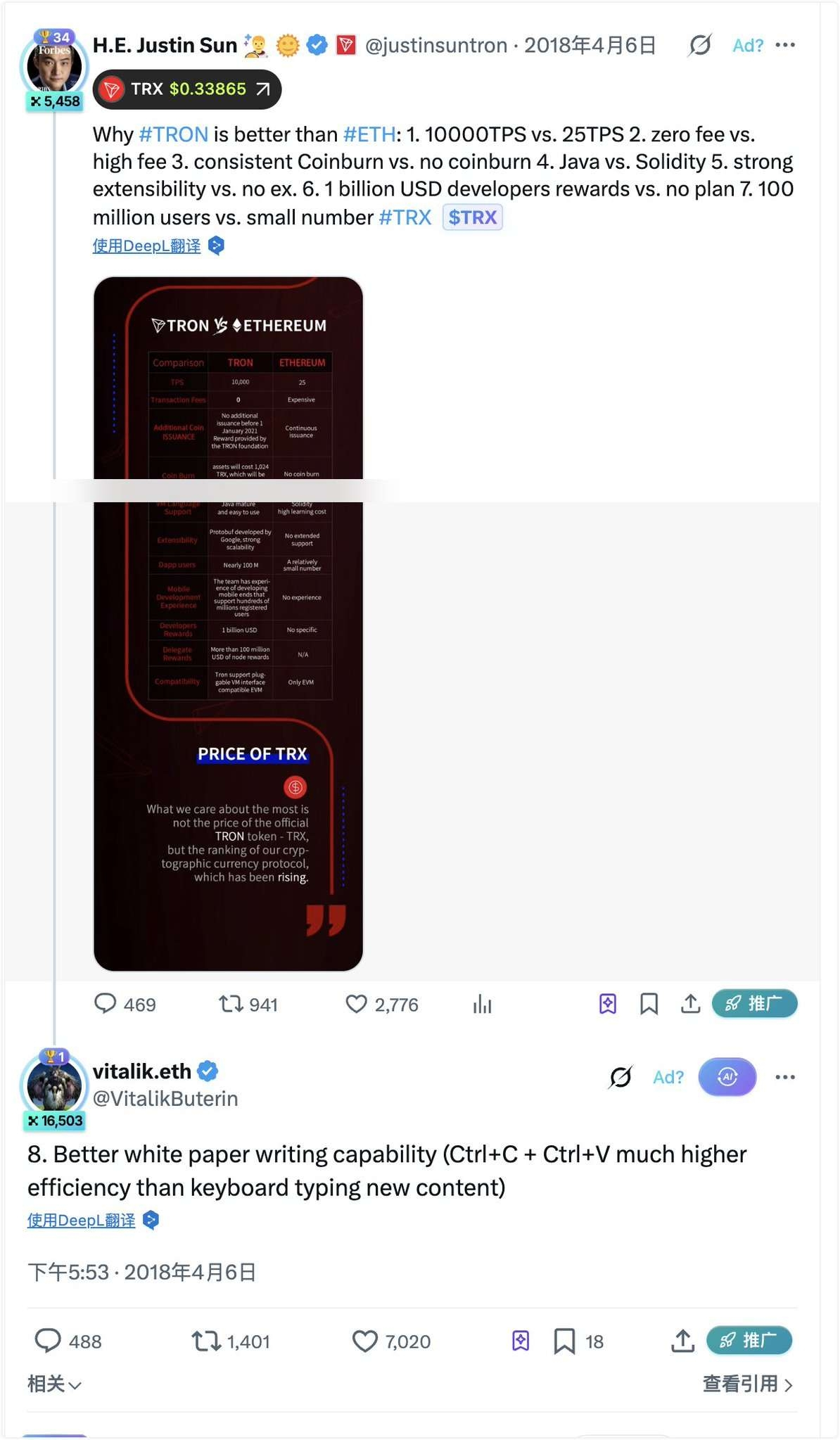
The TRON whitepaper was dug through by people in the industry, who found it borrowed heavily from the frameworks of Ethereum and IPFS. Even Ethereum founder Vitalik Buterin publicly mocked it: "The efficiency of TRX copying and pasting a whitepaper is far higher than creating an original one." But for all the criticism, sales were still blazing fast.
In August 2017, TRON launched on Binance for the first time: 500 million TRX tokens, all sold out within 53 seconds. After three rounds of fundraising, TRON raised about 70 million Bitcoins, which at the time was more than RMB 200 million. The private placement list included big names from the industry such as Wu Jihan, Li Feng, and Dai Wei.
Sun Yuchen hadn't even been happy for a few days when the regulatory hammer came down. On September 4, 2017, the People's Bank of China and seven other ministries jointly issued a statement: ICOs are illegal fundraising and must be cleared out.
After withdrawing the coins, he became the biggest winner
This was Sun Yuchen's first truly darkest moment in life.
At the time, almost the entire crypto market was obediently refunding their money, and only Sun Yuchen once kept his ground and didn't withdraw. People also said he was overseas, so the circle mocked him as "the LeJue Ting of the coin world," suspecting he was running.
A regulatory big stick hung overhead. Investors chased him for money every day. Public opinion called him a fraudster. If he truly didn't withdraw, he could face criminal risk; if he withdrew, then billions of dollars in raised funds would vanish and the project would be as good as done for.
If it succeeds, the project continues and his fortune explodes. If it fails, he ends up in prison, or the project becomes zero.
In the end, he withdrew. But something interesting happened—after he returned the Bitcoin he raised in full, those tokens that originally belonged to investors returned to his hands again. After the cleanup was completed, he alone controlled 90% of TRON's 100 billion token issuance.
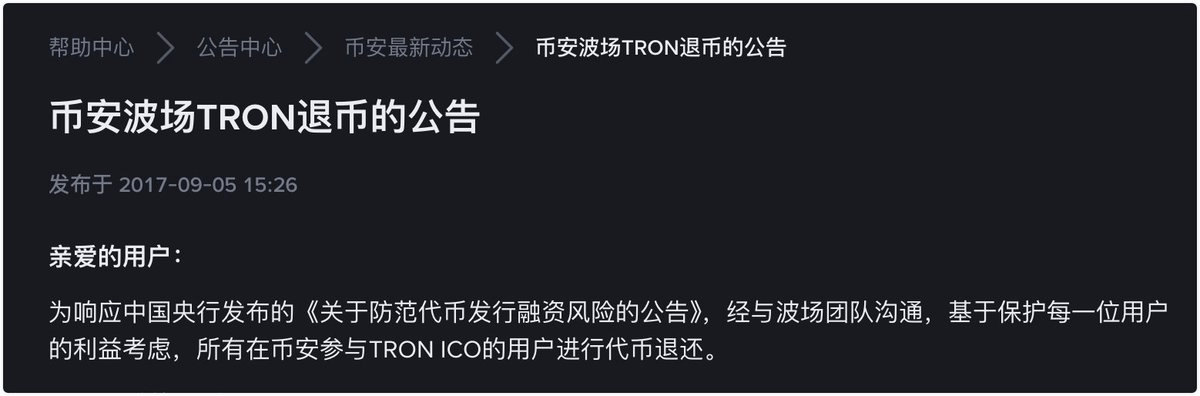
In other words, regulation helped him carry out a kind of "consolidation of equity." To others, it looks like a disaster; to him, it's an opportunity.
Then from late 2017 to early 2018, the crypto market fell into a frenzy party. TRON's coin price surged from 0.01 yuan all the way to a peak of 1.87 yuan. Based on the peak coin price, the total market value once reached 187 billion yuan—90% of which belonged to Sun Yuchen. It took Ma Yun 10 years to build a 100 billion market cap; Sun Yuchen did it in 4 months.
Cashed out 300 million, sealing the name "Sun Ge"
At the peak moment, Sun Yuchen did something that has been resented in the coin world ever since: in January 2018, when the price was high, he dumped 6 billion TRON coins. In a single day, he cashed out $300 million.
From that day on, he gained a nickname that echoed through the crypto world—"Sun Ge," the one who "cuts" retail investors' leeks. When retail rushed in to hold the bag, he sold from the mountaintop—that's the kind of move in the coin world that is unforgivable.
After cashing out, he didn't stop and instead continued expanding. In 2018, he spent $140 million to acquire BitTorrent, a globally well-known download software company—the P2P software that countless people had used to download movies and that had carried massive internet traffic worldwide every day. This acquisition brought TRON a huge number of users, and it made the whole platform look bigger and bigger.
After that, he also renamed Huobi to HTX and took control of this long-established exchange. He moved USDT stablecoins onto the TRON chain at scale—today, the circulating supply of USDT on the TRON chain accounts for about half of the world. Just in transaction fees, it's like a money tree. At this stage, he isn't a mere coin-issuing internet celebrity anymore; he is the ruler of a real crypto empire that holds the three lifelines of the public chain, exchange, and stablecoins.
One meal performed in three acts
In June 2019, Sun Yuchen did something shocking to the world: for $45.67888 million—about RMB 31.54 million—he bought the Buffett charity lunch, setting the highest record for this auction in its 20-year history.
Who is Buffett? He's the catchphrase for "value investing," and also one of Bitcoin's most famous opponents. He called Bitcoin "rat poison." Later, when Bitcoin rose more than 9,000 times, he added another jab: "Maybe it's rat poison squared." Having someone like him have a meal with a post-90s crypto kid is inherently full of drama.
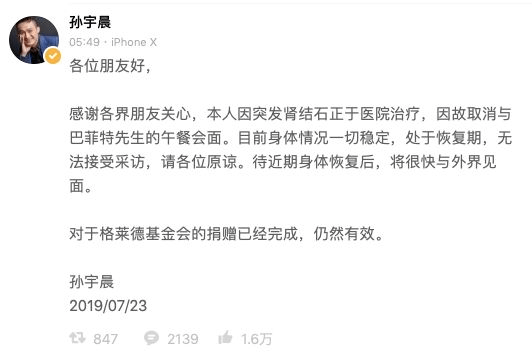
Even more dramatic is the process of that meal. Act one: he announced he had bought the ticket—global uproar followed. "A crypto kid challenges the value-investing guru." All media outlets reported it. Act two: on July 23, he suddenly announced he had to cancel lunch due to a "sudden kidney stone." The internet exploded and speculation flew everywhere—did regulators stop him? Or did Buffett reject him? The hype didn't die down; it only intensified. Act three: in January 2020, he quietly went to meet. After the meal, he released the news—Buffett said at the table that "blockchain has value," and TRON's coin price jumped 13%.
One meal, split into a three-act play—each act was a globally massive exposure. A cost of $4.56 million brought about hundreds of millions of transmissions. People in the circle calculated the numbers: it was worth it.
Sun Yuchen put it very plainly himself: "For companies like ours, to be honest, we're still too low. We can only rely on the boss going all out to issue statements and do PR like crazy to attract investors' attention. PR for us is like a beating heart—it has to jump now and then. If it doesn't jump, it dies. The presentation is hard to look at, but there's no way."
Buy passports, buy rockets, buy bananas
After the Buffett lunch, Sun Yuchen entered an "identity wholesaler" mode—taking the idea of "buying identities" to the extreme:
In 2021, he obtained citizenship of the Caribbean island nation of Grenada. Soon after, he was appointed Grenada's ambassador to the World Trade Organization (WTO)—a status that both the U.S. and China could have a say in, essentially giving him a diplomatic protection umbrella.
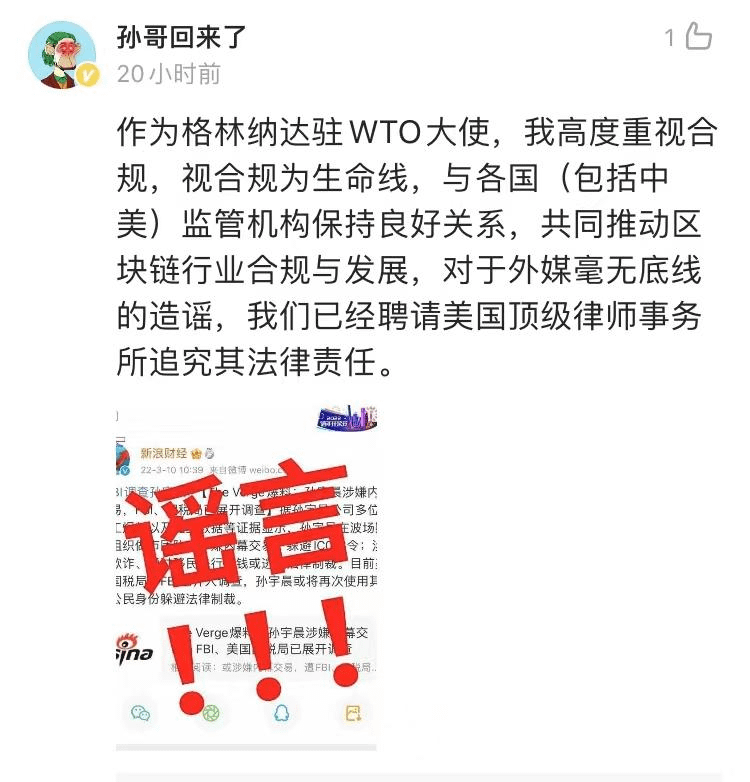
Also in 2021, he spent $28 million to buy the seat for the first flight of a Blue Origin "New Shepard" rocket, the one under Bezos. In August 2025, he truly flew into space and became the youngest Chinese businessman-astronaut.
In 2024, he spent $6.2 million to buy contemporary artist Cattelan's banana—taped to a wall—(a comedic twist), and then, in front of countless cameras, peeled the banana and ate it.
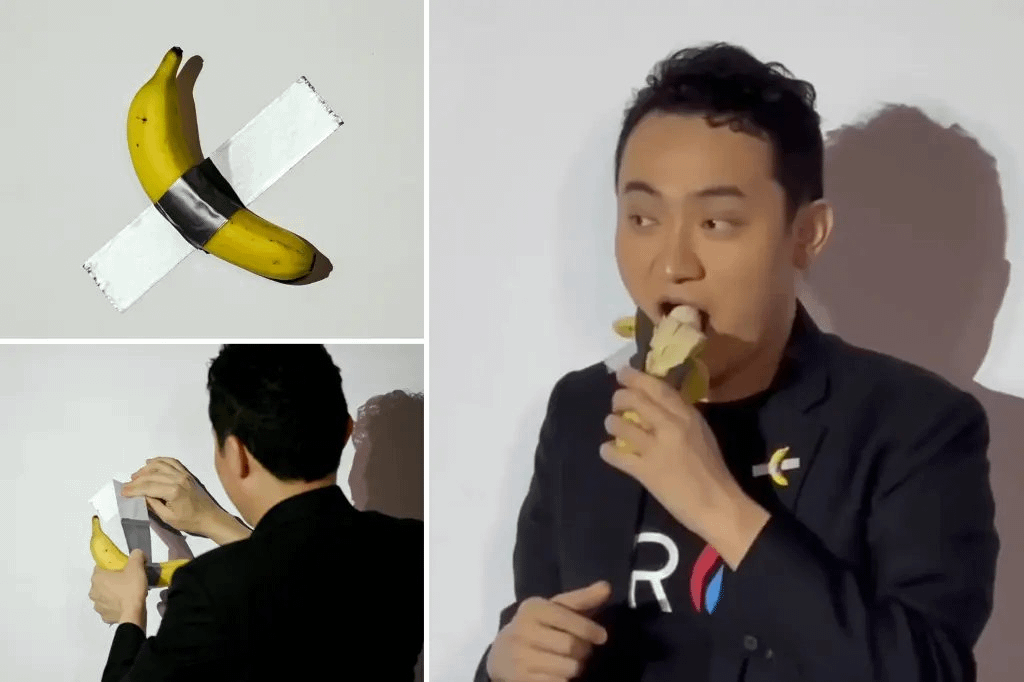
Buying passports, buying rockets, buying bananas—every time he "bought," it became a global headline. The money went out, but the attention came back. In his eyes, attention is the hardest currency of this era.
Bought a talisman for $75 million
At the end of 2024, Sun Yuchen placed the biggest bet of his life.
At the time, he was being sued by the U.S. SEC. In March 2023, the SEC accused him of manipulating the market through roughly 600,000 wash trades and illegally profiting $31 million. This case was hanging over his head, and at any moment it could land him in prison.
At this time, Trump was elected U.S. president, and the crypto projects launched by his family—World Liberty Financial (WLFI)—began fundraising. Sun Yuchen immediately poured in $30 million, and later kept adding until it reached $75 million, becoming the project's largest external investor. He also got an advisor title. Trump's two sons appeared on stage with him at crypto conferences in Dubai and Hong Kong; young Trump also praised his project fiercely on social media.
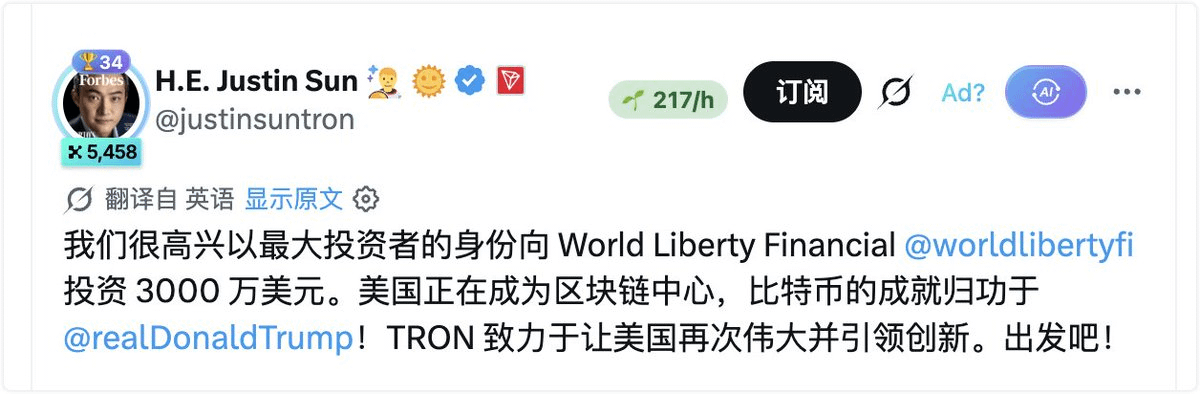
This money had an immediate effect. After Trump took office, in February 2025 the SEC took the initiative to request a pause of the lawsuit against Sun Yuchen. In March 2026, both sides settled for $10 million, and all allegations were completely dropped.
$75 million, buying a "political talisman." At the time, everyone thought he had already won this round.
The talisman turns into a blade
In April 2026, Sun Yuchen posted several angry tweets on the X platform, an unusually furious tone.
He accused WLFI of having a "backdoor blacklist" function built into its smart contracts—allowing anyone's token holders' assets to be frozen unilaterally, without notice, without reasons, and with no appeal channel. He said his 545 million WLFI tokens were frozen, worth more than $300 million. He condemned it as "the opposite of decentralization—dictatorship wearing a DAO mask," and called it a "trapdoor disguised as a doorway."
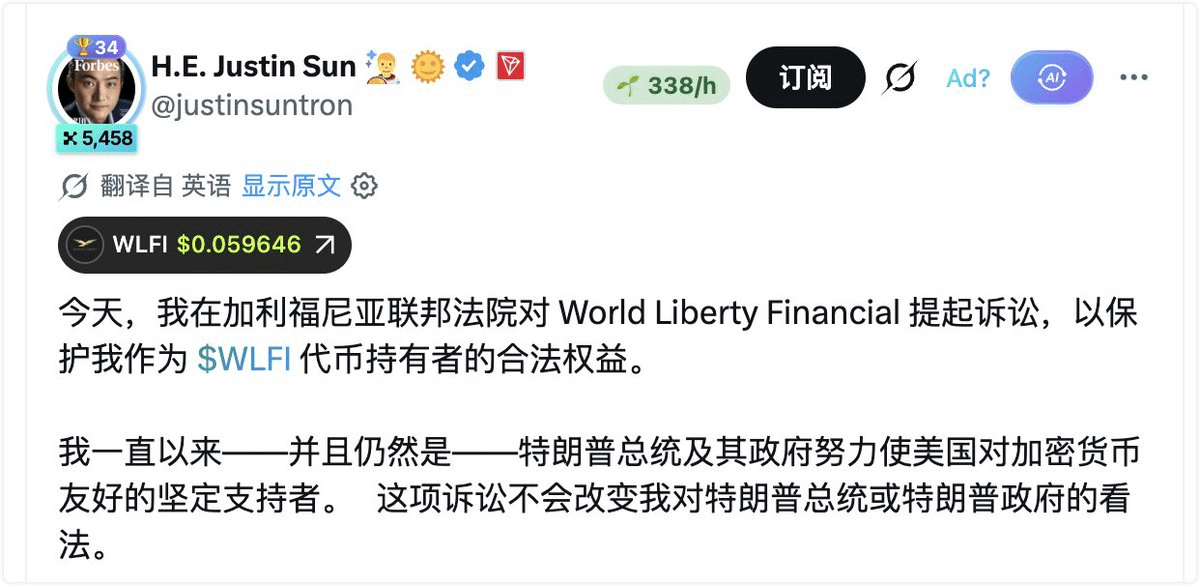
Then he sued the Trump family in a U.S. federal court in California, accusing WLFI of constituting "criminal extortion," seeking $276 million in damages. Trump's son Eric responded hard-line: "We have a contract and evidence. See you in court."
Look how ironic. He spent his life exploiting other people's bugs, and in the end he got stuck by a higher-level bug—because the talisman he bought for $75 million was itself a trap with a backdoor. He was betting on the rules; his opponent was playing with a black box. You use decentralized technology to evade centralized power, only to find that the people holding the code keys are the new power center.
A new version replaces the old one—then the new version becomes a god
On August 6, 2026, the Forbes real-time rich list was updated: Sun Yuchen is worth $8.5 billion, while the Wang Jianlin family is $4.4 billion.
Back then, Wang Jianlin topped China's richest person list for the third time on the strength of real estate, with peak net worth of over 200 billion yuan. Now, Wanda is stuck in a debt swamp, having sold more than 80 plazas in total. Wang Jianlin himself is also facing judicial risk related to joint guarantees. As for Sun Yuchen's wealth, it comes almost entirely from crypto assets—TRX tokens, Bitcoin, Ethereum, as well as the public chain, exchange, and stablecoin ecosystem he controls.
Two eras, completed a silent handover on the leaderboard.
Sun Yuchen replied with poise: "A new era gives birth to new champions. Seeing the Forbes rankings swap positions, I feel no turmoil—only vigilance. Wang Jianlin was also a version god back then, just as I was a young person who wasn't believed. The cruellest part of version upgrades is that those at the peak are always the last to notice."
He also specifically mentioned Wang Sicong: "So if today young people tell me things I can't understand, or even want to mock, it's hard for me to have the confidence like Wang Sicong again. I'll pour him a cup of tea and listen to him talk about his world."
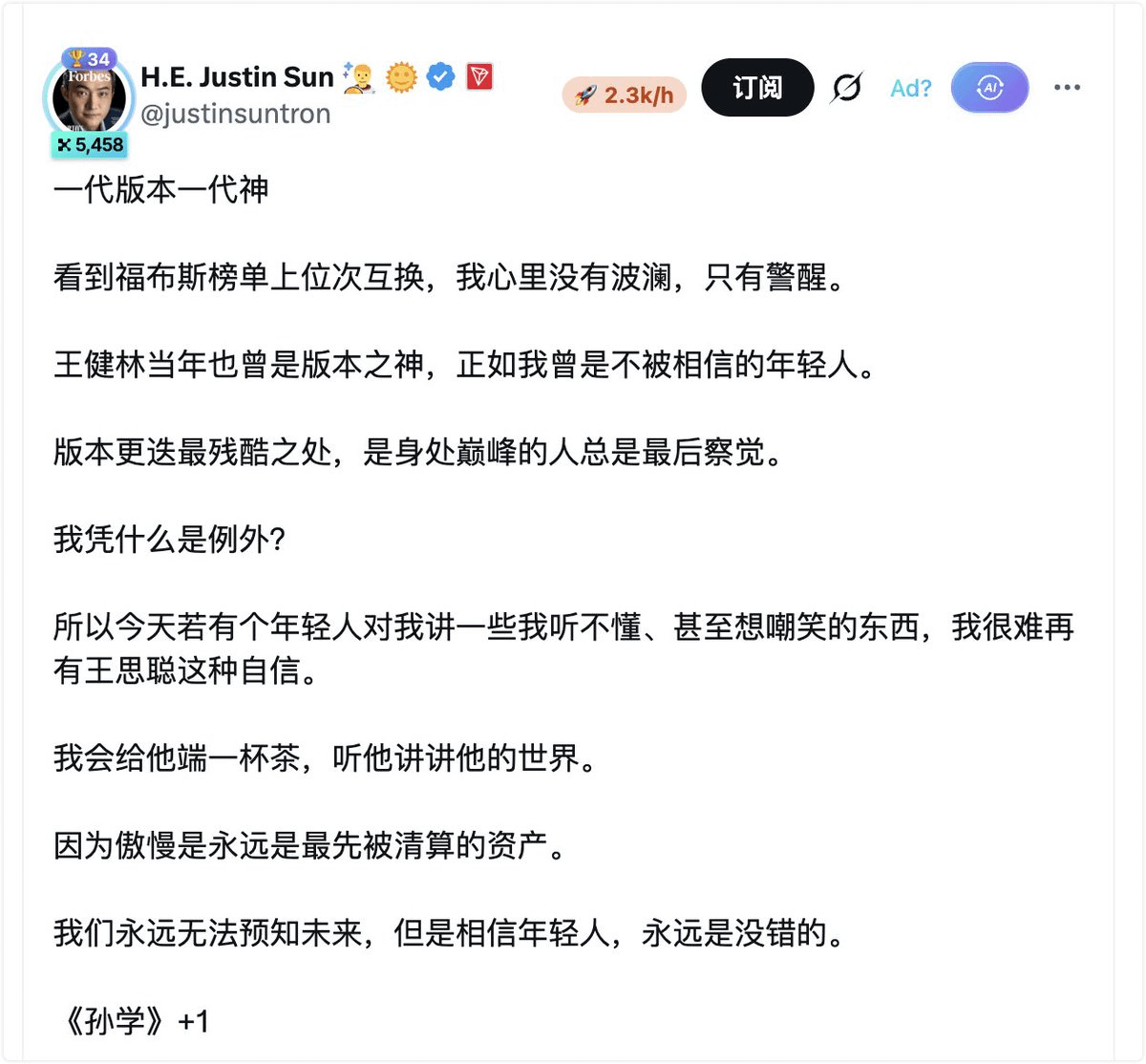
This passage went viral. Some praised his big-picture thinking; others said he was being sarcastic. But few people noticed that Sun Yuchen's own talisman incident still wasn't settled. His lawsuit against the Trump family is still ongoing; of his $8.5 billion fortune, a significant part is only book value—his crypto assets could shrink overnight at any time.
This person who has spent his whole life finding bugs is now sitting at the most difficult table in the world. Whether he can once again drill out of a crack—nobody can say for sure.
But one thing is certain: as long as there are rules and loopholes, Sun Yuchen will never stay put and behave within the rules.
This is his fate, and also his superpower.