


Bitcoin returns to $80,000; the 7-day gain widens to 8%
Bitcoin ($BTC) has recently regained the $80,000 level. After the market experienced a strong rebound earlier, attention has begun to shift to technical key resistance levels, as well as the first keynote speech expected from Federal Reserve (Fed) Chair Kevin Warsh at the Jackson Hole Global Central Bank Annual Conference.
According to CoinGecko’s latest data, as of the morning of August 28, Bitcoin was trading at about $80,402. Over the past 7 days, it has risen by roughly 8.1%. The 24-hour price range has been between $78,598 and $81,282. Total market capitalization is approximately $1.61 trillion, and 24-hour trading volume is about $35.09 billion.
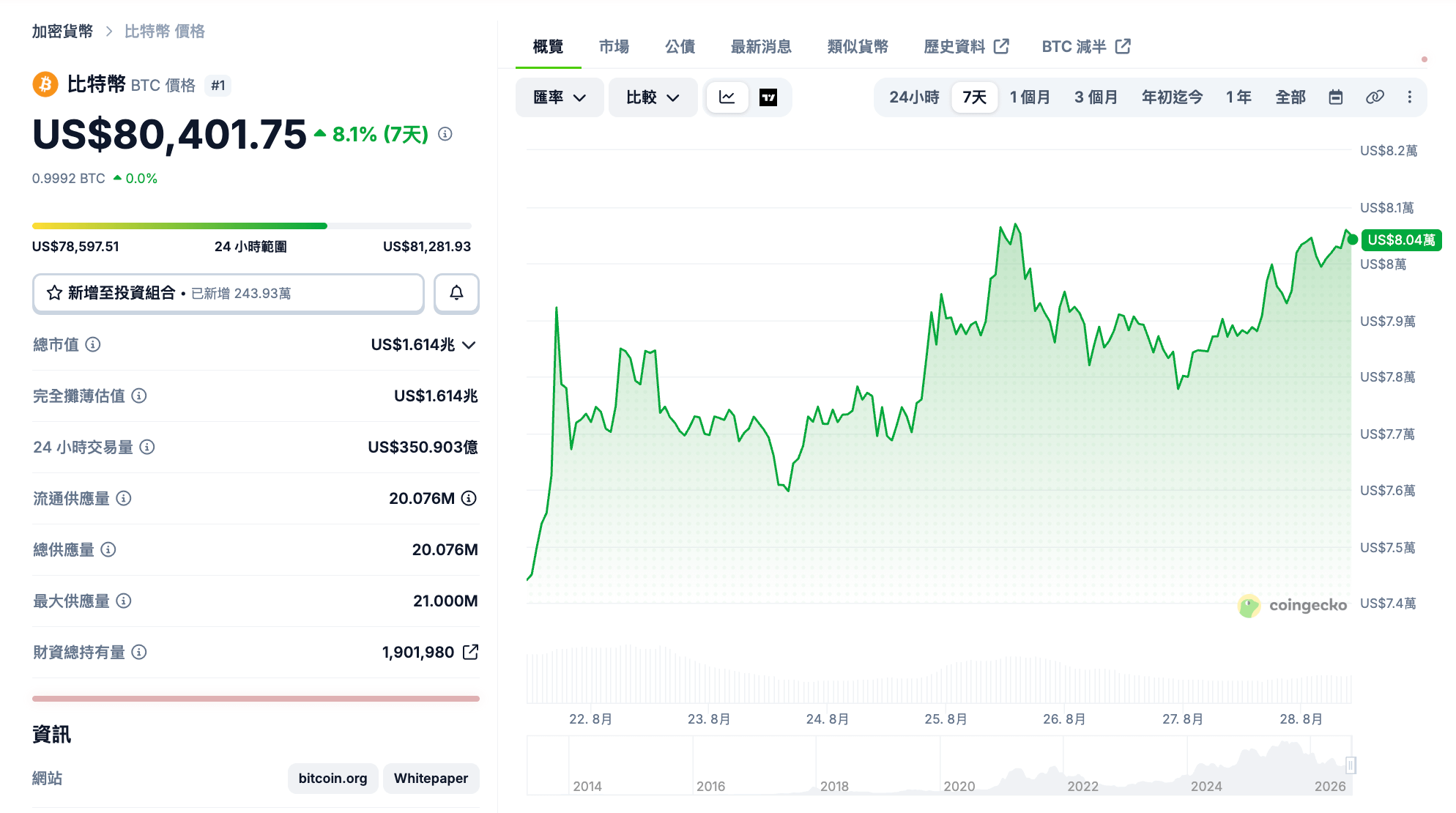 Chart source: CoinGecko. Bitcoin is quoted at about $80,402, up about 8.1% over the past 7 days.
Bitcoin’s rebound this round was once even more aggressive. Earlier, the U.S. Treasury expanded the scale of long-dated Treasury buybacks, which drove Treasury yields and the U.S. dollar lower. The market once again bet on improving liquidity. Bitcoin surged quickly from around $62,000 to $80,000, and the week-over-week gain reached about 23.6%.
After breaking above $80,000, Bitcoin’s rate of increase began to slow. The market is currently assessing whether this fast rebound, driven by short covering and liquidity, can gradually form a medium-term uptrend supported by spot buying.
$81,000–$83,000 is the key resistance area, and the RSI has entered the overbought zone.
From a technical standpoint, after Bitcoin moves above $80,000, it will face denser resistance overhead. Recently, Bitcoin encountered sell pressure around $81,265, while the 50-week moving average is currently near $81,085, forming the first major technical resistance.
On-chain chips are also concentrated in this area. Glassnode data shows that nearly 8% of the circulating Bitcoin supply has a cost basis between $80,000 and $82,000, meaning many investors’ positions are concentrated here. When the price returns to the cost basis zone, some trapped or waiting-to-break-even investors may choose to sell, making a breakout more difficult.
If Bitcoin can further break above the May high of about $82,820, market analysis suggests that the overhead chip pressure would be significantly reduced, and it may even reopen the space to challenge $100,000. Conversely, if the price is again suppressed within the $81,000–$83,000 range, it may retest support in the middle-to-late $70,000s.
Short-term overheating is also a signal the market needs to watch right now. Bitcoin’s Relative Strength Index (RSI) once reached around 82.4 and has clearly entered the overbought zone. While this signal cannot directly indicate that the trend will reverse soon, it usually means that short-term gains are moving fast and the likelihood of taking profits and consolidating increases.
Waller makes his first appearance at Jackson Hole—markets are closely watching rate-hike signals.
Whether Bitcoin can break through technical resistance may next depend on the broader macroeconomic environment. The 2026 Jackson Hole Global Central Bank Conference will be held from August 27 to 29. Fed Chair Kevin Warsh is expected to deliver a speech at 10:00 p.m. Taiwan time on August 28, which will also be his first themed keynote at Jackson Hole since taking office as Fed Chair.
The Fed currently keeps its target range for the federal funds rate at 3.50% to 3.75%, but inflation pressures have not been fully eliminated. July’s Personal Consumption Expenditures (PCE) year-over-year inflation rate came in at 3.7%, above the Fed’s long-term 2% inflation target, leading the market to once again raise expectations for a rate hike in September.
Mark Connors, Head of Investments at Risk Dimensions, believes Waller likely will not directly signal the next interest-rate decision in his speech, but he may still leave open the option of further rate hikes. The market will also watch how Waller discusses inflation, the Fed’s policy framework, the balance sheet, and the direction of future monetary policy.
For Bitcoin, U.S. Treasury yields and global liquidity are also key factors affecting market moves. Hashdex’s Head of Investments, Samir Kerbage, noted that Bitcoin’s relationship with long-end yields and global liquidity is even tighter, and that recent price action has been largely driven by improving liquidity. If Waller takes a more hawkish stance, pushing up Treasury yields and the U.S. dollar, it could compress Bitcoin’s near-term upside; if the market interprets the policy tone as relatively dovish, it would support Bitcoin in continuing to test resistance overhead.
This year’s Jackson Hole focuses on financial innovation, and crypto currencies are rare in taking center stage.
This year’s Jackson Hole theme is directly set as “Financial Innovation: Implications for Payments and Policy,” covering topics including digital payments, stablecoins, tokenized finance, and new financial infrastructure.
According to the agenda released by the host, the Federal Reserve Bank of Kansas City, Waller is scheduled to deliver the opening remarks on August 28. After that, discussions will include Cornell University professor Eswar Prasad, Stanford University professor Darrell Duffie, European Central Bank Executive Board member Isabel Schnabel, and IMF Managing Director Kristalina Georgieva, among others.
One agenda item is even more directly titled “Innovation in Tokenized Finance,” indicating that blockchain and tokenized assets have gradually entered the discussion of financial infrastructure in global central bank circles.
For the crypto market, how Waller views stablecoins, tokenized assets, and new payment systems may also influence longer-term expectations for smart-contract public chains such as Ethereum, as well as related financial agreements.
Bitcoin has now returned above $80,000, but the $81,000–$83,000 range remains a cluster of technical and on-chain resistance. With Jackson Hole set to begin, the market will closely watch the Fed’s latest stance on inflation, interest rates, and financial innovation, and how related signals may affect Bitcoin’s next moves.
“Bitcoin holds steady at $80,000 and takes on key resistance! Jackson Hole central bank conference becomes the focus”—this article was first published by “Crypto City”.