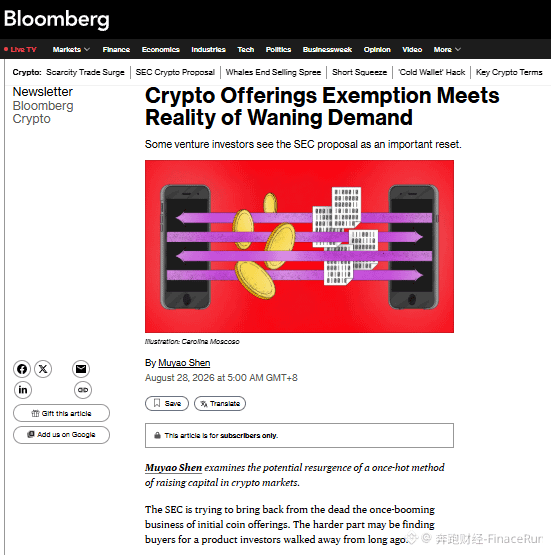
Bloomberg: SEC’s Proposed New Rule Would Revive Public Token Offerings, but the Market Can’t Recreate the 2018 ICO Craze
August 28, according to Bloomberg, the U.S. Securities and Exchange Commission (SEC) has recently put forward a new regulatory framework for crypto-asset financing, aiming to reignite the long-dormant ICO (initial coin offering) funding model.
Under the proposal, startups would be allowed to raise up to $5 million within four years, while the annual funding cap for large projects would be raised to $75 million, and they would not need to submit a complete SEC registration filing.
Judging by the regulatory intent behind the new crypto-asset financing rules, this is undoubtedly a groundbreaking move toward “compliance-based direct financing.”
However, just as the regulatory door has barely opened, the market has already moved on. Bloomberg admits in its report that today’s financing environment is no longer comparable to the frenzy of the 2018 ICO boom.
Data shows that at the peak in January 2018, the monthly funding scale for ICOs reached as high as $3 billion. Today, however, token trading volumes have declined sharply, and retail speculative capital has shifted toward perpetual futures contracts, prediction markets, and the U.S. stock AI sector.
For this “late gift,” industry giants have shown a notably restrained and clear-eyed stance. Dragonfly partner Tom Schmidt said bluntly that having such a rule is better than not having one, but if it had been introduced years ago, its impact would have been far greater.
Pantera Capital partner Cosmo Jiang, meanwhile, directly pointed to the industry’s current reality: previously, meme coins were deemed legal, while tokens with actual value were instead banned—this completely defies the logic of how capitalist societies operate.
Taken together, multiple analysts appear to share a rational consensus. That is, token financing in 2026 will never simply replicate the 2018 ICO wave.
Back then, the market could attract large amounts of capital based solely on whitepapers and concept-driven stories. But after multiple cycles of bull and bear markets, changes in the regulatory environment, and macroeconomic fluctuations, the judgment of investment institutions today has become more pragmatic and cautious.
Therefore, relying only on regulatory compliance exemptions—without genuine cash flow and narrative support—will likely be unable to reignite the financing enthusiasm of that “lawless era.”
#SEC代币融资新规
August 28, according to Bloomberg, the U.S. Securities and Exchange Commission (SEC) has recently put forward a new regulatory framework for crypto-asset financing, aiming to reignite the long-dormant ICO (initial coin offering) funding model.
Under the proposal, startups would be allowed to raise up to $5 million within four years, while the annual funding cap for large projects would be raised to $75 million, and they would not need to submit a complete SEC registration filing.
Judging by the regulatory intent behind the new crypto-asset financing rules, this is undoubtedly a groundbreaking move toward “compliance-based direct financing.”
However, just as the regulatory door has barely opened, the market has already moved on. Bloomberg admits in its report that today’s financing environment is no longer comparable to the frenzy of the 2018 ICO boom.
Data shows that at the peak in January 2018, the monthly funding scale for ICOs reached as high as $3 billion. Today, however, token trading volumes have declined sharply, and retail speculative capital has shifted toward perpetual futures contracts, prediction markets, and the U.S. stock AI sector.
For this “late gift,” industry giants have shown a notably restrained and clear-eyed stance. Dragonfly partner Tom Schmidt said bluntly that having such a rule is better than not having one, but if it had been introduced years ago, its impact would have been far greater.
Pantera Capital partner Cosmo Jiang, meanwhile, directly pointed to the industry’s current reality: previously, meme coins were deemed legal, while tokens with actual value were instead banned—this completely defies the logic of how capitalist societies operate.
Taken together, multiple analysts appear to share a rational consensus. That is, token financing in 2026 will never simply replicate the 2018 ICO wave.
Back then, the market could attract large amounts of capital based solely on whitepapers and concept-driven stories. But after multiple cycles of bull and bear markets, changes in the regulatory environment, and macroeconomic fluctuations, the judgment of investment institutions today has become more pragmatic and cautious.
Therefore, relying only on regulatory compliance exemptions—without genuine cash flow and narrative support—will likely be unable to reignite the financing enthusiasm of that “lawless era.”
#SEC代币融资新规