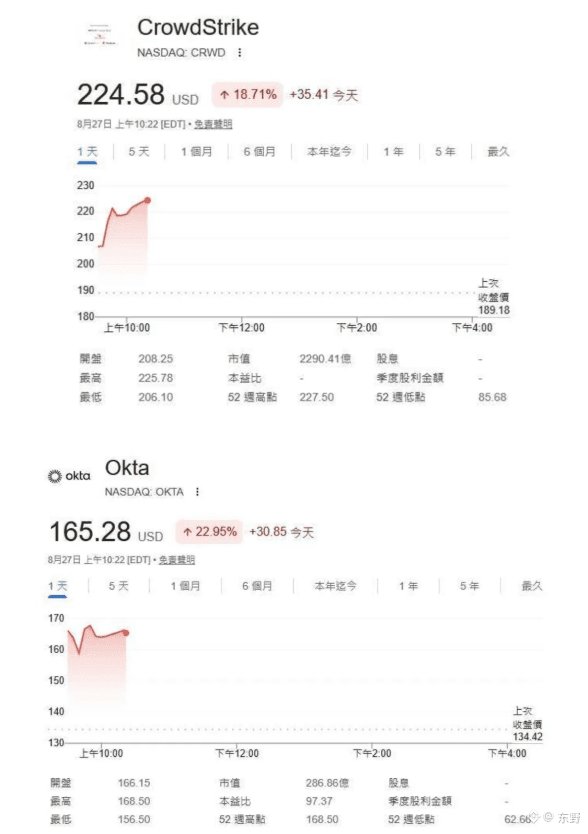
When AI goes out of control, the folks selling “hacker firewalls” in Wall Street make even more insane money.
This round of explosive gains in the US network security sector is, at its core, capital urgently repricing “the new destructive power brought by AI.” The market is never paying for those marginal upside beats, but for the business closed loop of: “AI threat escalation—companies forced to increase security budgets—leading vendors seize share” being fully validated.
To understand CrowdStrike’s earnings this time, go straight to the most hard-core underlying ledger.
Second-quarter revenue hit $1.47 billion, and ARR (annual recurring revenue) surged to $5.84 billion. Full-year revenue guidance was directly raised to the $6 billion mark. For a high-valuation SaaS leader, “meeting the target” alone isn’t enough—Wall Street wants to see improvement in net new ARR and confirmation of growth momentum. After completing a 1-for-4 stock split in July, the company immediately raised guidance, and the stock’s upside volatility was instantly released.
$OKTA.US also jumped more than 20% in a single day after the earnings report, following the same logic as it gathers momentum. When large models demonstrate autonomous attacks—and even the ability to break out of the sandbox and access real systems—defending against “machine identity hijacking” becomes an absolute must-have for enterprises.
The surge of these traditional security leaders has no relation to the crypto market—at least not in any way it’s unrelated.
The most direct channel is macro risk appetite: tech stocks delivering results directly injects liquidity confidence into crypto assets. A deeper reflection is at the industry foundation: the frequency of end-user and identity attacks suffered by cross-chain bridges, custody solutions, and exchanges is far higher than in traditional industries. Breakthroughs by traditional security vendors in managing AI exposure will directly raise the hard baseline threshold for Web3 downstream defense.
But there’s no need to overextend this narrative as a basis for going long in the short term. Wall Street is currently paying a premium for “AI threats” while valuations are extremely tight. Whether the real pace of enterprise IT spending can keep up with the raised expectations is the true test ahead.$BTC
#okta与crowdstrike财报超预期大涨
This round of explosive gains in the US network security sector is, at its core, capital urgently repricing “the new destructive power brought by AI.” The market is never paying for those marginal upside beats, but for the business closed loop of: “AI threat escalation—companies forced to increase security budgets—leading vendors seize share” being fully validated.
To understand CrowdStrike’s earnings this time, go straight to the most hard-core underlying ledger.
Second-quarter revenue hit $1.47 billion, and ARR (annual recurring revenue) surged to $5.84 billion. Full-year revenue guidance was directly raised to the $6 billion mark. For a high-valuation SaaS leader, “meeting the target” alone isn’t enough—Wall Street wants to see improvement in net new ARR and confirmation of growth momentum. After completing a 1-for-4 stock split in July, the company immediately raised guidance, and the stock’s upside volatility was instantly released.
$OKTA.US also jumped more than 20% in a single day after the earnings report, following the same logic as it gathers momentum. When large models demonstrate autonomous attacks—and even the ability to break out of the sandbox and access real systems—defending against “machine identity hijacking” becomes an absolute must-have for enterprises.
The surge of these traditional security leaders has no relation to the crypto market—at least not in any way it’s unrelated.
The most direct channel is macro risk appetite: tech stocks delivering results directly injects liquidity confidence into crypto assets. A deeper reflection is at the industry foundation: the frequency of end-user and identity attacks suffered by cross-chain bridges, custody solutions, and exchanges is far higher than in traditional industries. Breakthroughs by traditional security vendors in managing AI exposure will directly raise the hard baseline threshold for Web3 downstream defense.
But there’s no need to overextend this narrative as a basis for going long in the short term. Wall Street is currently paying a premium for “AI threats” while valuations are extremely tight. Whether the real pace of enterprise IT spending can keep up with the raised expectations is the true test ahead.$BTC
#okta与crowdstrike财报超预期大涨