The orders that really make money are often already prepared when nobody is paying attention. By the time everyone shows up, the opportunity is already gone...
Before, I posted something earlier where I talked about a line I’m increasingly coming to believe: In the financial markets, what you really need to learn is to buy when no one is talking about it, and to sell when the crowd is roaring.
Over the past few days, I’ve had another deep realization: many times, the orders that truly make money have already been prepared for most of the way before anyone starts discussing a product.
Lately, everyone’s attention has basically been pulled away by Crypto.
$BTC previously surged all the way back from around 60,000 to 80,000. Market sentiment suddenly turned hot again.
As for my current short-term outlook on BTC, it really hasn’t changed much—I still lean toward the possibility that this round may keep testing 82,000—85,000.
Yesterday it got pushed down again for a bit. Personally, I’m more willing to interpret that as a quick wipeout after a fast rise—washing out some of the high-leverage longs that chased earlier.
So I’ll keep watching BTC.
But what I really want to talk about in this post is something else: when everyone is watching Crypto, I still haven’t stopped tracking those few of my U.S. stock products.
Recently, I have a few of my own trades that I think make good examples.
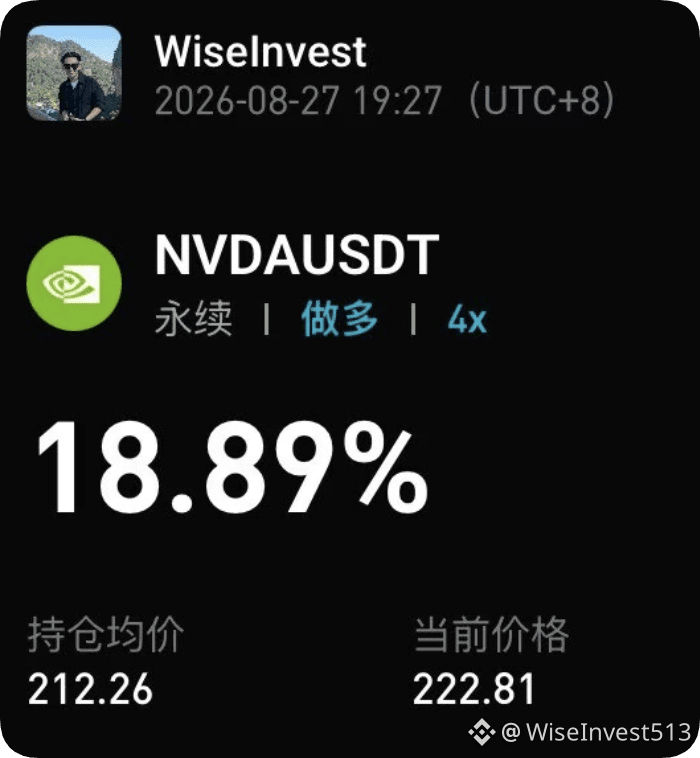
First: $NVDA
Yesterday Nvidia just reported earnings—this company really doesn’t need too much introduction at this point. I’ve talked about it far too many times in the past one or two years.
The AI compute theme is one I’ve been watching, and Nvidia is naturally one of the products I’ve tracked long-term.
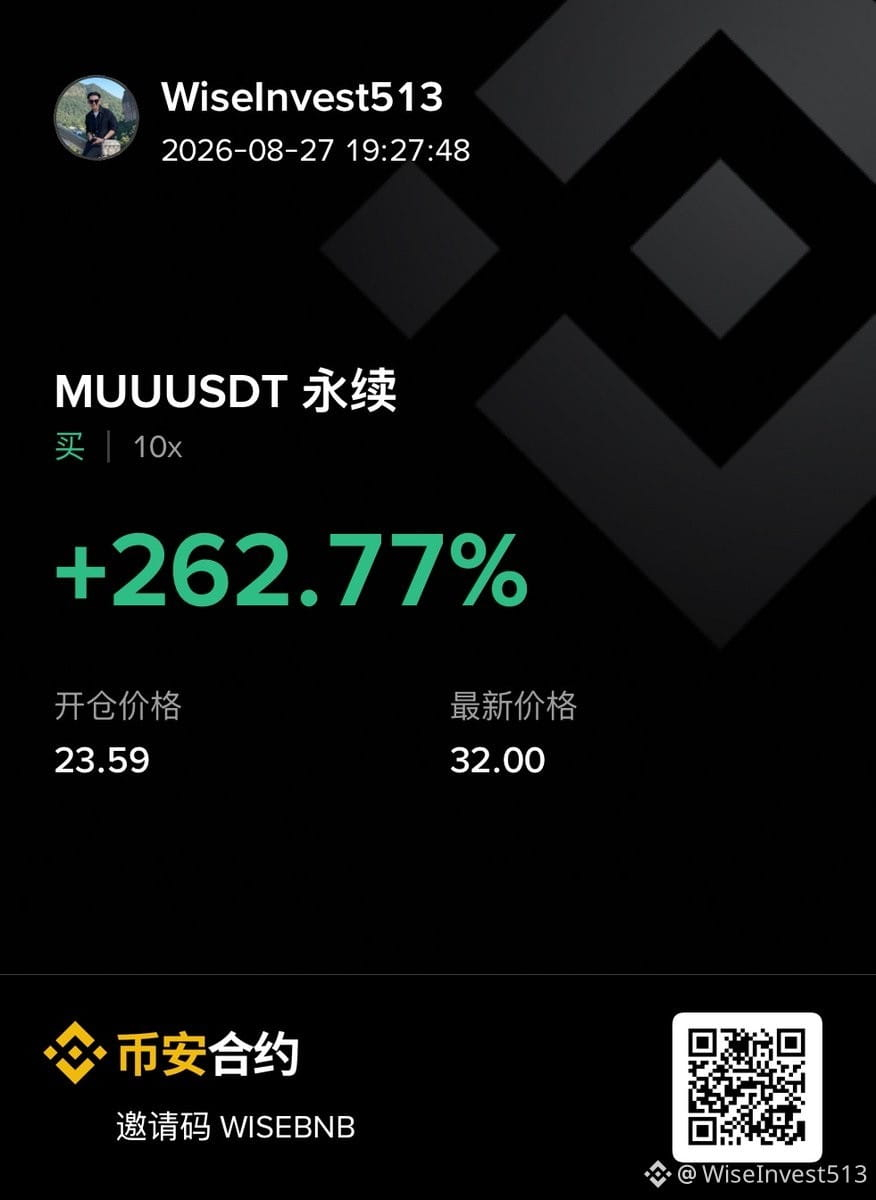
Second: $MUU
This chart should be pretty straightforward.
I’ve followed Micron for a long time. Back when the memory cycle wasn’t this hot yet, I was already continuously researching DRAM, HBM, and NAND—including Micron, Hynix, and SanDisk.
So when the行情 (the market trend) truly plays out, what I need to do is actually very simple: the logic is still there, and when the price reaches the level, I place the order—that’s also why the returns on this MU position ended up being pretty decent.
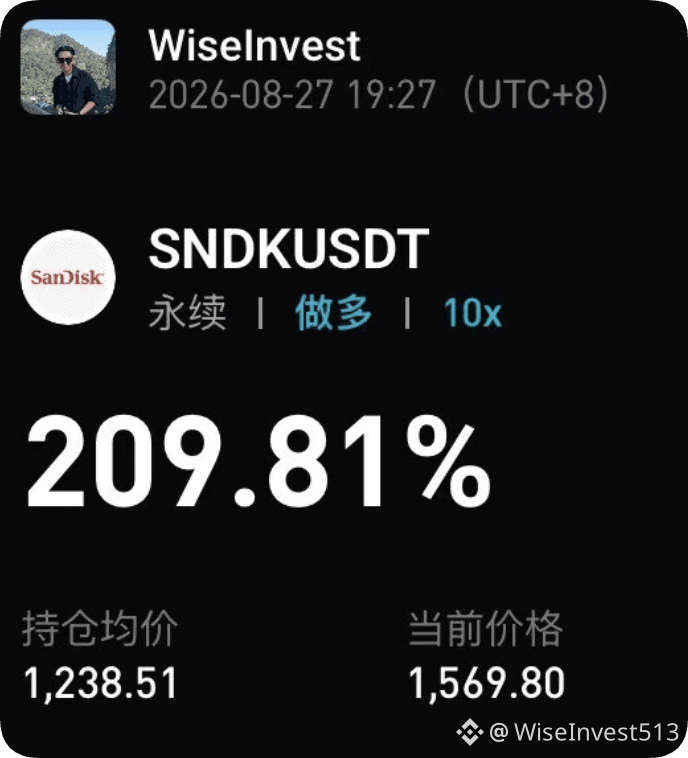
Third: $SNDK
SanDisk is the same.
When the market wasn’t really discussing memory, I was already researching the supply-demand and pricing cycle for NAND in this round. Later, when memory started getting hotter and the market began resetting valuations for these companies.
If you were only seeing it for the first time after it started rising, it would feel like it’s been going up every day and would be hard to get in.
But if you’ve been tracking it for a few months, what you see is completely different. You know why it’s rising, and you also roughly know what prices are worth buying, and at what point it starts to get expensive.
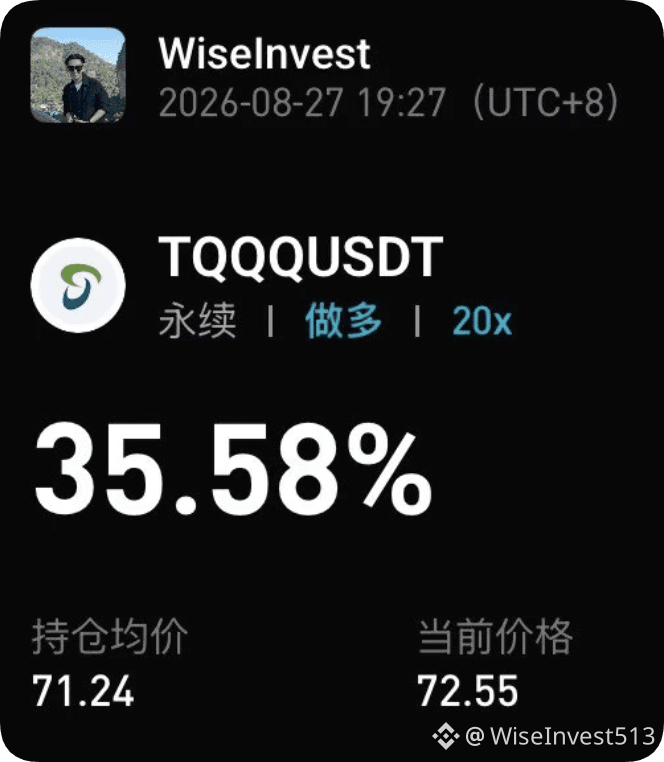
Finally: $TQQQ
I mentioned this before—I don’t rule out leverage.
When I’ve been tracking an opportunity for a long time, and the direction, entry level, and risk boundaries are relatively clear, I’ll sometimes use a leveraged product like TQQQ to amplify part of the returns.
Of course, the risk of these products is also amplified, so I don’t treat it as a daily long-term position.
I put these charts out—not really to prove that every trade I make is profitable. I have plenty of losing trades too.
What I truly want to say is: don’t wait until something has already started rising, and only then suddenly begin researching it.
When BTC was at 60,000, nobody asked. After it hit 80,000, everyone started asking whether it’s still possible to buy.
When MU and SNDK weren’t rising, very few people cared. Once they started going up, everyone began asking whether they can still chase.
The market is always like this.
So now I’m increasingly comfortable keeping my watchlist much smaller.
$BTC, $QQQ, $NVDA, $MU, $SNDK...
Products you truly like and truly understand—keep looking at them again and again.
How they rose over the past few years; how they fell;
In what situations the fundamentals might change;
At what price I’m willing to buy;
At what level a drop becomes the point where I start placing trades;
And at what level a rise is where I start backing off.
Think these things through in advance.
Then when the next time the market genuinely puts an opportunity in front of you, you won’t need to temporarily ask others: “Can I still buy this now?”
Because your trade may already have been prepared a few months ago.
That’s also one of the deeper realizations I’ve been getting lately: what really creates the gap in investing isn’t how many stocks you’ve learned about—it’s whether you’ve researched a small number of products for long enough.
When the market is lively, control your hands.
When nobody is talking about the market, do your homework.
Wait until the price truly comes in front of you—
Place the order.
Before, I posted something earlier where I talked about a line I’m increasingly coming to believe: In the financial markets, what you really need to learn is to buy when no one is talking about it, and to sell when the crowd is roaring.
Over the past few days, I’ve had another deep realization: many times, the orders that truly make money have already been prepared for most of the way before anyone starts discussing a product.
Lately, everyone’s attention has basically been pulled away by Crypto.
$BTC previously surged all the way back from around 60,000 to 80,000. Market sentiment suddenly turned hot again.
As for my current short-term outlook on BTC, it really hasn’t changed much—I still lean toward the possibility that this round may keep testing 82,000—85,000.
Yesterday it got pushed down again for a bit. Personally, I’m more willing to interpret that as a quick wipeout after a fast rise—washing out some of the high-leverage longs that chased earlier.
So I’ll keep watching BTC.
But what I really want to talk about in this post is something else: when everyone is watching Crypto, I still haven’t stopped tracking those few of my U.S. stock products.
Recently, I have a few of my own trades that I think make good examples.
First: $NVDA
Yesterday Nvidia just reported earnings—this company really doesn’t need too much introduction at this point. I’ve talked about it far too many times in the past one or two years.
The AI compute theme is one I’ve been watching, and Nvidia is naturally one of the products I’ve tracked long-term.
Second: $MUU
This chart should be pretty straightforward.
I’ve followed Micron for a long time. Back when the memory cycle wasn’t this hot yet, I was already continuously researching DRAM, HBM, and NAND—including Micron, Hynix, and SanDisk.
So when the行情 (the market trend) truly plays out, what I need to do is actually very simple: the logic is still there, and when the price reaches the level, I place the order—that’s also why the returns on this MU position ended up being pretty decent.
Third: $SNDK
SanDisk is the same.
When the market wasn’t really discussing memory, I was already researching the supply-demand and pricing cycle for NAND in this round. Later, when memory started getting hotter and the market began resetting valuations for these companies.
If you were only seeing it for the first time after it started rising, it would feel like it’s been going up every day and would be hard to get in.
But if you’ve been tracking it for a few months, what you see is completely different. You know why it’s rising, and you also roughly know what prices are worth buying, and at what point it starts to get expensive.
Finally: $TQQQ
I mentioned this before—I don’t rule out leverage.
When I’ve been tracking an opportunity for a long time, and the direction, entry level, and risk boundaries are relatively clear, I’ll sometimes use a leveraged product like TQQQ to amplify part of the returns.
Of course, the risk of these products is also amplified, so I don’t treat it as a daily long-term position.
I put these charts out—not really to prove that every trade I make is profitable. I have plenty of losing trades too.
What I truly want to say is: don’t wait until something has already started rising, and only then suddenly begin researching it.
When BTC was at 60,000, nobody asked. After it hit 80,000, everyone started asking whether it’s still possible to buy.
When MU and SNDK weren’t rising, very few people cared. Once they started going up, everyone began asking whether they can still chase.
The market is always like this.
So now I’m increasingly comfortable keeping my watchlist much smaller.
$BTC, $QQQ, $NVDA, $MU, $SNDK...
Products you truly like and truly understand—keep looking at them again and again.
How they rose over the past few years; how they fell;
In what situations the fundamentals might change;
At what price I’m willing to buy;
At what level a drop becomes the point where I start placing trades;
And at what level a rise is where I start backing off.
Think these things through in advance.
Then when the next time the market genuinely puts an opportunity in front of you, you won’t need to temporarily ask others: “Can I still buy this now?”
Because your trade may already have been prepared a few months ago.
That’s also one of the deeper realizations I’ve been getting lately: what really creates the gap in investing isn’t how many stocks you’ve learned about—it’s whether you’ve researched a small number of products for long enough.
When the market is lively, control your hands.
When nobody is talking about the market, do your homework.
Wait until the price truly comes in front of you—
Place the order.