


Fixed-rate lending has long been the hardest and scarcest part to build on-chain—but TermMax has made it work: fixed-rate, fixed-term borrowing has been deployed across 10 chains and 60 markets, accumulating tens of millions of dollars in deposits and liquidity. Using the same mechanism, tokenized U.S. stocks now— for the first time—simultaneously have fixed-rate financing and an on-chain options market, filling this long-standing gap.
On August 26, the fixed-rate lending protocol TermMax (parent company Term Structure Labs) announced a strategic investment from YZi Labs. The amount was not disclosed. TermMax is a selected project for EASY Residency Season 3, YZi Labs’ incubation program. Total funding to date exceeds $8 million. Previous investors include Cumberland DRW, which led the seed round in 2023, as well as institutions such as HashKey Capital, Decima Fund, Longling Capital, and MZ Web3 Fund.
The protocol launched on the mainnet in April 2025. It currently runs on 10 EVM-compatible chains, opening 60 fixed-rate markets and 40 strategy vaults, with a total value locked (TVL) of several tens of millions of dollars, and more than 1.5 million registered wallets. The token $TMX completed its TGE on August 25.
Co-founder and CEO Jerry Li has 25 years of experience in global financial markets. He previously served as Managing Director at Deutsche Bank, responsible for fixed income and FX businesses across the Greater China region. After retiring from the bank in 2022, he founded Term Structure. In his view, this is not a technical issue, but something that should have been done by someone long ago.
“When I left the bank, I saw a market of tens of billions of dollars ‘on-chain,’ and there wasn’t even a directly observable interest-rate curve—this is unimaginable in traditional markets. It made me decide to build an infrastructure based on the chain.”
— TermMax co-founder and CEO Jerry Li
Now, the public statements from investors appear to point to the same gap. On August 14, in the application materials for EASY Residency Season 5, YZi Labs wrote: tokenized blue-chip stocks have already produced meaningful trading volume, but broader financial application layers—credit, collateral management, risk transfer, and structured products—remain underdeveloped; especially options and other risk-transfer products are still an obvious blank for tokenized assets.
Yet YZi Labs’ strategic foresight has targeted its investment precisely into TermMax, filling this gap.
1. Borrowed six years’ worth of money on-chain, yet never knew what the interest would be tomorrow.
The real skeleton of modern finance is not money, but the value of time. The global fixed income market size is $160.7 trillion, and the notional amount of interest rate derivatives is $66.8 trillion. The only reason these markets exist is to help institutions know how much money three months from now, one year from now, and five years from now is worth.
But on-chain is not like that. More than 95% of outstanding loans are floating-rate, with no fixed maturity date. If you lend money today, the cost tomorrow could double—or be halved—and no market is pricing any answer to that.
There are three layers of reasons. Fixed rates have two more dimensions than floating rates—maturity date and interest rate—so liquidity is inherently fragmented. Market makers are consistently selected against in passive curves, making it impossible for them to make money, so they naturally don’t want to come. And DeFi borrowers have long been mainly leverage traders—they want liquidity right now, and the cost three months from now is not important to them. With all three combined, interest rate and maturity date become the two most uncertain variables on-chain.
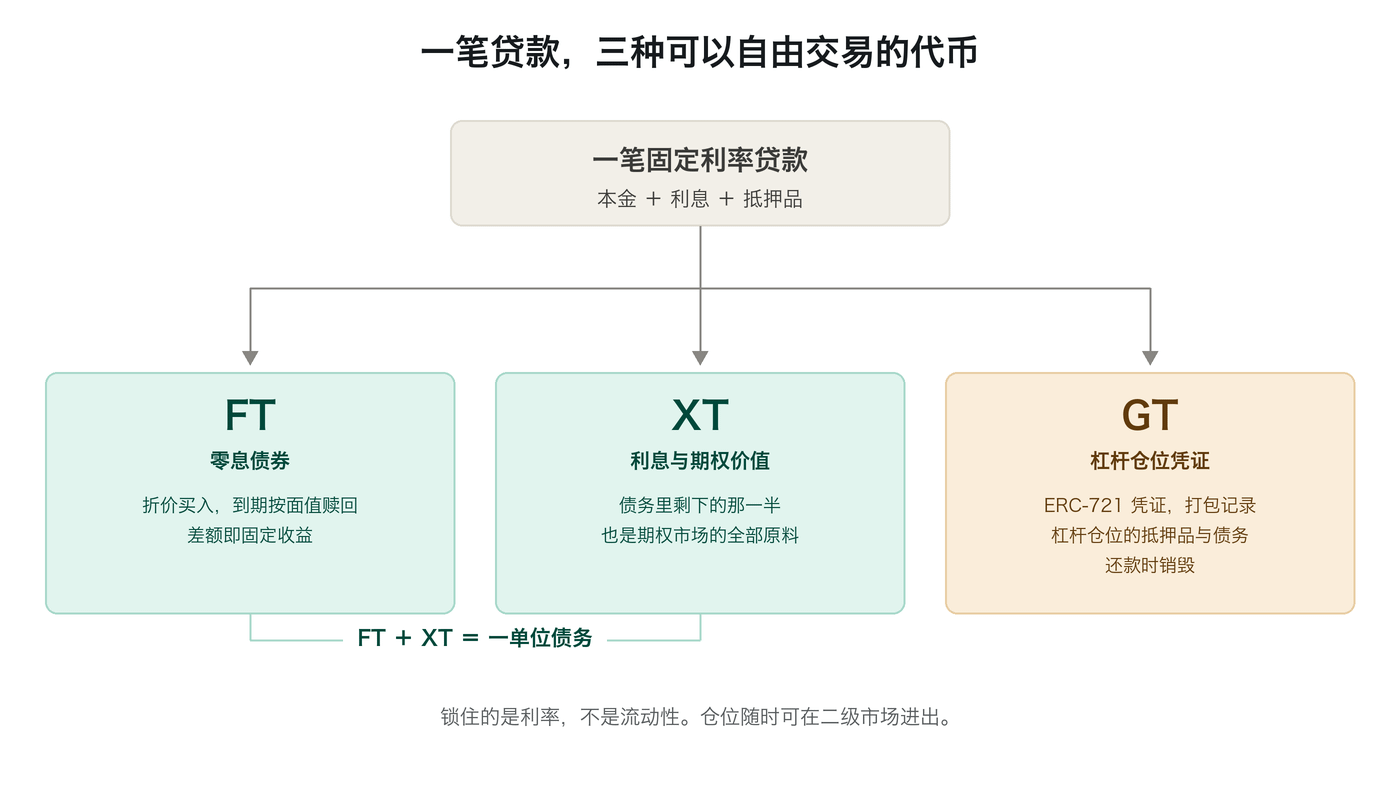
TermMax’s solution is to split the debt itself. A single loan is split into three tradable tokens:
1、FT (Fixed-rate Token, hereinafter referred to as “FT”): zero-coupon bonds purchased at a discount and redeemed at par at maturity; the difference is the fixed yield.
2. XT (Interest Token, hereinafter referred to as “XT”): carries interest or option value, and when added to FT is equal to one unit of debt.
3. GT (Gearing Token, hereinafter referred to as “GT”): ERC-721 certificates that record the collateral backing a leveraged position and the debt, and are destroyed upon repayment.
This unties the most criticized knot of fixed-rate—locking in the rate, not liquidity. Positions can be bought and sold on the secondary market at any time.
As for the two architectural challenges, the answers lie in market making. When TermMax’s Curator manages liquidity inside a vault, the same pool of funds can simultaneously place valid quotes across multiple markets and multiple orders. Here, what is placed are mirror orders with the same amount—not dividing one pool of capital into ten pieces and stuffing each into ten markets. Once orders in a market execute, the amounts of the remaining mirror orders are deducted atomically, so capital efficiency is maximized.
This step breaks the multiplicative relationship of fragmentation. Fixed-rate markets inherently need to be opened across three dimensions: “asset × maturity date × interest rate.” If each market requires its own dedicated capital in advance, liquidity will inevitably be sliced very thin. The previous generation of protocols couldn’t escape this liquidity trap. Mirror orders let markets share quotes: as the number of markets increases, it no longer dilutes depth in any single market, and the capital turnover rate of the same unit of capital improves by an order of magnitude.
Today, what allows TermMax to run 60 markets simultaneously on 10 chains is precisely this. Professional institutions like Keyrock, Hard Core Lab Capital, Edge Capital, and Origami are willing to serve as Curators on TermMax and manage their own strategy vaults—that in itself is validation of this structure.
Settlement uses physical delivery: collateral is delivered directly to the lender and does not enter the market for liquidation sales. Traditional settlement relies on the assumption that collateral can be sold on public markets at fair value—an assumption that holds for highly liquid assets like ETH, but does not hold for tokenized stocks with only a few million dollars of on-chain depth. Physical delivery is the real prerequisite for tokenized assets to become financable collateral.
After solving these things, on-chain assets finally truly get their own bond market for the first time. And what TermMax wants to do goes far beyond that.
2. Tokenized U.S. stocks: can be used for financing, and can also be used for hedging.
Tokenized stocks are the fastest-growing asset class over the past year: on-chain scale has reached $2.48 billion, and the number of holders has grown 165% within 30 days.
TermMax started importing this kind of asset into fixed-rate markets from the end of last year: in January 2026 it integrated Ondo Global Markets, launching the first fixed-rate lending market using tokenized U.S. stocks as collateral; it then integrated the equity token bStock issued by Binance; on August 12, it officially launched Robinhood Chain, supporting USDG borrowing using tokenized stocks like QQQ, SPY, and NVDA as collateral.
But financing is only half of how these assets are truly put to use. The other half is hedging—and so far, that half is still blank.
On the traditional market side, the U.S. options market has been setting records for the sixth consecutive year. In 2025, trading volume was 15.26 billion contracts, up 24.3% year over year; from 2026 to today, volume has averaged 71.1 million contracts. Among them, zero-day-to-expiry options account for 65% of S&P 500 index options trading volume; four years ago, that number was only 22%. In customer average daily volume, retail traders contribute two-thirds. Options are no longer exclusive to Wall Street institutions—they have become a native tool for retail.
However, what has been built for tokenized stocks this year is almost entirely perpetual contract platforms. Ondo’s stock perpetual platform launched in July and achieved $8 billion in cumulative trading volume in five weeks, and Kraken and Crypto.com each released their own versions. Demand has been thoroughly validated by the market. But until today, there is still no options market on-chain opened for tokenized stocks.
TermMax extends the capability of crypto options markets to tokenized stocks, filling exactly that gap. The TermMax Alpha launched by the protocol provides an options market with no liquidation prior to maturity: the conversion price is fixed at the time the position is opened, and does not move with market price fluctuations. Therefore, the position will not be force-liquidated due to dramatic market moves in the middle—only settled via physical delivery at maturity using the conversion price. For an asset class that has just been tokenized and is still shallow in on-chain depth, this is especially critical: it ensures users won’t have a directionally correct position wiped out just because of a liquidity shortage lasting a few minutes.
The same underlying mechanisms, the same batch of collateral—priced by time on one side, and by volatility on the other.
3. On the institutional side: public pricing, and non-public counterparties
In addition to products for retail users, TermMax also offers its own solution for institutions. Operated by the same team, the institutional platform TermPrime completed its first live trade on the Canton Network at the end of June this year: BitSafe and HashKey Cloud act as counterparties to each other, borrowing Canton Coin using CBTC as collateral, completing a loop of lending, borrowing, and repayment for a seven-day term, and repaying early before maturity. Matching uses TermPrime’s public order book, while settlement is handled by Canton’s native synchronizer. Assets remain entirely within each institution and its custody wallet throughout. Currently, TermPrime’s counterparty network has expanded to nine institutions, covering digital asset market makers, private credit funds, tokenized securities issuers, and credit platforms.
TermPrime’s decision to enter from the institutional side is not accidental. As an early validation node for Canton, the team saw a market that was already running: in just July, Franklin Templeton and Tradeweb completed on-chain trading of tens of billions in government bonds on Canton. The fixed-rate financing needs between institutions are real and persistent. What TermPrime is not doing is creating demand from scratch; rather, it captures this kind of demand more efficiently—allowing institutions to trade with counterparties they already know, using existing protocols and pre-approved credit limits. Price discovery is public, while who the counterparty is and the trade size are only visible to the two trading parties.
This is not a matter of technical preference, but a prerequisite for whether institutions can truly move their business on-chain. Institutions can accept that the market knows the price of seven-day funds, but cannot accept that the market knows who is borrowing and how much they borrowed.
Security is another concern for institutions. TermPrime partnered with Immunefi to address this concern directly. On the TermMax protocol side, it has completed the Cantina/Spearbit public audit competition, includes Immunefi bug bounties and Hypernative 24/7 monitoring, with a DeFiSafety process-quality score of 93%, on par with Aave V3.
Connecting these scattered points, TermMax’s full blueprint points to three directions:
1. Yield Curve: enabling the same asset to simultaneously have tradable quotes at 7 days, 30 days, 90 days, and 180 days—growing an on-chain yield curve matched by the market itself rather than set by the protocol;
2. TermMax: applying both fixed-rate financing and a zero-liquidation options market to tokenized stocks as well;
3. TermPrime: under the premise of privacy and security, giving institutions the ability to use the same toolkit as in traditional interest-rate markets on-chain.
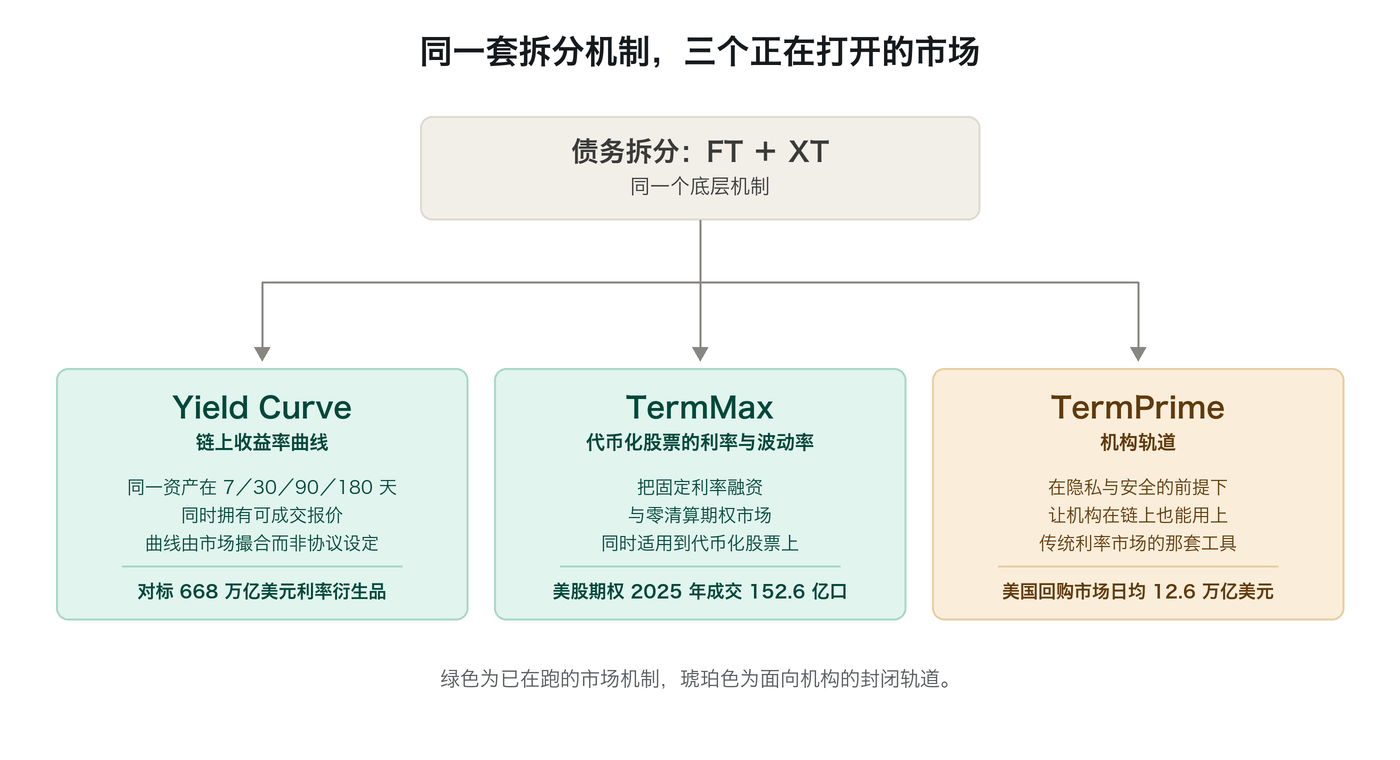
Three directions point to the same thing: enabling on-chain to truly have time prices that are observable, tradable, and hedgeable. Once this curve exists, forward contracts, hedging, swapping FX and rates—actions that traditional financial institutions are accustomed to—can truly be carried out on-chain. TermMax aims not to be just another lending protocol, but the interest-rate curve itself for on-chain assets—filling the final missing piece that DeFi lacks.
“What we’re doing isn’t teaching traditional financial institutions how to learn DeFi, but helping DeFi grow in a more professional way—so it can truly serve finance.”
— TermMax co-founder and CEO Jerry Li
4. On the first day of TGE: bringing this to the forefront
$TMX completed its TGE on August 25, and the first-day listings included platforms such as Binance Alpha, Kraken, Bitget, KuCoin, and MEXC. In the same period, TermMax ranked No. 2 on RootData’s DeFi popularity leaderboard, received an A transparency rating, and entered CoinMarketCap’s 24-hour trending list at No. 5.
But going live just brings it out into the spotlight. The real test comes next: an interest-rate curve produced by market clearing needs enough tenors, enough depth of quotes, and enough truly executed trades to stand on its own—this can’t be accomplished by a single release. Still, at least the question was placed in the right position for the first time—not to make DeFi borrow money faster, but to make it learn how to answer “how much is money worth three months from now.”
About TermMax
TermMax is a fixed-rate, fixed-tenor lending market developed by Term Structure Labs. Its mainnet launched in April 2025. It is currently deployed on 10 EVM-compatible chains, running 60 fixed-rate markets and 40 strategy vaults. The protocol splits debt into three types of tradable tokens: FT (principal), XT (interest and option value), and GT (leverage position certificates). Professional Curators set target interest-rate ranges in isolated markets and manage the strategy vaults. Settlement uses physical delivery. Co-founder and CEO Jerry Li has 25 years of experience in global financial markets. He previously served as Managing Director at Deutsche Bank, responsible for fixed income and FX businesses across the Greater China region.
Official website: ts.finance
About YZi Labs
YZi Labs manages more than $10 billion in assets worldwide. Its investment philosophy emphasizes “impact first,” believing that meaningful returns will follow. YZi Labs invests in projects at all stages, focusing on teams with solid fundamentals in Web3, AI, and biotech. Its portfolio spans six continents, with more than 300 projects across 25+ countries. Representative projects include Trust Wallet, CoinMarketCap, Polygon, Injective, Ethena, SafePal Wallet, Better Payment Network, Aster, and XAI, among others. More than 65 of its invested companies have participated in its incubation programs.