If you don’t have very strong analytical skills for the moment, I’ll give you a straightforward way to improve your odds in the market!
Lately, I’ve increasingly felt that if retail investors want to make money in the market, there’s actually a very simple method—yet many people are unwilling to do it: find a few people who truly research, and then seriously re-study what they’ve already researched.
Note: I’m not telling you to copy homework, or to rush in just because you see someone else shout “buy.”
Instead, when you find someone who’s willing to track the same company for a continuous month or two—someone who’s willing to break down the industry chain, orders, competitive landscape, financial reports, valuation, and even specific price levels piece by piece for you—then you’ve already gained an excellent starting point for research.
Because, to be realistic: if you spend only half an hour a day looking at the market, while someone else is researching these companies every day, then in certain areas, their understanding of the product is very likely deeper than yours.
At this point, the smartest approach isn’t to prove, “I can discover it from scratch on my own.” It’s: stand on someone else’s shoulders, and then complete your own judgment.
$MRVL is a very typical example of that for me recently.
Actually, I started talking about Marvell repeatedly back in July.
At that time, my biggest judgment was that this AI data center cycle was gradually moving from the very first phase of “competing on compute power” into the next stage.
At first, everyone just focused on GPUs. But then people gradually realized that truly large-scale AI data centers are not just about having GPUs.
The greater the compute power, the more important the network becomes; the bigger the model, the more important the memory becomes; the larger the cluster, the more crucial the interconnect and optical communications become; and hyperscalers are increasingly doing their own custom ASICs.
What’s interesting about $MRVL is that it has gradually shifted from “selling a specific chip” to being able to participate in almost every key component of the AI data center.
So by August, I rewrote about MRVL again.
By then, more and more partnerships were truly coming online:
Google’s TPU and custom AI, Nvidia’s NVLink and custom XPU, AWS’s customized chips and networking, SK Hynix’s CXL and memory expansion, plus Lumentum supporting optical interconnects.
My biggest feeling at the time can be summed up in one sentence:
The company is doing more and more things, but the price still doesn’t seem to have fully reflected it.
In that post, I also directly gave the levels: look at 245–252 first. If it can truly stand back above 252, I would continue to look toward around $270.
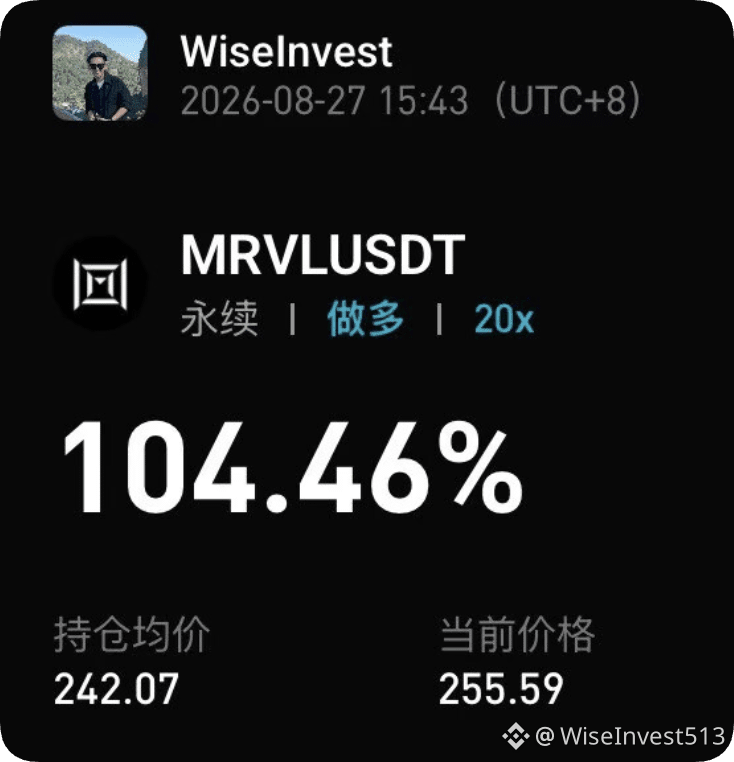
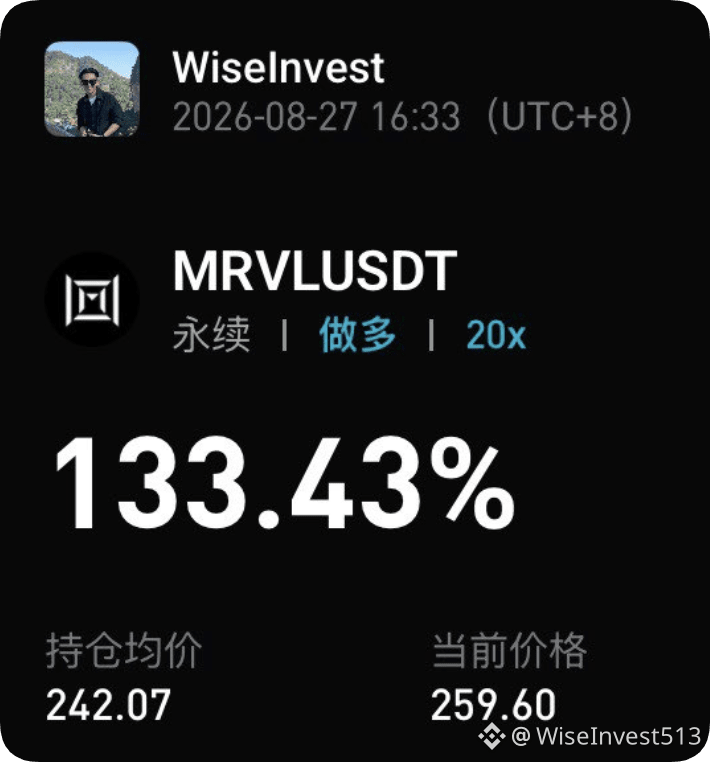
Later, I also opened a position in MRVL around $242.
Of course, the stock price won’t rise in a straight line forever.
If it rises too fast in the middle, it will definitely pull back. So I still judge based on the original supports, resistances, and market structure—not because I’m “long-term bullish” that I blindly chase any price.
Now MRVL is around $255. My position is also currently in a pretty comfortable profit state.
But I think what’s truly worth discussing about this trade isn’t “how much money I made.”
It’s the whole process: first, in July you discover the industry logic; then in August you continue tracking as cooperation gets implemented; then when the price reaches a level you think is appropriate, you place the order; and then you use the original logic to verify whether the market keeps delivering.
That’s what I think ordinary investors can really learn.
So if you still don’t have a particularly mature analysis framework, I really recommend: don’t spend every day in the market searching for so-called “wealth secrets” everywhere.
Find a few people you genuinely trust, and who can prove their research capability over the long term.
When they suddenly start discussing a company continuously, you add that company to your watchlist;
When they start breaking down an industry chain, you follow that industry chain and research downward;
When they give key levels, don’t just place an order directly—ask yourself:
Why is it here? What happens if it breaks down? If the logic plays out, where is the upside?
Over time, you’re basically borrowing other people’s research ability, and slowly building your own research ability.
And I’ve always felt that the dumbest thing in investing is this: someone has already helped you research 80% of a company, yet you insist on proving yourself starting from 0%.
First, stand on someone else’s shoulders.
Then turn the remaining 20% into your own judgment.
That might be the most realistic path for ordinary people in the market.
As for MRVL: since $252 has already regained that level, I’ll continue to follow the original logic and look ahead.
If the earnings reports, orders, and AI infrastructure investment continue to develop in a positive direction, around $270 will still be the key level I focus on in the next stage.
The path has been unfolding step by step. Next, we keep watching to see whether it can truly become the way we first imagined.
That’s all……
Lately, I’ve increasingly felt that if retail investors want to make money in the market, there’s actually a very simple method—yet many people are unwilling to do it: find a few people who truly research, and then seriously re-study what they’ve already researched.
Note: I’m not telling you to copy homework, or to rush in just because you see someone else shout “buy.”
Instead, when you find someone who’s willing to track the same company for a continuous month or two—someone who’s willing to break down the industry chain, orders, competitive landscape, financial reports, valuation, and even specific price levels piece by piece for you—then you’ve already gained an excellent starting point for research.
Because, to be realistic: if you spend only half an hour a day looking at the market, while someone else is researching these companies every day, then in certain areas, their understanding of the product is very likely deeper than yours.
At this point, the smartest approach isn’t to prove, “I can discover it from scratch on my own.” It’s: stand on someone else’s shoulders, and then complete your own judgment.
$MRVL is a very typical example of that for me recently.
Actually, I started talking about Marvell repeatedly back in July.
At that time, my biggest judgment was that this AI data center cycle was gradually moving from the very first phase of “competing on compute power” into the next stage.
At first, everyone just focused on GPUs. But then people gradually realized that truly large-scale AI data centers are not just about having GPUs.
The greater the compute power, the more important the network becomes; the bigger the model, the more important the memory becomes; the larger the cluster, the more crucial the interconnect and optical communications become; and hyperscalers are increasingly doing their own custom ASICs.
What’s interesting about $MRVL is that it has gradually shifted from “selling a specific chip” to being able to participate in almost every key component of the AI data center.
So by August, I rewrote about MRVL again.
By then, more and more partnerships were truly coming online:
Google’s TPU and custom AI, Nvidia’s NVLink and custom XPU, AWS’s customized chips and networking, SK Hynix’s CXL and memory expansion, plus Lumentum supporting optical interconnects.
My biggest feeling at the time can be summed up in one sentence:
The company is doing more and more things, but the price still doesn’t seem to have fully reflected it.
In that post, I also directly gave the levels: look at 245–252 first. If it can truly stand back above 252, I would continue to look toward around $270.
Later, I also opened a position in MRVL around $242.
Of course, the stock price won’t rise in a straight line forever.
If it rises too fast in the middle, it will definitely pull back. So I still judge based on the original supports, resistances, and market structure—not because I’m “long-term bullish” that I blindly chase any price.
Now MRVL is around $255. My position is also currently in a pretty comfortable profit state.
But I think what’s truly worth discussing about this trade isn’t “how much money I made.”
It’s the whole process: first, in July you discover the industry logic; then in August you continue tracking as cooperation gets implemented; then when the price reaches a level you think is appropriate, you place the order; and then you use the original logic to verify whether the market keeps delivering.
That’s what I think ordinary investors can really learn.
So if you still don’t have a particularly mature analysis framework, I really recommend: don’t spend every day in the market searching for so-called “wealth secrets” everywhere.
Find a few people you genuinely trust, and who can prove their research capability over the long term.
When they suddenly start discussing a company continuously, you add that company to your watchlist;
When they start breaking down an industry chain, you follow that industry chain and research downward;
When they give key levels, don’t just place an order directly—ask yourself:
Why is it here? What happens if it breaks down? If the logic plays out, where is the upside?
Over time, you’re basically borrowing other people’s research ability, and slowly building your own research ability.
And I’ve always felt that the dumbest thing in investing is this: someone has already helped you research 80% of a company, yet you insist on proving yourself starting from 0%.
First, stand on someone else’s shoulders.
Then turn the remaining 20% into your own judgment.
That might be the most realistic path for ordinary people in the market.
As for MRVL: since $252 has already regained that level, I’ll continue to follow the original logic and look ahead.
If the earnings reports, orders, and AI infrastructure investment continue to develop in a positive direction, around $270 will still be the key level I focus on in the next stage.
The path has been unfolding step by step. Next, we keep watching to see whether it can truly become the way we first imagined.
That’s all……