


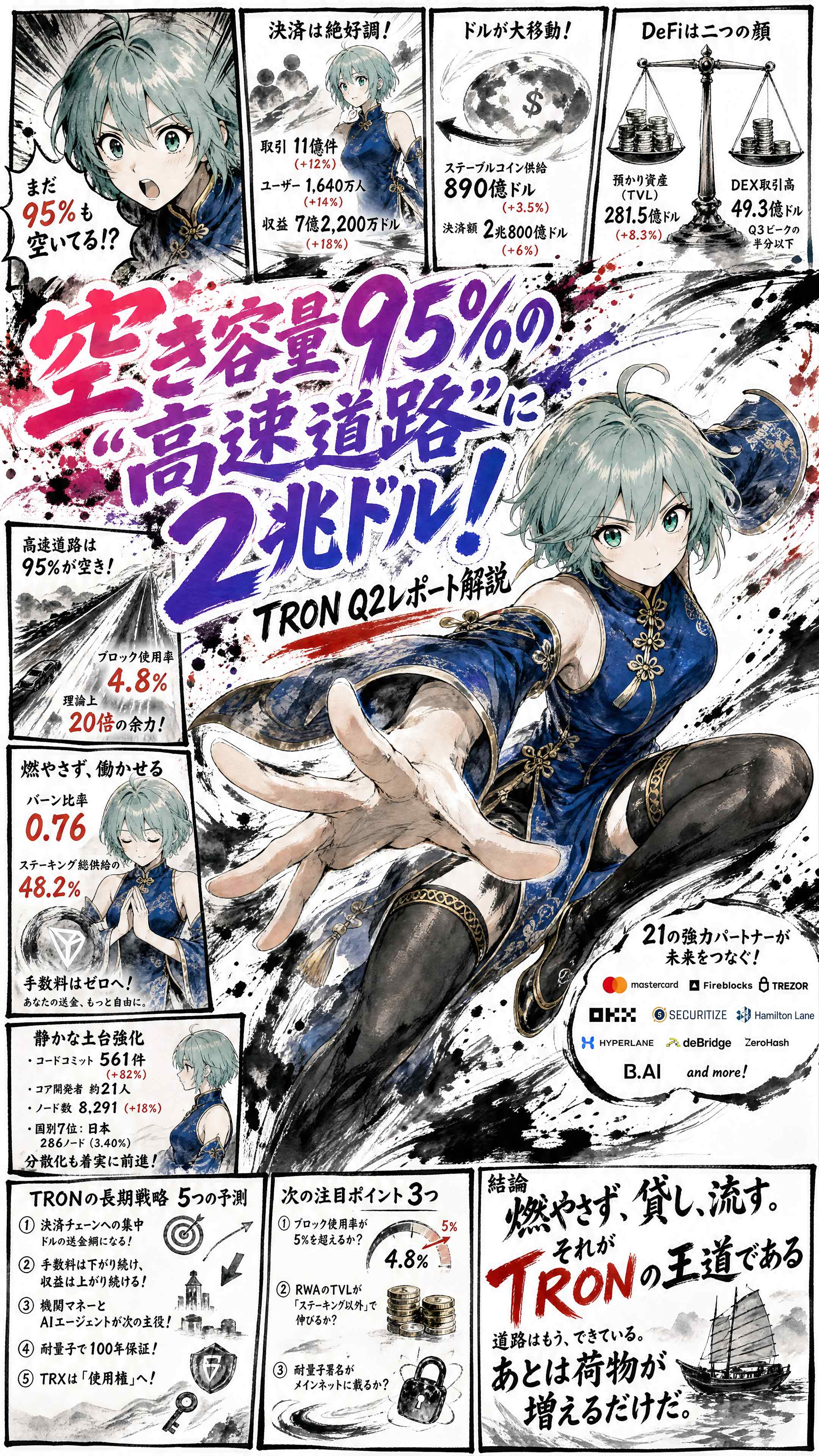
On August 24, 2026, the TRON DAO published its official “TRON Q2 2026 Quarterly Report.”
If you pick out only the numbers, it looks like the usual list of “all-time highs.” But when you read between the lines of this report, you can see that TRON for Q2 has clearly crossed “a certain line.” What’s interesting isn’t flashy numbers—it’s the “way it crosses.”
Tonight, first we dissect the contents of the report, and in the second half we’ll interpret this “report card.” It’s quite a long read, but I hope readers will stick with it to the end. For those who don’t have time, the gist is summarized in manga.
【How to read TRON’s scorecard — 5 numbers and 1 sense of discomfort】
1.1 billion transactions, 16.4 million users, and $722 million in revenue
In Q2, the number of transactions was 1.1 billion, up 12% quarter over quarter. The breakdown has three pillars: token transfers, smart contract execution, and TRX transfers—growth that isn’t dependent on any specific boom. In other words, “baseline metabolism” is increasing.
Active addresses are 16.4 million, up 14% year over year. Inflows of new users are also gradually returning.
And protocol revenue is $722 million, up 18% quarter over quarter—this is worth paying attention to. In the second half of 2025, TRON significantly cut fees, and as a result, revenue dropped by nearly 40%. This time is the first quarter of climbing back to profit from that “valley.” Lower the price, and still grow revenue. In retail terms, it’s a structure where you “make up the unit price with more customers.”
Stablecoin supply: $89 billion; payment amount: $2.08 trillion
The supply of stablecoins on TRON is $89 billion. It grew by 3.5% quarter over quarter. It may look bland, but this is “deposit balance”—money that doesn’t move. The money that does move is the stablecoin payment amount of $2.08 trillion. It recovered 6% from $1.96 trillion in the previous quarter.
For comparison: Japan’s nominal GDP is around $4 trillion per year. TRON has handled an amount equivalent to half of that in just three months. And this is a recovery while the whole industry is cooling off. The report says: “Despite the industry’s cooldown, it maintained a dominant position in international remittances and value transfer.”
TVL: $28.15 billion — but look at what’s inside.
DeFi’s assets under custody (TVL) are $28.15 billion. Up 8.3% from the previous quarter and up 16.9% year over year, it hit the highest level in the most recent quarter.
However, the breakdown should be read honestly. Out of the total $26.67 billion from the top 5 protocols, TRX staking is $15.21 billion. JustLend DAO is $6.64 billion. In other words, about 80% of TVL is either “depositing TRX” or “borrowing against TRX as collateral.” DEX-type protocols like SUN.io are only $640 million, and the trading volume of the main USDT-TRX pool—$4.93 billion—is less than half of the peak in 2025 Q3 ($11.08 billion).
In short, TRON has two faces: “payments are thriving” and “trading is in winter.” The report calls this an “early sign of stabilization,” but in my words, TRON isn’t winning in DeFi’s casino—it’s winning as a payments infrastructure. This is the core of the discussion in the second half.
Block utilization is only 4.8% — 20x “spare capacity”
A number that’s easy to overlook but is the most important: the average block size is 96kB, with an upper limit of 2,000kB. That means utilization is only 4.8%. The report explicitly states: “Without harming the user experience, it can theoretically accommodate a 20x increase in throughput.”
So even after processing 1.1 billion transactions and moving $2 trillion, the “TRON highway” is still 95% empty. That’s fundamentally different from chains designed for “when it gets congested, fees spike.” Of course cars gather on roads that don’t get jammed.
Burn ratio 0.76 — the oddity of “the king that doesn’t burn”
Now, let’s talk about the oddity. The TRX burn ratio has fallen to 0.76. If it’s below 1, supply increases. In Q2, 356.32 million TRX were newly issued, and 269.45 million TRX were burned. With inflation of 8.687 million TRX net, it’s expanding compared to the previous quarter.
In crypto circles with strong deflation beliefs, some call this “worsening.” But the report’s explanation is clear. Instead of users “burning” TRX to pay fees, they choose a path where they “deposit” TRX to obtain energy and bring fees to almost zero. That ratio increased from 6x to 7.5x compared to the previous quarter. 48.2% of the total supply is staked.
This is the core. Rather than making TRX scarce, TRON prioritized “reducing the transfer cost for people who hold TRX.” “BURN” rather than “making it work.” It’s not designed to raise token prices—it’s designed to make full use of the network.
Development and decentralization — a foundation that quietly got thicker
There were 561 code commits, an 82% increase quarter over quarter. Core developers recovered to about 21 people. Contract deployers reached 10,200. The effect is driven by a roughly 60% reduction in deployment costs with “Proposal 104.”
The number of nodes increased 18% to 8,291. By country: the U.S. accounts for 21.98%, Ireland 12.23%, China 9.30%, followed by Germany, Singapore, and Hong Kong; Japan comes next with 286 nodes (3.40%) ranking 7th. The distribution of SRs has a skewness of -0.4, which is assessed as having a good balance between old and new participants, but it also doesn’t hide the concentration structure where the top 11 SRs hold 60% of the voting power.
And for ecosystem integration, logos from 21 companies line up, including Mastercard, Fireblocks, Trezor, OKX, Securitize, Hamilton Lane, HyperLane, deBridge, ZeroHash, and B.AI. Cards, custody, interoperability, RWA, AI agents. The “EXIT” from the payments rails increased sharply in this quarter.
“What does this report say about TRON’s long-term strategy — 5 predictions”
From here, these are my long-term predictions. This scorecard almost doesn’t hide what TRON will do in the coming years.
Prediction 1️⃣: TRON will complete “concentration into a payments chain.”
As shown by the contents of TVL and DEX trading volume, TRON isn’t aiming for a full-stack DeFi. It focuses resources on stablecoin settlement, and increases the number of “exits” (cards, custody, and enterprise payments) that run on those rails.
This is a strategy of selection and concentration. If Ethereum aims to be a “computer that can do anything” and Solana aims to be a “trading exchange for high-speed trades,” then TRON aims to be a “dollar remittance network.” In terms of the internet, it’s trying to be TCP/IP rather than apps. TCP/IP isn’t flashy, but everyone uses it.
Prediction 2️⃣: Fees keep falling, and revenue keeps rising
“Increase sales by lowering prices” isn’t a coincidence. With the 60% reduction from Proposal 104, effectively zero fees enabled by energy and staking, and the spread of gasless transfers, TRON intentionally uses fees as a “weapon in price competition.”
The slack capacity—block utilization at 4.8%—backs up this strategy. Having 20x spare capacity means there’s room to lower the unit price further and multiply the number of customers by 20. The winner in payment infrastructure isn’t the fastest or the most decentralized—it’s the cheapest and the one that never stops. TRON is concentrating resources on that strategy.
Prediction 3️⃣: The next battleground is “institutional money” and “AI agents”
The next customers are not individuals. Tokenization of an institutional credit fund via Hamilton Lane × Securitize, corporate settlement via Fireblocks, and card payments via Mastercard. Added on top is an AI agent infrastructure like B.AI that handles small payments between AIs.
A chain that can move $2 trillion through individual P2P remittances goes after institutional capital and AI payments. The 95% unused capacity is reserved for that. I see this spare capacity not as “inventory,” but as “reserved seats.”
Prediction 4️⃣: Quantum resistance becomes a sales tool with a “100-year guarantee.”
Outside the scope of this report, but on July 3 shortly after the quarter end, TRON activated a quantum-resistant signature (Falcon-512, ML-DSA-44) compliant with the NIST standard on the Nile testnet. It’s the earliest implementation among major public chains.
Institutional investors don’t keep their assets in infrastructure that might be broken in 10 years. Quantum-resistance is not engineers’ self-satisfaction; it’s a “guarantee letter” for the customers of the “Prediction 3” mentioned above. When “cheap and fast” gets the addition of “can’t be broken,” the options for payment-chain selection narrow considerably.
Prediction 5️⃣: TRX is shifting from a “price-appreciating asset” to a “right to use it.”
Once TRON accepts the burn ratio of 0.76, the answer is already there. The value of TRX is placed not on scarcity caused by deflation, but on “the right to use this network cheaply.” The fact that 48.2% is staked means that half of holders already understand this.
Of course, there are side effects here. Inflation continues. The concentration of voting power doesn’t go away either. Even “the winter of DEXs” won’t end quickly. TRON designs itself not as a “beautiful decentralized utopia,” but as “the infrastructure that gets the job of payments done at the lowest cost.”
Summarizing the TRON Q2 2026 report in one sentence: “Instead of burning, it lends and routes the flow. That’s TRON’s true way.”
Get out of the game where you burn tokens to raise the price. Instead, lower fees to capture more transaction volume, and grow revenue through that volume. TRON is proving this textbook strategy for payment infrastructure every quarter.
And the three things to watch in the next quarter are: ① whether block utilization exceeds 5% ② whether the TVL of institutional RWA grows “other than TRX staking” ③ whether quantum-resistant signatures are listed on the mainnet.
When these three come together, TRON changes from being the “most-used stablecoin chain” into the “world’s dollar remittance network.”