Why Is Proof of Stake Different From Proof of Work? 🔐🔗
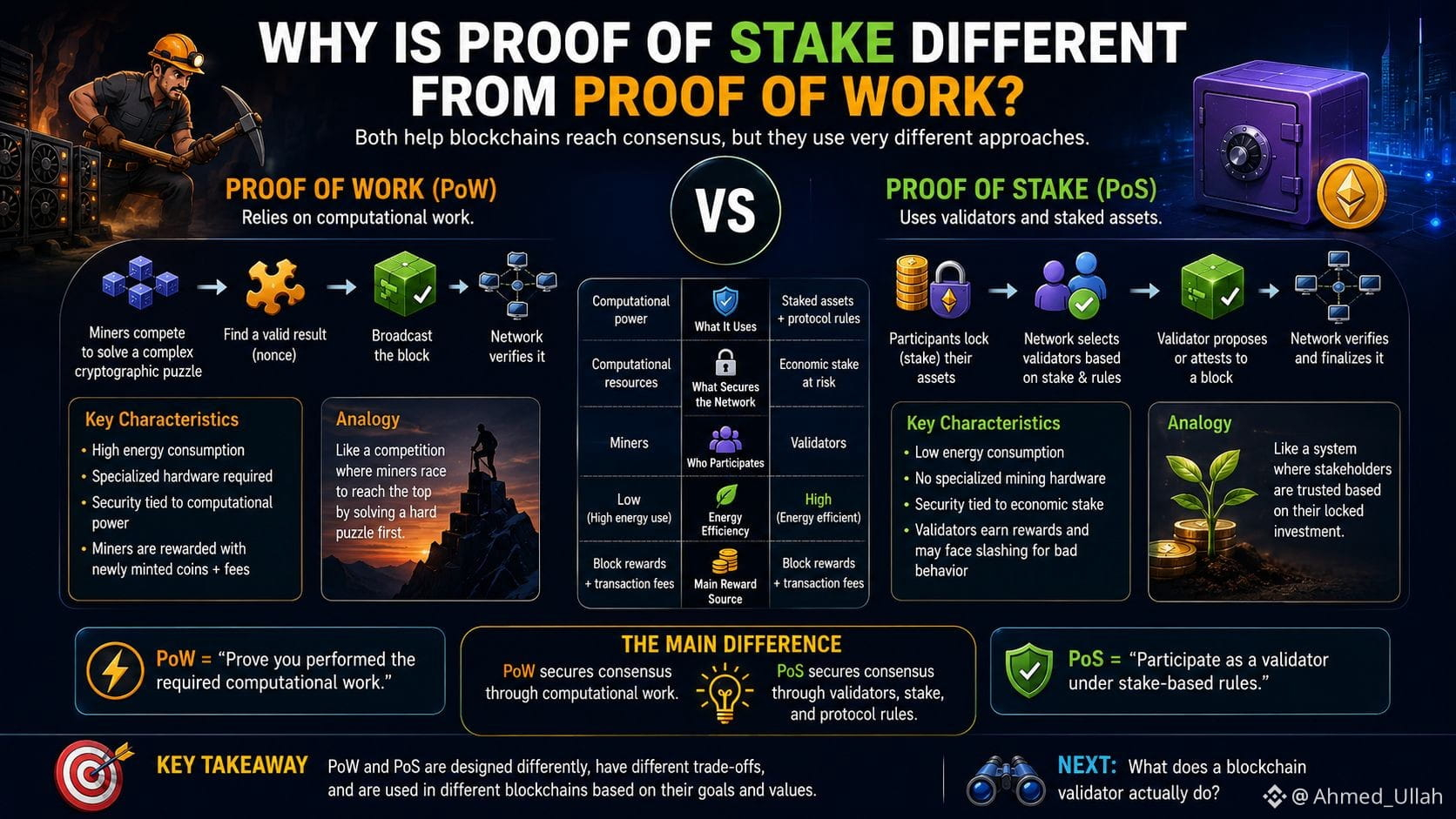
Both Proof of Work (PoW) and Proof of Stake (PoS) help blockchain networks reach consensus—but they use very different approaches.
⛏️ Proof of Work
PoW relies on computational work.
Miners compete to find a valid result by performing repeated hash calculations.
Computing power → Valid block → Network verification
🔐 Proof of Stake
PoS uses validators and staked assets.
Participants lock assets according to the protocol, and the network uses its rules to select validators to propose and/or attest to blocks.
Stake → Validator selection → Block validation
⚡ The Main Difference
PoW: Security is closely tied to computational resources and energy expenditure.
PoS: Security is closely tied to economic stake and protocol rules.
🧠 Why Does This Matter?
The two mechanisms approach decentralized consensus differently:
PoW = “Prove you performed the required computational work.”
PoS = “Participate as a validator under stake-based protocol rules.”
Neither concept is simply “better” in every situation. Their security models, incentives, hardware requirements, and network designs are fundamentally different.
🔥 Key Takeaway
PoW secures consensus through computational work.
PoS secures consensus through validators, stake, and protocol rules.
Understanding this difference is essential for understanding modern blockchain architecture.
Next: What does a blockchain validator actually do? 👀
#Blockchain #ProofOfStake #Pos #ProofOfWork #BlockchainTechnology
$BTC $ETH $BTTC
Both Proof of Work (PoW) and Proof of Stake (PoS) help blockchain networks reach consensus—but they use very different approaches.
⛏️ Proof of Work
PoW relies on computational work.
Miners compete to find a valid result by performing repeated hash calculations.
Computing power → Valid block → Network verification
🔐 Proof of Stake
PoS uses validators and staked assets.
Participants lock assets according to the protocol, and the network uses its rules to select validators to propose and/or attest to blocks.
Stake → Validator selection → Block validation
⚡ The Main Difference
PoW: Security is closely tied to computational resources and energy expenditure.
PoS: Security is closely tied to economic stake and protocol rules.
🧠 Why Does This Matter?
The two mechanisms approach decentralized consensus differently:
PoW = “Prove you performed the required computational work.”
PoS = “Participate as a validator under stake-based protocol rules.”
Neither concept is simply “better” in every situation. Their security models, incentives, hardware requirements, and network designs are fundamentally different.
🔥 Key Takeaway
PoW secures consensus through computational work.
PoS secures consensus through validators, stake, and protocol rules.
Understanding this difference is essential for understanding modern blockchain architecture.
Next: What does a blockchain validator actually do? 👀
#Blockchain #ProofOfStake #Pos #ProofOfWork #BlockchainTechnology
$BTC $ETH $BTTC