#dusk $DUSK @Dusk Today, it turns out there was no score release? I don’t know what’s going on. Everyone should hedge—hedge, hedge.
If you ask me to make a judgment about Dusk right now, I actually wouldn’t start by asking whether it can be made.
What I want to know is:
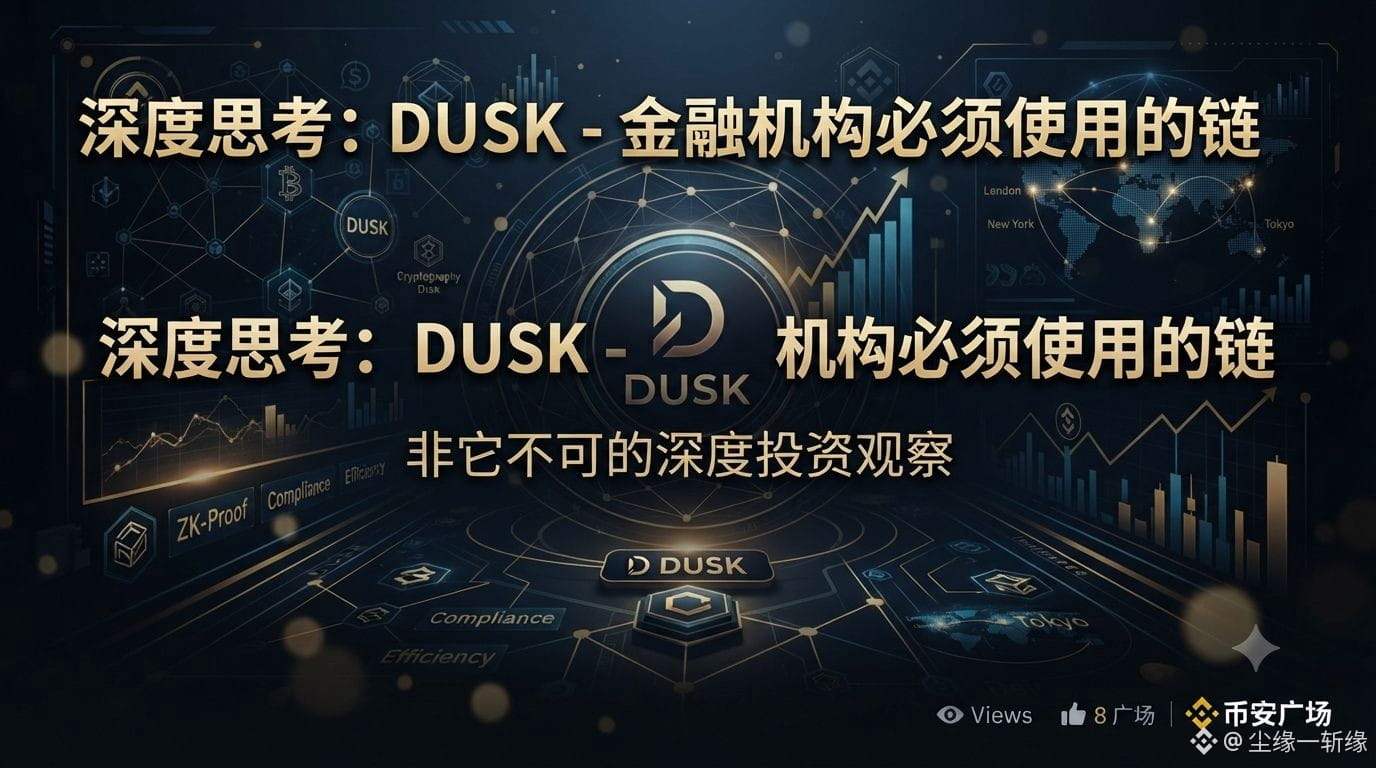
Will it ultimately become a “chain that financial institutions can use,” or a “chain that financial institutions must use”?
These two statements look like they differ by just a few words, but the actual difference is huge.
The former means Dusk’s technology, compliance, and infrastructure are solid, and institutions are willing to adopt it for some business.
But if there are other solutions in the market, institutions can simply switch to another chain—then Dusk always needs to keep proving itself.
The latter is completely different.
Once certain securities issuance, trading, or settlement processes form a dependency on Dusk, the migration cost starts to rise, and the network truly gains its own moat.
So after researching for so many days, I’m actually not that worried about whether Dusk’s technology is advanced enough.
Technology answers “can I do it.”
The real thing that determines a project’s ceiling is “why does someone have to use me.”
That’s also what I think is most worth observing about Dusk right now.
Not how many more partners can be added, and not what feature it will launch next.
But whether, in the future, there will be a certain financial business where:
Once you leave Dusk, costs, efficiency, or compliance handling will clearly get worse.
If such a scenario emerges, I’ll reassess its valuation.
If it never happens, even a complete architecture might just be an infrastructure that’s very nicely built.
So after studying it these few days, my view of Dusk has become simpler and simpler:
I’m not in a rush to prove it will succeed, and I’m not in a rush to prove it will fail.
I’m just waiting for that real moment when it’s “indispensable.”
Because by then, what Dusk is talking about won’t be a story anymore.
It will be a need.
If you ask me to make a judgment about Dusk right now, I actually wouldn’t start by asking whether it can be made.
What I want to know is:
Will it ultimately become a “chain that financial institutions can use,” or a “chain that financial institutions must use”?
These two statements look like they differ by just a few words, but the actual difference is huge.
The former means Dusk’s technology, compliance, and infrastructure are solid, and institutions are willing to adopt it for some business.
But if there are other solutions in the market, institutions can simply switch to another chain—then Dusk always needs to keep proving itself.
The latter is completely different.
Once certain securities issuance, trading, or settlement processes form a dependency on Dusk, the migration cost starts to rise, and the network truly gains its own moat.
So after researching for so many days, I’m actually not that worried about whether Dusk’s technology is advanced enough.
Technology answers “can I do it.”
The real thing that determines a project’s ceiling is “why does someone have to use me.”
That’s also what I think is most worth observing about Dusk right now.
Not how many more partners can be added, and not what feature it will launch next.
But whether, in the future, there will be a certain financial business where:
Once you leave Dusk, costs, efficiency, or compliance handling will clearly get worse.
If such a scenario emerges, I’ll reassess its valuation.
If it never happens, even a complete architecture might just be an infrastructure that’s very nicely built.
So after studying it these few days, my view of Dusk has become simpler and simpler:
I’m not in a rush to prove it will succeed, and I’m not in a rush to prove it will fail.
I’m just waiting for that real moment when it’s “indispensable.”
Because by then, what Dusk is talking about won’t be a story anymore.
It will be a need.