


After the recent bull push, the market has started to trade sideways.
Although in just a short week, the overall cryptocurrency market rose by about 30%, strangely, it doesn’t seem like the market has shown particularly intense FOMO—nor that kind of crazy sentiment like “a bull market is here, hurry up and go all-in.”
I wonder if anyone has felt something like this?
Of course, and there really is a small portion of people who made money.
For example, Big Brother Maji. It’s said that with just 60,000 yuan, he rolled his positions along the way, and in the end he made over 10 million. Those returns are indeed extremely astounding.
But the problem is that most retail investors actually missed this round of行情.
Why?
Because during the earlier market downturn, a large number of retail investors kept waiting for the so-called “final drop.”
“If it drops another wave, I’ll buy.”
“When BTC drops to more than 50,000, I’ll get in.”
“We’re still not at the real bottom.”
In the end, waiting and waiting didn’t give another chance to break out—it just shot up directly.
Now there’s still a group of people thinking:
“No problem. Once this wave of gains is over, it will definitely drop again—then I’ll get in.”
But I think this time may not be that easy.
Because the funds that are driving this rally may already have changed.
First, this bottom-catching may not be retail, but institutions
I just checked the BTC balance on exchanges across the whole network recently, and currently it’s about 700,000 BTC.
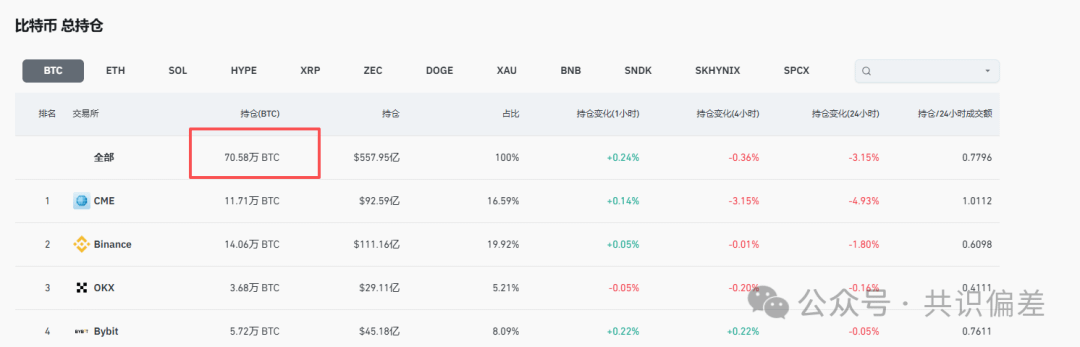
Of course, this number may differ somewhat across different data platforms, but the trend is very clear:
There is less and less BTC on exchanges.
Why is exchange balance worth paying attention to?
Because for most regular investors, if they plan to trade frequently, BTC will most likely still be kept on exchanges.
In other words:
BTC on exchanges can be approximated as coins that are relatively active in the market—coins that could enter trading anytime.
And this number has changed dramatically compared with a few years ago.
I remember in the last bull market, the BTC balance on exchanges across the whole network was still around 1.5 million to 2 million coins.
If there are only around 700,000 coins left now, that would mean that the BTC on exchanges has already dropped by more than half over the past few years—possibly close to 70%.
This is actually a very terrifying change.
Of course, this doesn’t mean that the BTC in retail hands “disappears out of thin air.”
More accurately:
BTC is moving from exchanges and retail hands to an increasing number of long-term holders, ETFs, listed companies, and institutions.
Second, where did the BTC that retail sold go?
That’s what’s interesting.
If BTC on exchanges drops from 1.5–2 million coins to 700,000 coins, where did those coins go?
One very important destination among them is the ETF.
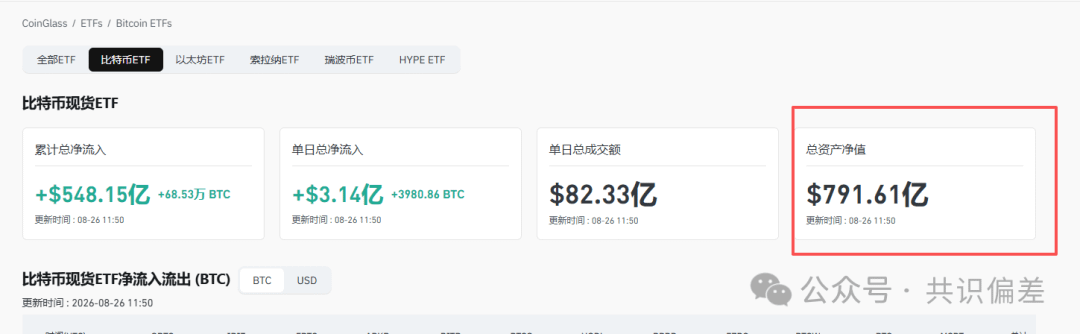
The current size of holdings in U.S. spot BTC ETFs is already enormous.
Based on current data, the BTC held by ETFs is around 1.2 million coins.
In other words:
Exchange 700,000 coins + ETF 1.2 million coins = 1.9 million BTC.
You’ll find that this number is actually very close to the scale of exchange BTC balances—1.5 million to 2 million coins—during the previous bull market period.
Behind this may reflect a very important change:
Previously:
Retail → exchanges → buy and sell BTC
Now:
Retail sells → institutions/ETFs absorb → long-term BTC lockup
BTC hasn’t disappeared.
It’s just that the holders have changed.
Third, listed companies are becoming another huge BTC liquidity pool
Besides ETFs, there is an even more obvious trend:
Public companies are hoarding BTC like crazy.
The value of BTC held by listed companies is already in the hundreds of billions of dollars; based on the current price, that’s roughly 1.3 million BTC.
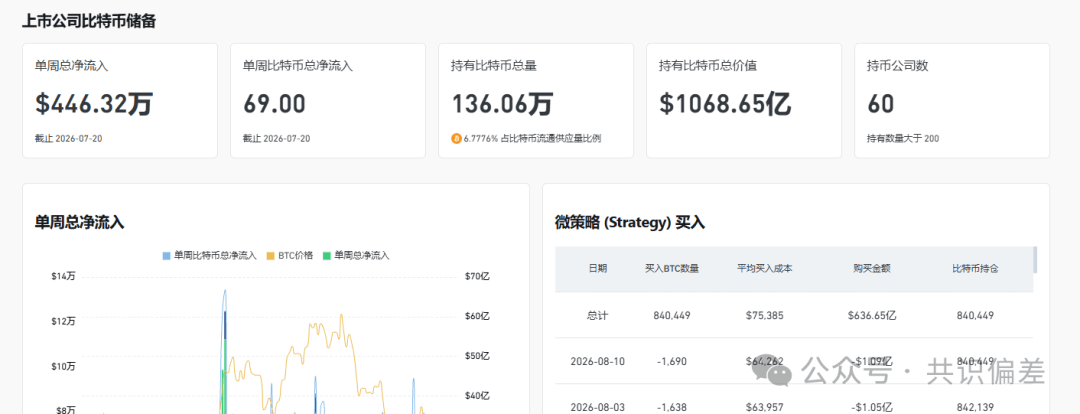
Of course, the biggest player among them is MicroStrategy—i.e., what’s now Strategy.
Other listed companies are increasing in number, but compared with Strategy, they’re still just the smaller part.
So you’ll see a very interesting phenomenon:
The amount of BTC held by listed companies has already surpassed ETFs.
And there’s also a special issue here:
A company like Strategy is completely different in logic from ordinary retail investors.
The core purpose of buying BTC is to hold it long term—treating BTC as part of a company’s balance sheet.
So while these BTC theoretically belong to the “market circulating supply,” in reality they are very hard to become near-term sell pressure.
Fourth, truly active BTC may be far fewer than 20 million coins.
So we can rethink one question:
So, how much BTC in the market is actually “tradable”?
Bitcoin’s total supply is close to 21 million coins.
About 20 million coins have already been mined.
But you can’t simply say:
“There are 20 million BTC in the market.”
Because there is a large amount of BTC in here:
permanently lost;
early wallets sitting unmoved for a long time;
Satoshi-related addresses;
long-term holders;
ETFs;
listed companies;
governments;
various institutional treasuries;
individual cold wallets.
These BTC still exist, but many of them are actually already very difficult to form near-term selling pressure.
On the other hand, currently, the BTC that is relatively more active may mainly be concentrated in:
Exchange 700,000 coins + ETF about 1.2 million coins.
That’s about 2 million BTC.
Of course, this is not a strict sense of “true circulating supply,” because ETFs themselves involve subscription and redemption, and exchange balances don’t necessarily mean they will be sold.
But at least it helps us understand a very important trend:
The amount of BTC that is truly actively traded in the market is likely far fewer than 20 million.
And this number is still continuously decreasing.
Fifth, BTC is undergoing a “major coin migration”
I remember that I wrote an article in 2024:
(Everyone should own one BTC)
I once put together a diagram of BTC holdings.
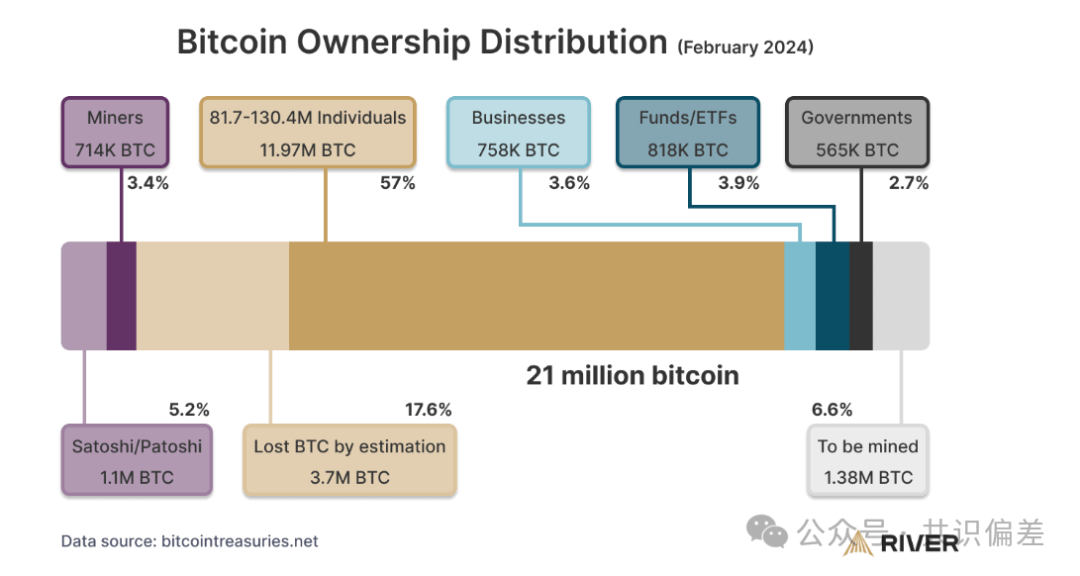
There is a very interesting data point in there:
At that time, the listed companies held about 750,000 BTC.
And now, it’s already over 1.3 million.
In just a few years, it basically got close to doubling.
Now look at ETFs.
At that time, spot BTC ETF holdings were around 800,000 BTC.
It has already exceeded 1.2 million coins.
In other words, ETF holdings are increasing again by about 50%.
Government holdings are also increasing.
And now, some U.S. states are even starting to discuss and push to build their own BTC reserves.
So you’ll find a very clear trend:
BTC is shifting from “retail investors’ asset” to “institutional asset.”
Sixth, the biggest change for future BTC may not be the price, but the holding structure
When we used to discuss BTC, the question we liked to discuss most was:
How many BTC haven’t been mined yet?
21 million coins.
But I think the importance of this issue in the future will keep declining.
The real question worth focusing on should become:
Out of these 21 million BTC, how many are actually willing to sell?
Because BTC’s biggest feature is that its supply is extremely limited.
As more and more BTC is absorbed by ETFs, listed companies, governments, funds, and long-term investors, the supply of coins that can truly flow freely in the market will become less and less.
Then you end up with a very interesting result:
The more institutions hold → the fewer circulating coins there are in the market → even a small amount of new capital could drive much bigger price changes.
But at the same time, as the proportion of institutional holdings keeps rising, BTC’s market structure is becoming more and more mature.
Ultimately, it may increasingly resemble gold, core assets in the U.S. stock market, and even super large-cap assets like Nvidia or Moutai.
Why are these assets so hard to see long-term, sustained large declines?
Not because they’ll never fall.
But it’s because:
There is a lot of institutional capital in there.
Pension funds, funds, ETFs, insurance capital, and long-term capital are all in there.
These funds won’t all run away just because the price drops 5% in a day.
Seventh, so I actually think what’s most worth watching right now is not FOMO, but “coins are disappearing.”
This may also explain why, even though the bull market’s BTC has risen 30% recently, the market hasn’t shown especially wild emotions.
Because the participants in this cycle may have already changed.
Previously:
Retail chases the rally → price rises → FOMO → more retail investors jump in.
And now it’s increasingly likely to become:
Institutional accumulation → fewer circulating coins → price rises → retail investors catch on too late.
By the time retail investors truly realize the bull market is here, they may not get the most comfortable price anymore.
Of course, this doesn’t mean BTC won’t crash hard in the future.
Institutions will also sell, ETFs can also see outflows, and the macro environment will change too.
But from a longer-term perspective, a trend has become clearer and clearer:
BTC is moving from the hands of “people willing to trade” to the hands of “people who are more willing to hold long term.”
So in the future, true scarcity for BTC may have nothing to do with those 21 million coins at all.
Instead, it’s this:
The BTC that is truly willing to sell.
That’s also why I’m increasingly convinced that:
Don’t just focus on how much BTC can still rise—what you should care about is how many BTC remaining coins can be bought.
If this trend continues, then the biggest change for BTC in the future may not be another round of a “crazy bull market,” but rather that it gradually becomes a super asset dominated by institutional accumulation, with the circulating float getting smaller and smaller—making it harder and harder for prices to be pushed down.
So if you’re still waiting for a “lower point with higher certainty” right now, you must figure out one thing:
Once more and more BTC is taken by institutions, will the market really keep giving you, just like before, the opportunity to get on board with a big pile of coins whenever you want?
I’m not sure.
But I think opportunities may be getting more and more expensive.$BTC
