
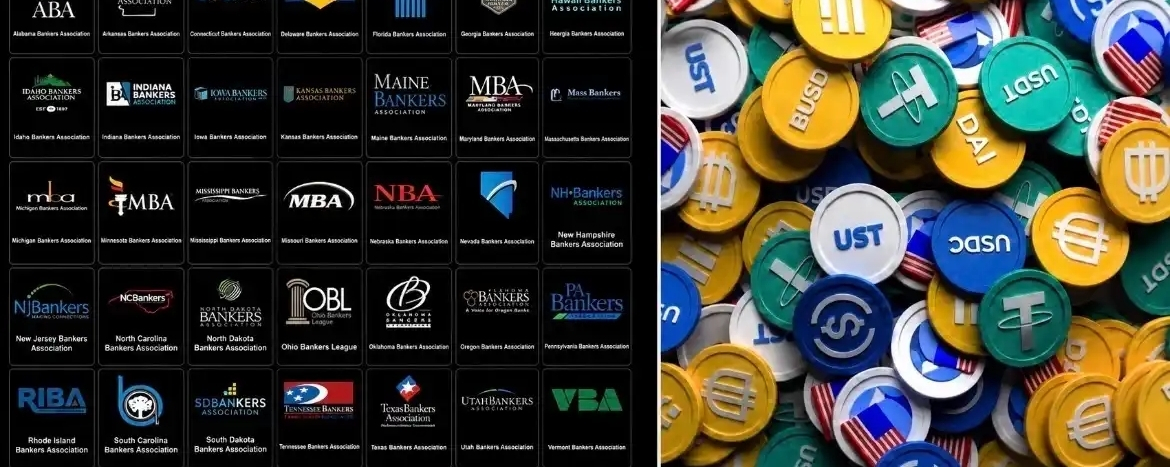

Traditional Finance (#TradFi ) isn't just watching the crypto revolution anymore—it’s trying to build its own rails.
In a massive, coordinated industry move, a coalition of 39 U.S. State Banking Associations has officially formed the BankChain Alliance. The goal? Building a nationwide, industry-owned blockchain network explicitly engineered for regulated financial institutions.
With a full commercial launch targeted for 2027, this marks one of the largest pushes by traditional banking to reclaim dominance over digital liquidity.
The Power Scale: $21.8 Trillion in Assets
The sheer size of this coalition is staggering. The participating state associations represent a network of 3,283 regional and community banks controlling a combined pool of $21.8 trillion in assets.
The alliance is being led by interim chair Kathy Kraninger, the current CEO of the Florida Bankers Association and former director of the Consumer Financial Protection Bureau (CFPB). Instead of building separate, expensive, siloed blockchains, these banks are pooling resources into a single shared network.
⚙ What Will the BankChain Alliance Network Do?
According to the official announcement, the private network will focus heavily on regulated, institutional-grade utilities:
🪙 Bank-Issued Stablecoins: Directly competing with private issuers like Tether (USDT) and Circle (USDC).
💳 Tokenized Deposits: Turning standard commercial bank deposits into digital tokens for instant internal transfers.
⚡ Automated Settlement: Implementing smart contracts to enable 24/7 programmable, instant financial settlement.
🌐 Interoperability Rails: Built-in multi-chain bridges to seamlessly connect with external blockchain ecosystems.
The Real Strategy: Stopping the Deposit Bleed
Why now? It all comes down to deposit flight. Traditional banks are watching billions of dollars continuously leave standard checking accounts and flow into yield-bearing or high-utility private stablecoins.
By launching an on-chain banking network, these regional and community banks can offer corporate and retail clients the exact same benefits—24/7 instant settlement and programmability—while keeping the cash inside the regulated banking system. This directly complements recent Wall Street moves, like The Clearing House’s on-chain deposit settlement network launched earlier this year.
What Happens Next?
The BankChain Alliance is moving fast but is still in its early infrastructure phase. They are currently interviewing and selecting their core technology infrastructure partners. The specific list of individual participating banks, governance models, and funding structures will be disclosed in the coming months.
One thing is absolutely clear: TradFi is no longer fighting the blockchain—it is trying to absorb it.
What do you think? Will bank-issued stablecoins threaten USDT and USDC, or are they too late to the game?
#Stablecoins #Banking #Blockchain #Tokenization
