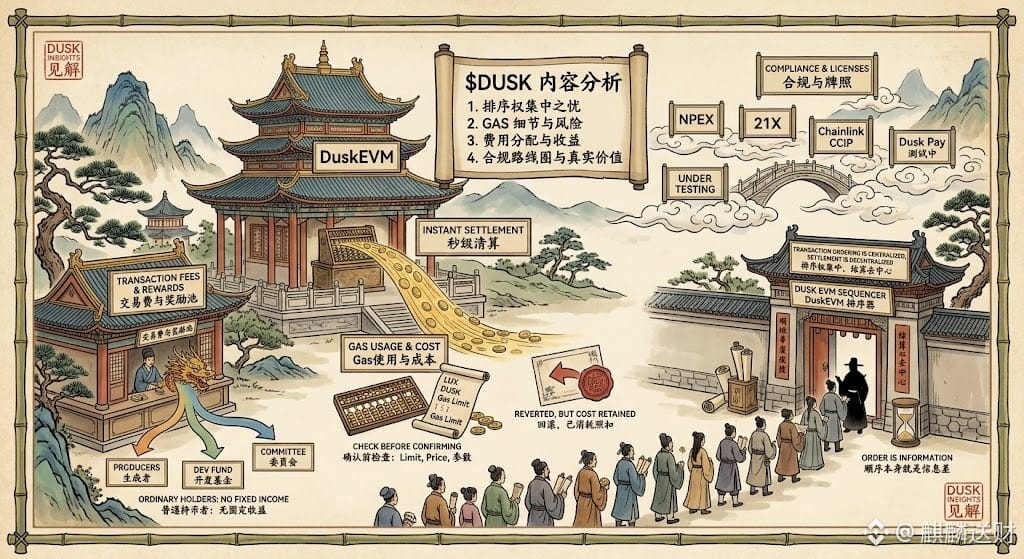
To be honest, when that “instant settlement” slogan for @Dusk first came out, I was actually a bit tempted. But once I sat down and looked closely at the first challenge, I calmed down: all trades have to be stuffed into DuskEVM’s sequencer first to queue up—like going through the subway gate during rush hour, just one narrow opening. The question is, who manages this “cashier counter”? Is it centralized? Can people cut the line? The docs don’t mention a single word. They made the on-chain order book so complicated to prevent manipulation, yet the sorting privilege at the entry is held by one party. The order itself is an information advantage. Deterministic settlement is decentralized, but sorting power is centralized—somehow, this deal doesn’t feel right.
Let’s talk about Gas too. It’s calculated as gas_used × gas_price, and the unit is LUX. 1 DUSK equals 1 billion LUX—pretty straightforward. The gas limit is a cap: you don’t pay for unused gas; if the transaction runs out of gas mid-way, it rolls back, but the portion already consumed is still charged. They say this is to prevent attackers from freeloading node compute power. So every time I confirm in my wallet, I have to break it down and check three things: is the limit enough, is the price reasonable, and did I enter the parameters correctly. If it fails, don’t just get emotional and try again with doubled values—first open the browser and figure out why.
Where the fees go also affects your judgment. The block reward is the newly issued $DUSK plus transaction fees, distributed to the block producer, the developer foundation fund, and the committee. Any undistributed portion is said to be possibly burned. But after I looked around, I didn’t see any fixed automatic payouts for ordinary token holders.
They’ve covered compliance and licenses pretty extensively—NPEX, 21X, Chainlink CCIP, DuskEVM are all listed by name—but the on-chain TVL is still low. There isn’t much real settlement data yet, and Dusk Pay is still in testing. Total supply is 1 billion: half is released at genesis, and the other half gradually gets diluted through long-term staking. Transaction fees are not burned; they flow back to the rewards pool. For me, real value capture isn’t in those license numbers—it depends on contract interaction volumes that are not for foundations, auditable on-chain settlement records, and whether the fees can sustain a sufficient security buffer for the network.
Instant settlement sounds like a smooth experience, but sorting power is an invisible form of control. Gas is the price you pay for computing resources. Compliance is a roadmap that hasn’t finished being walked yet. Once you sort all of that out, then consider boarding. #dusk
Let’s talk about Gas too. It’s calculated as gas_used × gas_price, and the unit is LUX. 1 DUSK equals 1 billion LUX—pretty straightforward. The gas limit is a cap: you don’t pay for unused gas; if the transaction runs out of gas mid-way, it rolls back, but the portion already consumed is still charged. They say this is to prevent attackers from freeloading node compute power. So every time I confirm in my wallet, I have to break it down and check three things: is the limit enough, is the price reasonable, and did I enter the parameters correctly. If it fails, don’t just get emotional and try again with doubled values—first open the browser and figure out why.
Where the fees go also affects your judgment. The block reward is the newly issued $DUSK plus transaction fees, distributed to the block producer, the developer foundation fund, and the committee. Any undistributed portion is said to be possibly burned. But after I looked around, I didn’t see any fixed automatic payouts for ordinary token holders.
They’ve covered compliance and licenses pretty extensively—NPEX, 21X, Chainlink CCIP, DuskEVM are all listed by name—but the on-chain TVL is still low. There isn’t much real settlement data yet, and Dusk Pay is still in testing. Total supply is 1 billion: half is released at genesis, and the other half gradually gets diluted through long-term staking. Transaction fees are not burned; they flow back to the rewards pool. For me, real value capture isn’t in those license numbers—it depends on contract interaction volumes that are not for foundations, auditable on-chain settlement records, and whether the fees can sustain a sufficient security buffer for the network.
Instant settlement sounds like a smooth experience, but sorting power is an invisible form of control. Gas is the price you pay for computing resources. Compliance is a roadmap that hasn’t finished being walked yet. Once you sort all of that out, then consider boarding. #dusk