

Original: Wu 00000 Kong Qin Shuo Moments
The three giants race to expand production capacity
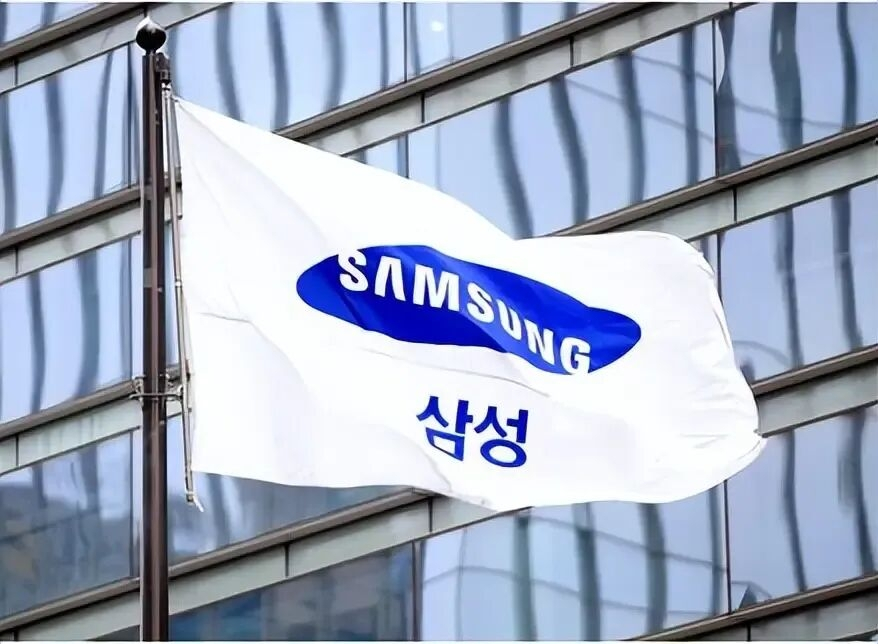
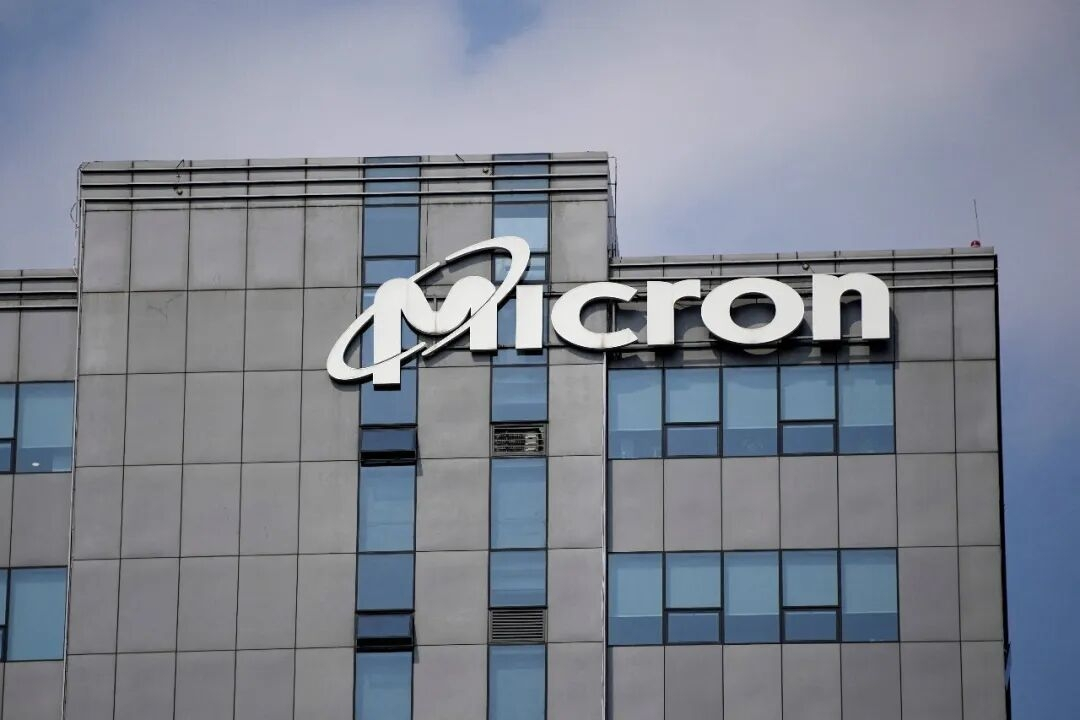
Recently, Samsung Electronics, SK hynix, and Micron Technology have all announced large-scale capacity expansion plans, with investment focused on HBM, server DRAM, and enterprise-class NAND flash.
The three giants repeatedly emphasized that most of the new capacity is locked in for cloud providers’ long-term orders, and that the capacity buildout cycle is relatively long. From civil construction, to moving in and installing equipment, and then ramping up yields, wafer fabs need two to three years, or even four to five years. Meanwhile, AI storage demand is surging, so the near-term situation of supply falling short will not change.
On August 13, when SK Group chairman Choi Tae-won was interviewed by CNBC, he even put forward the concept of “a storage shortage.” He predicted that the gap would be most pronounced in 2027, and that the tight situation may continue until 2030. He expressed regret over the sharp surge in storage prices, but also said it was unavoidable— the supply shortage is simply too severe.
Even so, many investors remain quite worried, because historical experience—or lessons—tell them that in the storage industry, the word “capacity expansion” is dangerous.

The curse of capacity expansion
The storage industry has very strong cyclical characteristics. When demand rises, capacity is tight—prices go up. Expansion adds supply. When supply exceeds demand, prices crash, losses lead to bankruptcy, the industry reshuffles, capacity contracts, and then again supply is tight while demand is high—prices rise, expansion adds supply, supply exceeds demand, prices crash… it repeats endlessly.
Because the storage industry has volatile demand, a long supply chain and strong bullwhip effects, and long capacity construction cycles, the peak of capacity ramp-ups often collides perfectly with the demand trough. A price halving is considered lucky—falling 95% or more is also very common. It’s extremely brutal.
To some extent, this is attributable to one player in the industry: Samsung Group, the “work-yourself-to-death” one.

In 1974, Samsung’s first-generation leader Li Byung-chul entered the semiconductor industry by acquiring a Korean semiconductor company. In 1983, it announced entry into the DRAM memory race. In 1987, Li Byung-chul died, and his son Li Kun-hee took over. Samsung fully leveraged the nationwide system of “state guidance—research and education for industry,” using that approach to do to Japanese storage companies what they had done—crushing them all through “counter-cyclical capacity expansion.”
When storage prices collapsed and the whole industry fell into losses, and rivals all compressed production and capacity, Samsung, on the one hand, kept increasing output; on the other hand, it continued pouring huge capital into new plants, buying equipment, and expanding capacity. This caused prices to plunge even faster. Rivals went bankrupt and out of the game, while it also deterred potential entrants. By the time old capacity cleared and market demand rebounded, Samsung’s large amount of newly added capacity was already built and ready to be put into production—directly taking market share.
The most classic Samsung counter-cyclical capacity expansion happened in 2008. That year, the U.S. subprime mortgage bubble burst and triggered a global financial crisis. PC demand shrank rapidly. At the same time, earlier market expectations that the Microsoft Vista system would bring a memory-driven incremental boost turned out to be far too optimistic. DRAM prices crashed. The vast majority of storage companies fell into deep losses.
Facing a deep industry winter, Qimonda (spun out from Infineon, Europe’s only DRAM manufacturing giant), Elpida (formed by merging DRAM businesses from Japanese firms such as Hitachi, NEC, etc.—Japan’s last independent DRAM company), and numerous DRAM makers in Taiwan all reduced wafer output, shrank capex, and prioritized preserving cash flow to avoid breaking the capital chain.
But Samsung isn’t afraid. Even if its storage business suffers huge losses too, it doesn’t cut capex. It keeps expanding capacity, aggravating oversupply and relentlessly pressuring prices downward. Soon, prices break through most competitors’ unit variable production costs, driving marginal profit negative. Not only can it not cover fixed costs, but each additional wafer sold means losing even more money—sell more, lose more.
Qimonda’s cash flow ran out first, and in 2009 it officially declared bankruptcy and exited the DRAM market. Next was Japan: Elpida struggled for years. Even though it received government support, persistent losses were hard to reverse. In 2012, it filed for bankruptcy protection, and was later acquired by Micron. Local DRAM companies in Taiwan also suffered severe blows, and most exited mainstream competition.
Only Micron managed to dodge the crisis under its own efforts and protection from the U.S. government.
After this reshuffle, the global DRAM industry was left with only three core manufacturers: Samsung, SK hynix, and Micron. Samsung paid the price of massive short-term losses to buy a three-oligopolist market structure. It is the top oligarch among them.
This battle is widely regarded as the “apotheosis” battle that showcased the strategy and courage of Samsung’s second-generation leader, Li健熙.
After a duopoly-like power structure formed, the “three giants” began to develop an unspoken understanding. They consciously constrained capital expenditures and didn’t readily expand DRAM capacity to avoid a vicious price war.
Over the next six or seven years, the storage industry entered a consolidation period. During this time, NAND flash upgraded from 2D to 3D. In September 2012, Samsung officially began construction of the world’s first batch of large-scale commercial 3D-NAND capacity in Xi’an, China. Production officially started in May 2014—this became the starting point of Samsung’s 3D NAND expansion. As for DRAM, it no longer substantially increased the number of wafers; instead, it relied on process shrinks to increase bit output (the effective total storage bit capacity produced per wafer).
In 2016, the storage industry entered a major cycle. Cloud computing and large-scale server construction, smartphone storage upgrades, and crypto mining all stacked together in demand. Meanwhile, 3DNAND yields climbed slowly, limiting supply release. DRAM and NAND prices continued to soar. By 2018, the profits of the three major manufacturers hit record highs.
In Q4 2018, the storage cycle hit a turning point. Downstream server and smartphone manufacturers ramped down inventories on a large scale. The capacity released from earlier expansions was concentrated and unleashed, causing DRAM and NAND prices to drop rapidly. Samsung’s semiconductor division’s operating profit month-over-month nearly halved. The bull market was declared over.
Li Lu and other big-name investors move in
By the end of 2019, the storage industry had fallen to the bottom of its cycle. Himalaya Capital, managed by Li Lu, began heavily buying Micron starting in Q4 2019. It continued to add later on, with a cost basis of about $49. At its peak, Micron accounted for 51% of Himalaya’s U.S. equity portfolio, becoming the largest holding. Around the same time, Monish Parberley also held Micron heavily, with a position that once reached as high as 77%.
Li Lu, a Chinese-American value investor, is Munger’s close friend. In 1997, he founded Himalaya Capital, entrusted to manage the Munger family’s assets, and once recommended BYD to Buffett. He has written books such as (Civilization, Modernization, Value Investing and China), and is committed to spreading value investing ideas.

Monish Parbie? An Indian-American value investor, a faithful disciple of Buffett. In 2007, he co-won a live auction to dine with Buffett. He founded the Parberley Investment Fund in 1999.
Li Lu and Parberley’s logic is that since only Samsung, SK hynix, and Micron remain in the DRAM market, the oligopoly industry structure has already formed. Oligopolists will restrain capex, creating capacity constraints, no longer engaging in vicious competition, maintaining reasonable high prices, and sharing monopoly profits.
From the perspective of industry structure, the storage industry is like the technology sector’s “coke”: it’s not a duopoly monopoly, but a three-oligopolist monopoly. Like storage, the oligopoly structure in the coke industry was also formed only after fierce competition.
Before World War II, Coca-Cola was dominant, while Pepsi-Cola repeatedly came close to bankruptcy. On the market there were also many competitors such as Dr Pepper and Crown Cola. In the 1980s, Coca-Cola and Pepsi both poured huge sums into aggressive marketing (including advertising, promotions, discounts, giveaways, and terminal icebox placements, etc.). They expanded channels to fight for customers, even leading to physical conflicts between employees of the two sides. This period is known as the “Coke Wars.”
At the peak of the “arms race” in 1984, Coca-Cola’s marketing expenses were about $200 million, accounting for 8% to 11% of revenue; Pepsi-Cola’s marketing expenses were about $150 million, accounting for 9% to 12%. What’s especially impressive is that in 1983, Pepsi signed Michael Jackson for $5 million, setting the highest record for celebrity fees of that era.
After a decade or so of intense fighting, by the 1990s, the two companies had to accept a reality: neither could beat the other. If they kept fighting, both would suffer losses. Peaceful coexistence was the only way out. The “Coke Wars” finally ended.
Before the “Coke Wars” began, Coca-Cola and Pepsi’s market shares were 34% and 24%, respectively; after the “Coke Wars” ended, the two companies’ market shares became 42% and 32%, respectively. That is to say, both giants were winners of the “Coke Wars,” while the losers were all other cola companies. The “Coke Wars” is one of the most popular marketing case studies in business schools.
For fiscal year 2025, Coca-Cola’s marketing spend was $6.4 billion, 13% of revenue; for PepsiCo, these two figures are $7.6 billion and 8%. The brand assets created by high marketing expenses are like a deep and wide moat—surrounding the “castle” of the beverage/coke industry and blocking all potential entrants. Its other moat is the bottling network.
Every time Buffett talks about moats, he uses the example of Coca-Cola. After he finished building his Coca-Cola position in the late 1980s and early 1990s, he held it ever since and never sold a share. His original cost was $1.299 billion. Coca-Cola has long remained in the top four holdings in Berkshire’s stock portfolio. Over the years, the dividends received alone have already far exceeded the total capital originally投入.
From the perspective of moats, the castle of the storage industry is like the castle of the coke industry as well. It also has at least two moats: first, the huge capital and long time required to build capacity; second, technology patents and know-how.
In theory, the three storage giants could fully coordinate like the two duopolists in the coke industry—sharing ample profits through tacit cooperation. Li Lu and Parberley had very good reasons to be heavily invested in Micron.

However, at least the following three points made them hope for nothing.
First, capacity expansion has already been deeply embedded in Samsung’s “work-yourself-to-death” genetic code, turning into its instinctive reaction. Back then it was able to overwhelm all competitors from Japan, Europe, and the like—leaving only two players that couldn’t be crushed. One was its domestic rival, SK hynix, equally fierce and equally backed by strong support from the Korean government. The other was Micron, whose operating philosophy and management style are very similar to Samsung and SK hynix, and it also receives major support from its home government.
Second, the cyclicality and technology-driven nature of the storage industry is far stronger than that of the coke/beverage industry. Those dramatic swings always lead players—especially Samsung—to entertain fantasies: maybe if we expand capacity one more time, we can kick the other two out, or at least kick one so hard it can’t survive—if not completely knock it out, then at least cripple it.
The rapid development of storage chip technology further strengthens this ambition. Every time technology progresses or changes, that’s an opportunity—if you don’t change, you’ll fall behind and be eliminated. Coke is the opposite. In 1985, facing Pepsi’s疯狂 competition, Coca-Cola changed its classic century-old formula. After it was released, longtime consumers strongly resisted, protested, and complained. The company was forced to restore the old formula within just a few months and get back to the old Coca-Cola. Chips are the new good; Coke is the old good.
Third, Samsung’s third-generation leader, Li在镕, was eager to make achievements and prove himself. In 2014, Li健熙 suffered a sudden heart attack and was laid up in bed. Li在镕 interrupted his studies at Harvard and returned home to take over. In 2020, Li健熙 passed away, and Samsung officially entered the Li在镕 era.
It should be said that from 2018 to 2022, Li在镕 was fairly restrained, suppressing the impulse to expand capacity. But when the industry returned to a bear market in 2023, Li在镕 could no longer control himself. SK hynix and Micron cut production significantly to avoid worsening oversupply, but Samsung didn’t. It accelerated HBM capacity expansion. On one hand, it froze new DRAM and NAND capacity expansions to make room for HBM; on the other hand, it renovated old fabs for HBM packaging.
Clearly, Li在镕 very much wanted to make up for Samsung’s mistakes in HBM.
In 2013, SK hynix and AMD合作 launched the world’s first HBM. Since then, they have continuously pushed HBM R&D and production, actively seeking close cooperation with NVIDIA with坚定 confidence and steady execution.
But Samsung went on-and-off and missed the opportunity. From 2015 to 2017, Samsung followed with R&D on HBM1 and HBM2 and supplied AMD and NVIDIA. In fact, in the NVIDIA V100 era, Samsung was the main HBM supplier—not SK hynix.
It’s said that in 2018, Jensen Huang visited Samsung and proposed deep collaboration on HBM. At that time, Li在镕 was mired in legal cases, and the collaboration plan was put on hold.
In the 2019 storage bear market, Samsung judged that HBM was a niche market and disbanded the core HBM team, leaving only a few people to keep the project going. Around the same time, SK hynix persisted despite losses, believing in the future. In 2022, NVIDIA’s H100 adopted SK hynix’s HBM3, and since then the two have been deeply bound together.
In 2023, ChatGPT ignited AI computing power demand, causing HBM demand to surge. Samsung quickly restarted the HBM team, but it bet on the wrong packaging route. HBM3E couldn’t pass NVIDIA certification in the long run, missing the golden window of the AI computing boom—so it could only watch SK hynix run away ahead.
In this situation, it’s not hard to understand why Li在镕 resorts again to Samsung’s capacity-expansion genetic code.
In early 2023, stimulated by Samsung’s capacity expansion, SK hynix and Micron also followed by increasing capital expenditures. Market inventories piled up quickly, and storage product prices kept falling. Micron quickly swung from profits to large losses. The market even worried it might go bankrupt. If it goes bankrupt, Micron would exit the DRAM market just like Japan and Europe did.
At this point, the premise for Li Lu and Parberley to invest in Micron—“the industry structure of an oligopoly forms capacity constraints”—no longer held, because the three giants expanded capacity at the same time. According to the principles of value investing, when the underlying logic that supported the buy no longer exists, you should exit. In Q1 2023, Li Lu began to reduce holdings; by Q2, he completed liquidation. The average selling price was about $62, and holding for 3.5 years resulted in a small profit. Parberley also completed full liquidation in Q3 of that same year.

“How do I describe my pain?”
After that, everyone already knows what happened. Since 2023, as the AI wave crashed in like a storm, NVIDIA’s market cap surged from under $400 billion to surpass $5 trillion. On June 25, 2025, it officially topped the world in market value as of the close—maintaining that lead for about 13 straight months.
Storage stocks have also performed remarkably well. Especially in the second half, as AI development hit a bottleneck and shifted from computing chips to storage chips, the stock price drivers outperformed NVIDIA. Let’s look at the stock prices of the three giants.
Samsung Electronics, with a multi-business group structure, has had its elasticity diluted. From the bottom in late 2023, the biggest rise is roughly threefold. In May 2026, its market cap reached over $1 trillion. Currently its market cap is $1.19 trillion.
SK hynix, with a tenfold maximum gain from the bottom in late 2023. On June 27, 2025, its market cap broke $1 trillion, with a peak market cap of $1.35 trillion. Currently its market cap is $0.98 trillion.
Micron Technology, about $48 at its lowest within 2023, trading in a range of $45 to $75 throughout the year. With HBM3E and HBM4 completed certification in 2024 and entering NVIDIA’s supply chain, the stock price surged all the way. On May 26, 2026, its market cap broke $1 trillion (one day earlier than SK hynix). Currently the stock price is $1,011 and the market cap is $1.16 trillion.
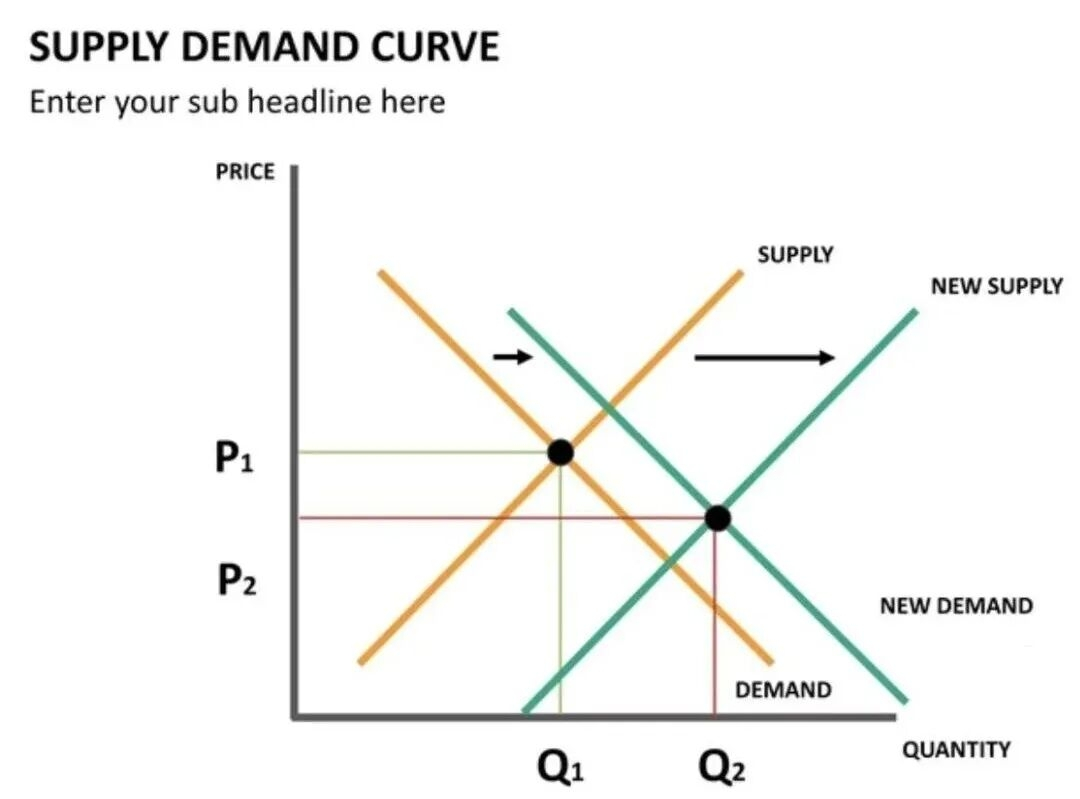
The three storage giants have gone through a truly epic rally. Let’s illustrate it simply using the supply-and-demand curves.

Samsung expands capacity; SK hynix and Micron follow. The industry’s capacity constraints disappear. If market demand stays the same, prices would plunge as hard as in the previous cycles. But what no one expected was that when the AI wave arrived, demand jumped several “energy levels,” absorbing all capacity and leaving a huge gap—prices skyrocketed, and so did the stock.
We use the vertical axis to represent price, and the horizontal axis to represent quantity. The demand curve is a line sloping down toward the right: as price falls, demand increases. The supply curve is a line sloping up toward the right: as price rises, supply increases. The intersection of the two curves determines the market-clearing price and quantity.
When the industry expands capacity, the supply curve shifts outward (to the right). With the demand curve unchanged, the market-clearing price falls while quantity rises.
But what no one expected was that the AI wave pushed the demand curve far outward—well beyond the new supply curve. This caused the intersection point between the new supply curve and the new demand curve to be far to the right and above the original intersection. That means both quantity and price rise, and the increase is very large. The “three storage giants” saw a猛 surge in profits, and their stock prices skyrocketed.
People in the investment community have been speculating about the feelings of big-name investors like Li Lu and Parberley over the past three years. Some playful Chinese stock investors say that a Chinese song title might best express their feelings: that is (How do I describe my pain).
However, if you can’t accept, understand, and dissolve that pain, you aren’t an outstanding investor. They made the right decisions, yet got disappointing results. But those disappointing results can’t prove their decisions were wrong. When the reasons that supported your investment (capacity constraints) no longer exist, the correct decision is to exit in time. What happens afterward has nothing to do with you.
If you didn’t see the AI wave coming early, you can’t make money from it—fair enough. In fact, it’s also a kind of protection. If you make money beyond your understanding—especially a lot—your brain may receive incorrect feedback signals. Either you think next time you can still pretend to know what you don’t and get more big money, or you fall into a delusion that you understand everything.
And investing is repeated games. Under such a brain-led command, one day you will lose badly. So not making money beyond your understanding is both fair and protective for you—it’s a good thing.
Seeing the AI wave early is extremely difficult—almost no one can do it, unless you have a “God’s-eye view.” So there’s no need to grieve. God’s matters are God’s; yours are yours. What you already understand is enough.
Returning to the question raised in the article title: with the three storage giants expanding capacity, is it a signal for investors to retreat? It depends on how you judge the extent to which the two curves—supply and demand—shift. If you are 100% sure that the demand curve shifts outward far more than the supply curve, then you shouldn’t retreat. If you are 100% sure the supply curve shifts outward far more than the demand curve, then you should withdraw in time, just like Li Lu and Parberley.
However, you can’t be 100% certain—especially in something extremely complex like investing. You can determine your position based on win probability and odds, for example using the Kelly formula. Investing is a game of probabilities. As Howard Marks put it: “Investing deals with a distribution of probabilities, not a sure outcome.”
If someone is absolutely certain, then they should get out of the stock market right away. Their stupidity and arrogance will eventually wipe them out.
“One of the essences of rationality is not being absolutely certain.” (Russell)
No.7056 original first release article | author? Wu00000kong
Author bio: studied and taught at Fudan University for 9 years; worked at CEIBS (China Europe International Business School) for 20 years. WeChat personal account: 无语2022; WeChat video account: 无语20220425.
Open whitelist duanyu_H | submission tougao99999
Special statement: The above content only represents the author’s personal views or positions, and does not represent the views or positions of Sina Finance’s headlines. If you need to contact Sina Finance’s headlines due to issues related to the work’s content, copyright, or other matters, please do so within 30 days after the above content was published.