I happened to be scrolling through Twitter and saw that the Dutch data protection authority fined Uber nearly a billion euros. The reason was that an automated system suspended drivers’ accounts without providing adequate notice. Many drivers opened the app and found their status was still there, but they couldn’t do anything. That reminded me of my friend’s experience a couple of days ago. He panicked in the middle of the night saying his assets were gone. When I looked, the numbers were clearly there—but the moment he tried to do anything, it returned an error. @Dusk After messing around for a long time, he finally realized the money hadn’t evaporated; it had just been allocated into the two existence modes that Dusk’s native support uses.
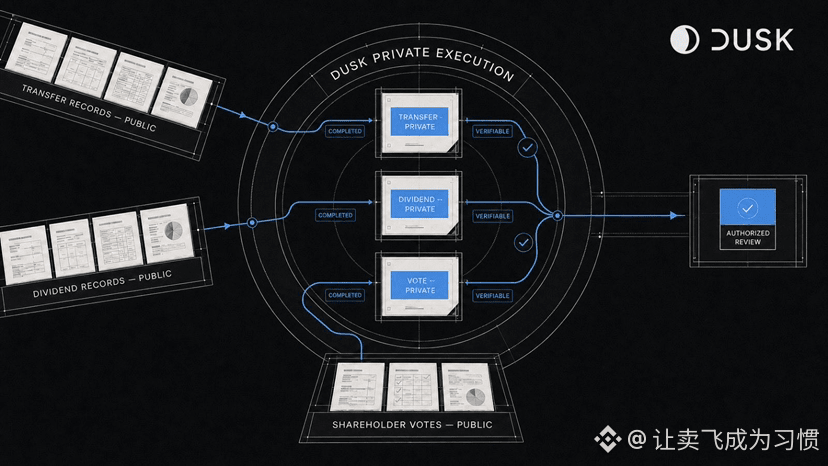
From the ground up, Dusk provides two different transaction models at the same time. $DUSK Moonlight is the public account mode: balances and flows are written directly on the ledger, requiring sequential processing—well suited for scenarios that need auditing. Phoenix is the encrypted note mode: the amount and source are hidden using zero-knowledge proofs. The system only verifies that you’re authorized to move it and that it hasn’t been reused, and it also supports selective disclosure by checking the keys. Both ultimately settle on the same settlement layer. Switching from one mode to the other isn’t automatic. Many wallets, for the sake of a simple interface, simply add the two balance types into one number. As a result, you think you’re holding cash you can move anytime—but when you actually try, you find that part of it is still locked inside private channels that require additional proof. It’s like you think you have all cash in your pocket, but at checkout you pull out vouchers that need to be exchanged first. #dusk
Dusk makes privacy a native dual-model design rather than an after-the-fact toggle. The original intent is to provide more precise choices for different scenarios. The real problem is why this kind of basic conversion still requires users to trip over the pitfalls themselves. The best technology should be invisible—you shouldn’t feel its presence, yet it keeps the rules aligned behind the scenes. Hopefully one day, no one will have to stare at a screen in frustration because the rules aren’t aligned. $BTC
From the ground up, Dusk provides two different transaction models at the same time. $DUSK Moonlight is the public account mode: balances and flows are written directly on the ledger, requiring sequential processing—well suited for scenarios that need auditing. Phoenix is the encrypted note mode: the amount and source are hidden using zero-knowledge proofs. The system only verifies that you’re authorized to move it and that it hasn’t been reused, and it also supports selective disclosure by checking the keys. Both ultimately settle on the same settlement layer. Switching from one mode to the other isn’t automatic. Many wallets, for the sake of a simple interface, simply add the two balance types into one number. As a result, you think you’re holding cash you can move anytime—but when you actually try, you find that part of it is still locked inside private channels that require additional proof. It’s like you think you have all cash in your pocket, but at checkout you pull out vouchers that need to be exchanged first. #dusk
Dusk makes privacy a native dual-model design rather than an after-the-fact toggle. The original intent is to provide more precise choices for different scenarios. The real problem is why this kind of basic conversion still requires users to trip over the pitfalls themselves. The best technology should be invisible—you shouldn’t feel its presence, yet it keeps the rules aligned behind the scenes. Hopefully one day, no one will have to stare at a screen in frustration because the rules aren’t aligned. $BTC