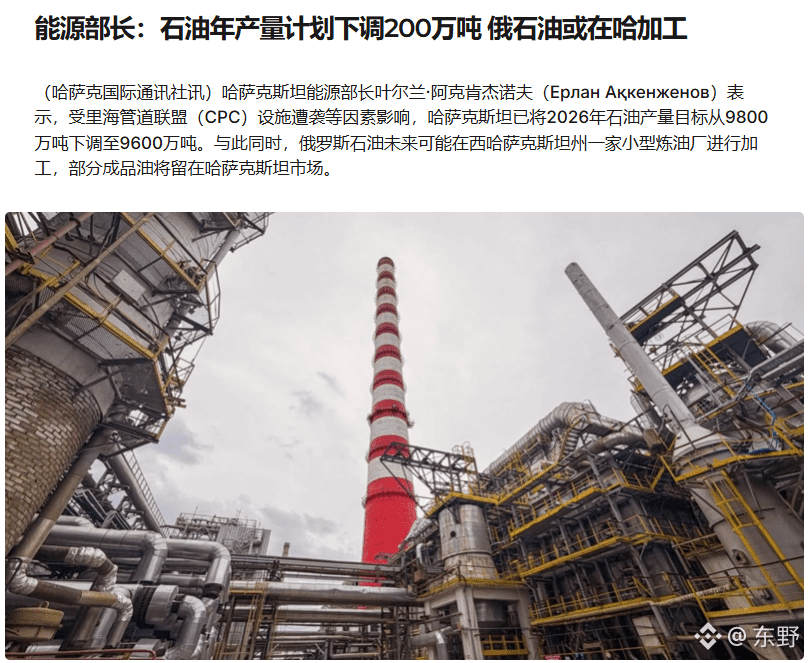
Kazakhstan directly cut its 2026 target for oil production by 2 million tonnes, bringing it down to 96 million tonnes. The trigger was an attack on facilities along the Caspian Sea pipeline. Many people’s first reaction was,
What does doing long $BTC have to do with an oil field?
That mindset is precisely the root of how players get liquidated amid macro volatility. After spot Bitcoin ETF approvals and institutional capital stepped in, BTC has long been fully embedded as the most sensitive “microscope” for global macro liquidity.
Throwing this 2 million-tonne shortfall into the current environment turns it into the fuse that transfers to your position. With geopolitical turmoil, disruptions to Hormuz shipping, and low crude oil inventories all overlapping, any change on the supply side can instantly lift the risk premium. A surge in oil prices raises baseline costs, quickly permeating the consumer side and pushing up sticky inflation.
Once inflation rebounds, the interest-rate path of the Federal Reserve will immediately shift. The rate-cut expectations that were already priced in may not only be wiped out directly, but could even reopen the window for rate hikes. A high-rate environment causes marginal USD liquidity to drain instantly, making U.S. Treasury yields and the U.S. Dollar Index strengthen as a matter of course.
After risk-free yields rise, institutions’ asset-allocation models automatically execute de-risking moves—without hesitation, they withdraw from risk assets and move into gold, Treasuries, or money-market instruments.
Within this pricing transmission chain, BTC’s high-beta risk-asset characteristics are magnified infinitely. On the surface, it looks like a distant pipeline attack. In reality, within just a few hours it completes the full transmission: “supply contraction—oil price surge—inflation rebound—rate-hike expectations heating up—liquidity tightening,” and it shows up directly in your liquidation price.
Treat BTC as a safe haven independent of the macro picture, or focus only on the candlestick charts and on-chain coin holdings—under today’s capital structure that’s no different from a blind person feeling their way around an elephant. When trading BTC now, you not only need to watch the U.S. Dollar Index and the Fed’s balance sheet; sometimes you even have to account for black swan events transmitted from the macro and geopolitics.
#哈萨克斯坦下调石油产量预期至9600万吨 #比特币受阻于81000美元50周均线
What does doing long $BTC have to do with an oil field?
That mindset is precisely the root of how players get liquidated amid macro volatility. After spot Bitcoin ETF approvals and institutional capital stepped in, BTC has long been fully embedded as the most sensitive “microscope” for global macro liquidity.
Throwing this 2 million-tonne shortfall into the current environment turns it into the fuse that transfers to your position. With geopolitical turmoil, disruptions to Hormuz shipping, and low crude oil inventories all overlapping, any change on the supply side can instantly lift the risk premium. A surge in oil prices raises baseline costs, quickly permeating the consumer side and pushing up sticky inflation.
Once inflation rebounds, the interest-rate path of the Federal Reserve will immediately shift. The rate-cut expectations that were already priced in may not only be wiped out directly, but could even reopen the window for rate hikes. A high-rate environment causes marginal USD liquidity to drain instantly, making U.S. Treasury yields and the U.S. Dollar Index strengthen as a matter of course.
After risk-free yields rise, institutions’ asset-allocation models automatically execute de-risking moves—without hesitation, they withdraw from risk assets and move into gold, Treasuries, or money-market instruments.
Within this pricing transmission chain, BTC’s high-beta risk-asset characteristics are magnified infinitely. On the surface, it looks like a distant pipeline attack. In reality, within just a few hours it completes the full transmission: “supply contraction—oil price surge—inflation rebound—rate-hike expectations heating up—liquidity tightening,” and it shows up directly in your liquidation price.
Treat BTC as a safe haven independent of the macro picture, or focus only on the candlestick charts and on-chain coin holdings—under today’s capital structure that’s no different from a blind person feeling their way around an elephant. When trading BTC now, you not only need to watch the U.S. Dollar Index and the Fed’s balance sheet; sometimes you even have to account for black swan events transmitted from the macro and geopolitics.
#哈萨克斯坦下调石油产量预期至9600万吨 #比特币受阻于81000美元50周均线