

A timeline that’s easy to overlook reveals the power struggle currently unfolding in the global semiconductor industry.
The equipment license the U.S. issued to SK Hynix China’s plant covers only until the end of this year. South Korean media reports that the Dalian NAND fab, which has been shut down for four years, will move production equipment in as early as November. Ten days after this news broke, SK Hynix again reported plans to build a large memory chip plant in Miyagi, Japan, with potential investment of as much as tens of trillions of won.
While restarting the Dalian production line ahead of the expiration of the annual license, SK Hynix is also assessing whether to place its next factory in Japan. SK Hynix appears to be expanding globally, but behind the scenes, two forces are directly colliding. China has facilities, workers, and supply chains that can go into production immediately—an operating base SK Hynix can’t bypass if it wants to keep expanding into global markets. Meanwhile, the U.S. is trying to use equipment licensing to control SK Hynix, aiming to keep future advanced capacity within the allied ecosystem, preferably on U.S. soil.
SK hynix
Media reports from South Korea indicate that SK hynix plans to invest tens of trillions of won to build a memory semiconductor manufacturing plant in Miyagi Prefecture in Japan’s Tohoku region. It’s worth noting that in recent years, South Korea and Japan have had ongoing frictions over chips and semiconductors, constantly keeping an eye on each other and guarding against one another. This is the first time a South Korean semiconductor company has invested in semiconductors in Japan to establish a production base.
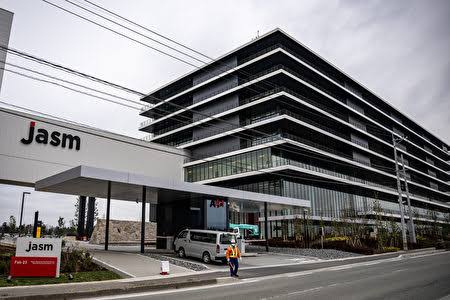
SK hynix’s choice to build a plant in Japan is, on the one hand, because Japan offers large subsidies for foreign-invested plant construction. Reports show that Japan has already provided up to 476 billion yen in support for TSMC’s Kumamoto project, and provided 500 billion yen of support to Micron for building a plant in the U.S. If SK hynix’s Japan project moves forward, the Japanese government would also bear part of the plant construction costs.
TSMC Kumamoto project
Another factor is Japan’s advantage in materials and equipment. Japan still leads in areas such as silicon wafers, photoresist, packaging materials, and various semiconductor equipment. SK hynix’s chip production lines already use materials and equipment from Japanese companies such as Namics, Shin-Etsu Chemical, and Tokyo Ohka. Building a plant in Japan would allow them to directly embed upstream suppliers.
However, for SK hynix to start production in Japan, on the one hand it will definitely face domestic public opinion in South Korea. On the other hand, the U.S. will also have its reservations.
The U.S. has long been pressuring the South Korean government and companies to invest in and build memory chip factories on U.S. soil. According to a report from North Korea’s media, the U.S. has already asked South Korean semiconductor companies to build memory chip factories in the United States. It also expressed dissatisfaction with South Korea’s announcement of a 800 trillion-won South Korean Hunan semiconductor cluster, believing that South Korea is prioritizing the next round of the scarcest memory production capacity and huge capital for the country itself, yet it has been slow to come up with proposals to build memory factories in the U.S.
While the U.S. and Japan quietly build up strength to compete for South Korea’s memory factories, over here SK hynix’s factories in Dalian, China are already nearly done with their capacity expansion.
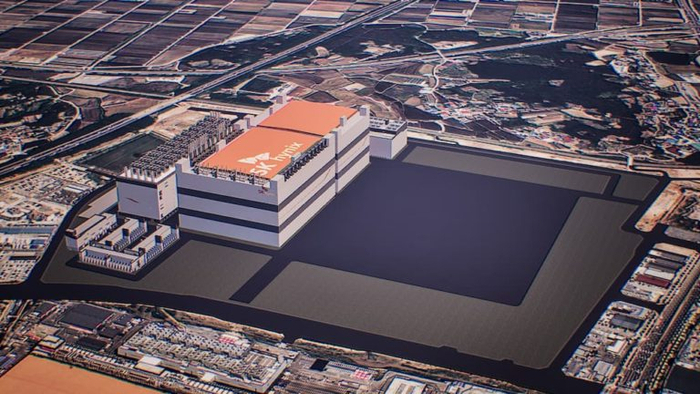
SK hynix’s subsidiary Solidigm has resumed investment in the Dalian Phase II plant in the first half of this year. The earliest it could move in equipment is November this year. The target is to achieve mass production in the first half of 2027, adding roughly 40,000–60,000 wafers per month. The current monthly production capacity of the Dalian Phase I plant is about 100,000 wafers. After Phase II comes online, the total production capacity of the Dalian base will reach 150,000 wafers, close to about half of its NAND capacity. Moreover, if you look only at overseas NAND front-end manufacturing, Dalian is currently SK hynix’s only production site, accounting for 100%.
SK hynix Dalian Phase II
It needs to be clarified that SK hynix’s Dalian Phase II plant is not an entirely new project. In 2021, SK hynix took over Intel’s Dalian NAND factory. In May 2022, construction on Phase II was launched, but it was later halted due to a sharp drop in NAND prices and U.S. equipment export controls. As memory chip demand has surged in the past two years, SK hynix restarted the project in the first half of this year.
As for why SK hynix is restarting the Dalian Phase II project right now—on the one hand, everyone can see that storage chip prices have been rising, and SK hynix wants to lock in capacity by expanding its production base. On the other hand, there is also a more discreet reason.
In August last year, the U.S. Department of Commerce revoked Samsung and SK hynix China factory’s existing authorization for “verifying the final end users.” By the end of the year, the U.S. had issued equipment import licenses for the 2026 fiscal year to Samsung and SK hynix, allowing them to continue shipping some U.S. equipment to their China factories. That means that by the end of this year, SK hynix’s Dalian Phase II plant will not face too much pressure in advanced equipment imports.
By placing the Dalian project within SK hynix’s current global investment map, the significance of SK hynix’s probing is even more evident.
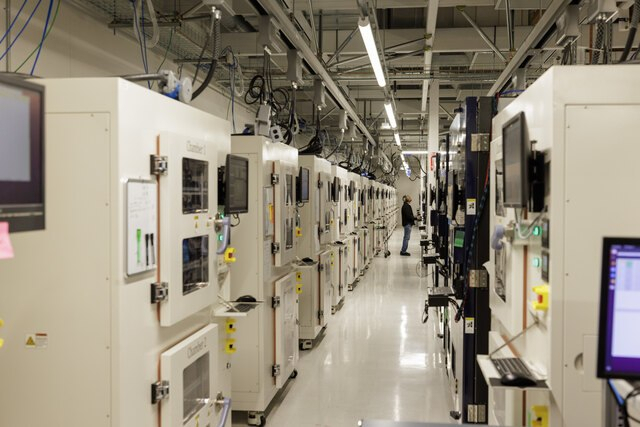
In South Korea, SK hynix has already approved an investment of 543 trillion won to build two factories: the Yongin Y2 and Cheongju M17. Of these, the first cleanroom at Cheongju M17 is expected to be completed by the end of 2028; the first cleanroom at Yongin Y2 will not be completed until mid-2029. In the United States, SK hynix has already confirmed an investment of $3.87 billion to build an HBM advanced packaging and R&D base in Indiana, with operations expected at least by 2028.
Chip factories
That is to say, even if expansion proceeds as fast as possible, during the long vacuum period from this year to next, SK hynix can still only rely on China’s supply chain to meet capacity requirements. This is determined by the industrial structure China has built. If the U.S. wants to control SK hynix and make it bypass China again, it also has to consider what it can use to meet the ever-growing orders from customers.
This also exposes the internal contradictions facing U.S. chip export controls. The U.S. wants to use equipment licenses to restrict Chinese fabs from expanding capacity and upgrading technology, and to pull SK hynix’s next round of investment toward the United States. But at the same time, AI companies in the U.S., South Korea, and Japan also need more HBM, DRAM, and NAND, and they cannot afford to have China’s existing storage capacity suddenly exit the market. Moreover, Korean companies will not fully follow U.S. instructions; they are not going to give up such good business.
SK hynix’s three-pronged layout may seem to hedge bets and capitalize on opportunities from both sides, but in reality it is a difficult struggle for survival for a company caught between political barriers and the laws of industry. It cannot give up the existing factories and supply chains in China; it is hard to decline Japan’s advantages in materials and massive subsidies; and it also dares not ignore the U.S.’s market and political pressure. This “can’t afford to miss a single one” kind of dilemma precisely reflects the semiconductor industry’s decades-long globalization network of supply chains—one that has never been something that can be dismantled by administrative orders alone.
Geopolitics can delay factory construction, but it cannot rewrite the physical laws of industry. In this game over memory chips, the winner will not be the one with the loudest voice pressuring others, but the one that can truly get lithography machines to run.

This article is an Observer Network exclusive submission. The content of the article only represents the author’s personal views and does not represent the platform’s views. Without authorization, it may not be reproduced; otherwise, legal responsibility will be pursued. Follow Observer Network’s WeChat account guanchacn to read interesting articles every day.