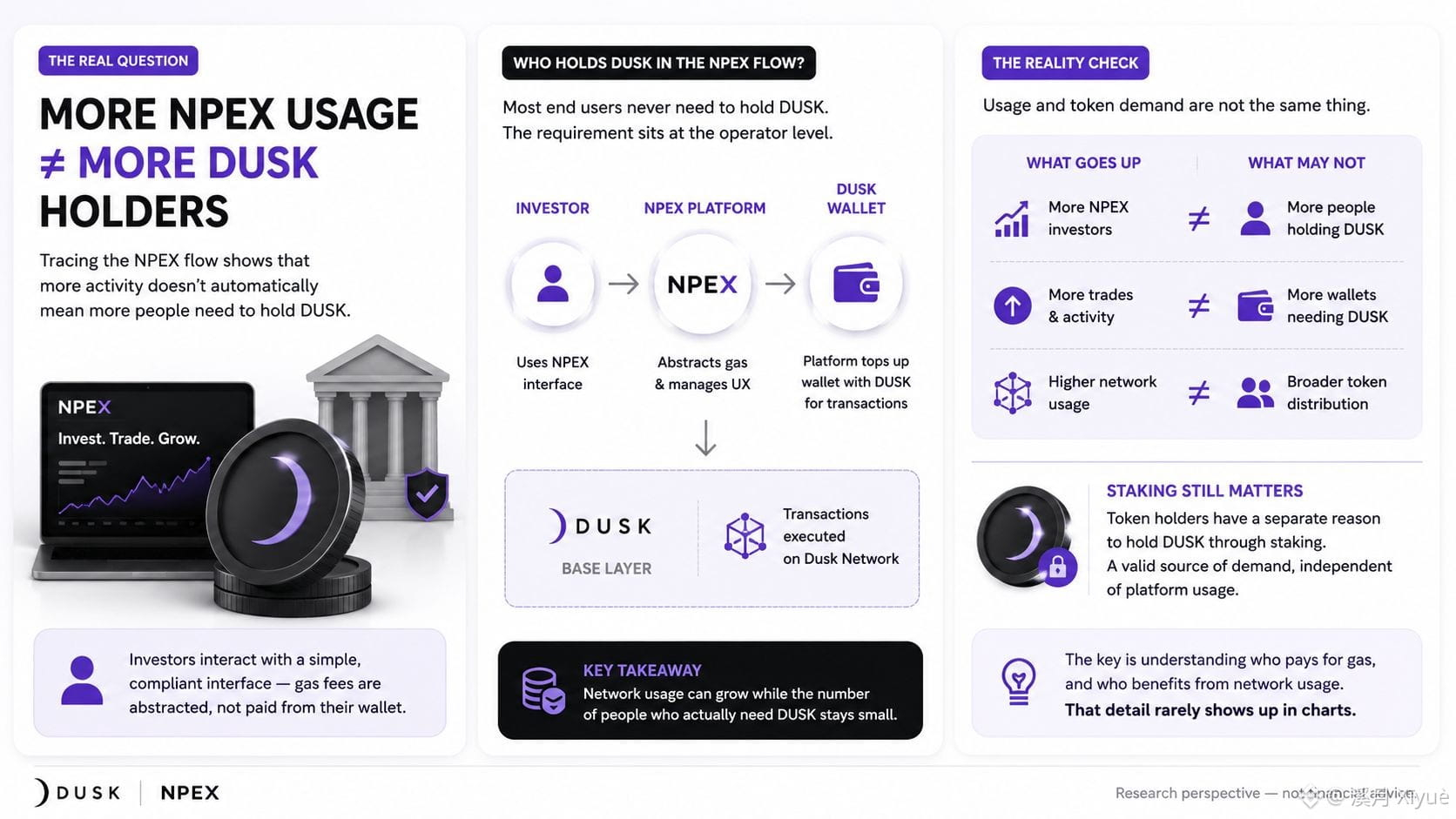
#dusk $DUSK @Dusk I tried to trace, step by step, who in the NPEX flow actually has to hold DUSK, and the answer got less obvious the further I looked.
On paper, DUSK's utility is straightforward. Gas to transact, and a token to stake. Simple enough for a base-layer asset. But regulated platforms serving investors almost never expose the underlying crypto mechanics directly to end users, for compliance and UX reasons as much as anything else. An investor buying into an NPEX offering is very plausibly interacting with a normal-looking interface, with the DUSK gas cost abstracted away and covered by the platform itself, not paid out of the investor's own wallet.
If that's roughly how it works, then more investors and more trades on NPEX doesn't necessarily mean more people acquiring DUSK. It might just mean the platform operator periodically tops up a wallet to keep transactions running. Network usage goes up. The number of humans who ever need to hold the token stays small.
Staking still gives token holders a separate reason to want DUSK regardless of any of this, so it's not that the token has no role. It's that the specific assumption "more usage equals more organic token demand" looks weaker once you actually trace who's paying gas versus who's just using an app.
That's the kind of detail that never shows up in a usage chart, and probably should.
$TAC $PROM
On paper, DUSK's utility is straightforward. Gas to transact, and a token to stake. Simple enough for a base-layer asset. But regulated platforms serving investors almost never expose the underlying crypto mechanics directly to end users, for compliance and UX reasons as much as anything else. An investor buying into an NPEX offering is very plausibly interacting with a normal-looking interface, with the DUSK gas cost abstracted away and covered by the platform itself, not paid out of the investor's own wallet.
If that's roughly how it works, then more investors and more trades on NPEX doesn't necessarily mean more people acquiring DUSK. It might just mean the platform operator periodically tops up a wallet to keep transactions running. Network usage goes up. The number of humans who ever need to hold the token stays small.
Staking still gives token holders a separate reason to want DUSK regardless of any of this, so it's not that the token has no role. It's that the specific assumption "more usage equals more organic token demand" looks weaker once you actually trace who's paying gas versus who's just using an app.
That's the kind of detail that never shows up in a usage chart, and probably should.
$TAC $PROM